



 Chat with AI
Exam 14: Environmental Health and Toxicology

Exam 1: Science and Sustainability35 Questions
Exam 2: Earths Physical Systems38 Questions
Exam 3: Evolution,biodiversity,and Population Ecology39 Questions
Exam 4: Species Interactions and Community Ecology42 Questions
Exam 5: Environmental Systems and Ecosystem Ecology37 Questions
Exam 6: Ethics,economics,and Sustainable Development40 Questions
Exam 7: Environmental Policy39 Questions
Exam 8: Human Population40 Questions
Exam 9: The Underpinnings of Agriculture45 Questions
Exam 10: Making Agriculture Sustainable35 Questions
Exam 11: Biodiversity and Conservation Biology37 Questions
Exam 12: Forests,forest Management,and Protected Areas30 Questions
Exam 13: The Urban Environment33 Questions
Exam 14: Environmental Health and Toxicology45 Questions
Exam 15: Freshwater Systems and Resources37 Questions
Exam 16: Marine and Coastal Systems and Resources38 Questions
Exam 17: Atmospheric Science,air Quality,and Pollution Control35 Questions
Exam 18: Global Climate Change33 Questions
Exam 19: Fossil Fuels32 Questions
Exam 20: Conventional Energy Alternatives45 Questions
Exam 21: New Renewable Energy Alternatives35 Questions
Exam 22: Managing Our Waste34 Questions
Exam 23: Minerals and Mining27 Questions
Exam 24: Sustainable Solutions33 Questions
Select questions type


_______________ is a naturally occurring substance that is potentially toxic to people.
(Multiple Choice)
4.9/5  (89)
(89) What are epidemiological studies,and what is their value? Are there any disadvantages to epidemiological studies?
(Essay)
4.9/5 (77)
(77) 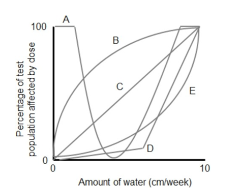 A student wants to test the toxicity of water on corn plants.After providing different amounts of water to different groups of corn plants for the duration of a growing season,the student graphed the results.The graph is most likely to look like which of the dose -response curves depicted above?
 (Multiple Choice)
4.8/5 (78)
(78) The "dirty dozen" POPs targeted by the Stockholm Convention include _______________.
(Multiple Choice)
4.9/5 (80)
(80) The European Union's experience with polybrominated diphenyl ethers (PBDEs)has shown that _______________.
(Multiple Choice)
5.0/5 (83)
(83) Explain how response to hazards can vary based upon individual differences and type of exposure.Give examples,where appropriate.
(Essay)
4.8/5 (79)
(79) List the environmental factors and chemical properties that determine the rate of degradation of toxicants.
(Essay)
4.9/5 (78)
(78) Debate over the use of DDT to control malaria is likely to continue.However,over the past several decades,much has been learned about how this insecticide works,and why its extensive use poses an environmental concern.Discuss three characteristics of this chemical that cause it to be problematic.
(Essay)
5.0/5 (88)
(88) Explain what endocrine disruptors are,and give examples.Explain why endocrine disruptors are a problem for humans,and discuss why they have not been banned.
(Essay)
4.9/5 (67)
(67) Studies of endocrine disruptors have shown that they are closely associated with all of the following EXCEPT _______________
(Multiple Choice)
5.0/5 (86)
(86) Carcinogens may be difficult to identify because _______________.
(Multiple Choice)
4.9/5 (70)
(70) The worldwide drop in sperm counts among men has been attributed to _______________.
(Multiple Choice)
4.7/5 (78)
(78) The first goal of the Stockholm Convention is to _______________.
(Multiple Choice)
4.7/5 (89)
(89) Explain risk assessment and risk management.Discuss how risk management combines science and other social factors.
(Essay)
4.9/5 (80)
(80) According to a 2002 study by scientists at the National Water -Quality Assessment Program (NAWQA), _______________ % of U.S.streams contain traces of wastewater contaminants.
(Multiple Choice)
4.9/5 (73)
(73) 
Filters
- Essay(0)
- Multiple Choice(0)
- Short Answer(0)
- True False(0)
- Matching(0)