



 Chat with AI
Exam 19: The World of International Finance

Exam 1: Introduction: What Is Economics144 Questions
Exam 2: The Key Principles of Economics195 Questions
Exam 3: Exchange and Markets135 Questions
Exam 4: Demand, Supply, and Market Equilibrium279 Questions
Exam 5: Measuring a Nations Production and Income161 Questions
Exam 6: Unemployment and Inflation206 Questions
Exam 7: The Economy at Full Employment165 Questions
Exam 8: Why Do Economies Grow203 Questions
Exam 9: Aggregate Demand and Aggregate Supply189 Questions
Exam 10: Fiscal Policy166 Questions
Exam 11: The Income-Expenditure Model265 Questions
Exam 12: Investment and Financial Markets179 Questions
Exam 13: Money and the Banking System184 Questions
Exam 14: The Federal Reserve and Monetary Policy203 Questions
Exam 15: Modern Macroeconomics: From the Short Run to the Long Run176 Questions
Exam 16: The Dynamics of Inflation and Unemployment186 Questions
Exam 17: Macroeconomic Policy Debates143 Questions
Exam 18: International Trade and Public Policy226 Questions
Exam 19: The World of International Finance189 Questions
Select questions type


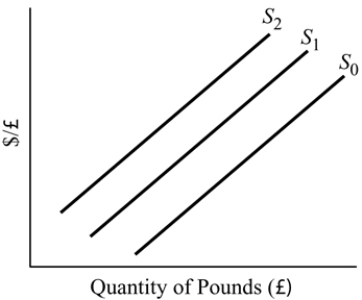 Figure 19.4
-Refer to Figure 19.4. Which of the following will shift the supply of pounds from S1 to S2?
Figure 19.4
-Refer to Figure 19.4. Which of the following will shift the supply of pounds from S1 to S2? (Multiple Choice)
4.8/5  (87)
(87) If the income from investments by Americans abroad exceeds the income from investments by non- Americans in the U.S. , then net income from abroad is:
(Multiple Choice)
4.9/5 (71)
(71) An index that reflects the average of real exchange rates of the U.S. and its major trading partners is called:
(Multiple Choice)
4.8/5 (77)
(77) 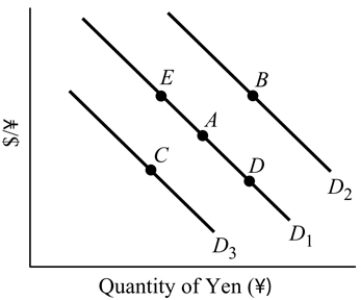 Figure 19.1
-Refer to Figure 19.1. The yen is currently at Point A. An appreciation of the yen causes a movement to Point _______.
Figure 19.1
-Refer to Figure 19.1. The yen is currently at Point A. An appreciation of the yen causes a movement to Point _______. (Multiple Choice)
5.0/5 (77)
(77) Suppose a pound of dry roasted coffee beans cost $3 in the United States and 6 pounds in England. The law of one price would predict that the exchange rate in the long- run is:
(Multiple Choice)
4.8/5 (82)
(82) The system of accounts that measures transactions of goods, services, income, and financial assets between domestic households, businesses, and governments and residents of the rest of the world during a specific time period is called the:
(Multiple Choice)
4.9/5 (71)
(71) With a fixed exchange rate system, the balance of payments of a country:
(Multiple Choice)
4.8/5 (83)
(83) Recall Application 2, "World Savings and the U.S. Current Account Deficits," to answer the following questions:
-According to the application, the U.S. can continue having current account deficits only because:
(Multiple Choice)
4.8/5 (84)
(84) An increase in U.S. interest rates relative to Canadian interest rates will cause the U.S. dollar to appreciate.
(True/False)
4.9/5 (81)
(81) If the prices in the United States decrease, we would expect:
(Multiple Choice)
4.9/5 (97)
(97) Flexible exchange rates require the coordination of economic policies between countries. 177)
(True/False)
4.9/5 (77)
(77) Recall Application 4, "The Argentine Financial Crisis," to answer the question below:
-Which of the following contributed to the collapse of the Argentine peso in 2002?
(Multiple Choice)
4.8/5 (83)
(83) The real exchange rate between the U.S. and Japan is expressed as:
(Multiple Choice)
4.8/5 (77)
(77) More German companies start to invest in the United States. This will lead to a(n):
(Multiple Choice)
4.8/5 (78)
(78) The trade deficit in Mexico did not cause a problem prior to 1994 because:
(Multiple Choice)
4.7/5 (73)
(73) In 1986, the U.S. net international investment position was $136 billion. This means that in 1986:
(Multiple Choice)
4.9/5 (82)
(82) Which of the following affects a country's net international investment position?
(Multiple Choice)
4.8/5 (74)
(74) 
Filters
- Essay(0)
- Multiple Choice(0)
- Short Answer(0)
- True False(0)
- Matching(0)