



 Chat with AI
Exam 19: The World of International Finance

Exam 1: Introduction: What Is Economics144 Questions
Exam 2: The Key Principles of Economics195 Questions
Exam 3: Exchange and Markets135 Questions
Exam 4: Demand, Supply, and Market Equilibrium279 Questions
Exam 5: Measuring a Nations Production and Income161 Questions
Exam 6: Unemployment and Inflation206 Questions
Exam 7: The Economy at Full Employment165 Questions
Exam 8: Why Do Economies Grow203 Questions
Exam 9: Aggregate Demand and Aggregate Supply189 Questions
Exam 10: Fiscal Policy166 Questions
Exam 11: The Income-Expenditure Model265 Questions
Exam 12: Investment and Financial Markets179 Questions
Exam 13: Money and the Banking System184 Questions
Exam 14: The Federal Reserve and Monetary Policy203 Questions
Exam 15: Modern Macroeconomics: From the Short Run to the Long Run176 Questions
Exam 16: The Dynamics of Inflation and Unemployment186 Questions
Exam 17: Macroeconomic Policy Debates143 Questions
Exam 18: International Trade and Public Policy226 Questions
Exam 19: The World of International Finance189 Questions
Select questions type


An excess supply of dollars will cause an appreciation of the pound relative to the dollar.
(True/False)
4.8/5  (81)
(81) Which of the following is an item in the U.S. current account?
(Multiple Choice)
4.8/5 (80)
(80) An increase in the U.S. interest rate relative to the British interest rate will cause a(n):
(Multiple Choice)
4.9/5 (94)
(94) Recall Application 4, "The Argentine Financial Crisis," to answer the question below:
-The Argentine economy suffered a depression after the financial crisis in 2002 because:
(Multiple Choice)
5.0/5 (85)
(85) One benefit of flexible exchange rates is that flexible exchange rates are
(Multiple Choice)
5.0/5 (77)
(77) 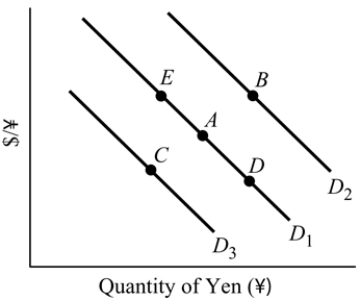 Figure 19.1
-Refer to Figure 19.1. The yen is currently at Point A. A depreciation of the yen causes a movement to Point _______.
Figure 19.1
-Refer to Figure 19.1. The yen is currently at Point A. A depreciation of the yen causes a movement to Point _______. (Multiple Choice)
4.8/5 (84)
(84) The exchange rate is the rate at which one currency can be traded for another.
(True/False)
4.9/5 (76)
(76) The theory of international exchange that holds that exchange rates are set so that the price of similar goods in different countries is the same as:
(Multiple Choice)
4.8/5 (88)
(88) The _______ states that goods that are easily tradable across two countries should sell at the same price, expressed in a common currency.
(Multiple Choice)
4.8/5 (65)
(65) Which of the following units of measurement would be appropriate for a real exchange rate?
(Multiple Choice)
4.9/5 (75)
(75) Identify whether each of the following would lead to an appreciation or depreciation of the dollar. In each case, explain why the currency either appreciates or depreciates.
(a) U.S. citizens switch from buying stock in British companies to buying stock in U.S. companies.
(b) The inflation rate in the United States increases relative to the inflation rate in England.
(c) The money supply is increased in the United States.
(Essay)
4.8/5 (72)
(72) An increase in U.S. imports from Mexico _______ the supply of dollars and _______ the demand for pesos.
(Multiple Choice)
4.9/5 (73)
(73) What was the U.S. response to the Mexican currency crisis of 1994?
(Multiple Choice)
4.9/5 (83)
(83) There is an exchange rate between any two countries that use different currencies.
(True/False)
4.9/5 (84)
(84) Explain what effect an increase in the U.S. price level have on the U.S. dollar- Japanese yen exchange rate. Make sure you identify which currency appreciates.
(Essay)
4.8/5 (78)
(78) If the income from investments by Americans abroad is less than the income from investments by non- Americans in the U.S. , then net income from abroad is:
(Multiple Choice)
4.9/5 (97)
(97) 
Filters
- Essay(0)
- Multiple Choice(0)
- Short Answer(0)
- True False(0)
- Matching(0)