



 Chat with AI
Exam 19: The World of International Finance

Exam 1: Introduction: What Is Economics144 Questions
Exam 2: The Key Principles of Economics195 Questions
Exam 3: Exchange and Markets135 Questions
Exam 4: Demand, Supply, and Market Equilibrium279 Questions
Exam 5: Measuring a Nations Production and Income161 Questions
Exam 6: Unemployment and Inflation206 Questions
Exam 7: The Economy at Full Employment165 Questions
Exam 8: Why Do Economies Grow203 Questions
Exam 9: Aggregate Demand and Aggregate Supply189 Questions
Exam 10: Fiscal Policy166 Questions
Exam 11: The Income-Expenditure Model265 Questions
Exam 12: Investment and Financial Markets179 Questions
Exam 13: Money and the Banking System184 Questions
Exam 14: The Federal Reserve and Monetary Policy203 Questions
Exam 15: Modern Macroeconomics: From the Short Run to the Long Run176 Questions
Exam 16: The Dynamics of Inflation and Unemployment186 Questions
Exam 17: Macroeconomic Policy Debates143 Questions
Exam 18: International Trade and Public Policy226 Questions
Exam 19: The World of International Finance189 Questions
Select questions type


Define a nation's balance of payments. Identify the major accounts of a country's balance of payments and explain their relationship.
(Essay)
4.9/5  (88)
(88) Recall Application 2, "World Savings and the U.S. Current Account Deficits," to answer the following questions:
-According to the application, Japan has a low investment rate because:
(Multiple Choice)
5.0/5 (87)
(87) Purchasing power parity implies that a unit of any given currency should be able to buy the same quantity of goods and services in any country.
(True/False)
5.0/5 (70)
(70) 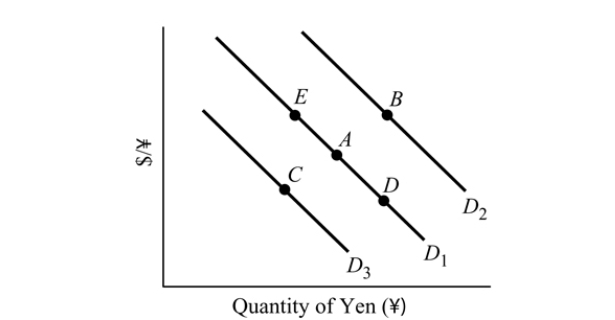 Figure 19.3
-Refer to Figure 19.3. The market for yen is currently at Point A. An increase in the U.S. interest rates causes the equilibrium to move to point _______ and the U.S. dollar will _______.
Figure 19.3
-Refer to Figure 19.3. The market for yen is currently at Point A. An increase in the U.S. interest rates causes the equilibrium to move to point _______ and the U.S. dollar will _______. (Multiple Choice)
4.9/5 (84)
(84) Which of the following causes the dollar to depreciate relative to the British pound?
(Multiple Choice)
4.9/5 (73)
(73) Recall Application 4, "The Argentine Financial Crisis," to answer the question below:
-The main reason Argentina had pegged its currency to the U.S. dollar prior to the 2002 crisis was:
(Multiple Choice)
4.8/5 (86)
(86) Fixed exchange rates are exposed to sudden devaluations or revaluations.
(True/False)
4.8/5 (79)
(79) Recall Application 1, "The Chinese Yuan and Big Macs," to answer the following questions:
-According to the application, the dollar price of a Big Mac in the US is lower than the dollar price of the Big Mac in:
(Multiple Choice)
4.9/5 (75)
(75) When the economy experiences a balance of payments surplus, the central bank must _______ to maintain the exchange rate.
(Multiple Choice)
4.9/5 (80)
(80) When the country is experiencing a balance of payments deficit, it must devalue its currency.
(True/False)
4.8/5 (71)
(71) Recall Application 2, "World Savings and the U.S. Current Account Deficits," to answer the following questions:
-According to the application, the U.S. can continue having current account deficits only because:
(Multiple Choice)
4.9/5 (96)
(96) Which of the following countries were severely affected during the Asian Financial Crisis in 1997- 1998?
(Multiple Choice)
4.7/5 (77)
(77) Suppose the exchange rate between the United States and Russia changed from $1 = 5 rubles to $1 = 4 rubles, which of the following statements is true?
(Multiple Choice)
4.9/5 (84)
(84) Which of the following is not included in the U.S. current account?
(Multiple Choice)
4.7/5 (93)
(93) _______ is the situation where the central bank buys or sells foreign currencies to affect the country's exchange rate.
(Multiple Choice)
4.9/5 (68)
(68) 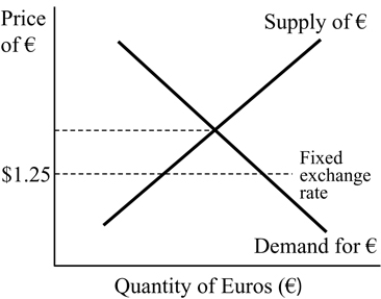 Figure 19.5
-From Figure 19.5 above, if the U.S. fixes the exchange rate at $1.25 per euro, then the U.S experiences:
Figure 19.5
-From Figure 19.5 above, if the U.S. fixes the exchange rate at $1.25 per euro, then the U.S experiences: (Multiple Choice)
4.9/5 (75)
(75) Recall Application 1, "The Chinese Yuan and Big Macs," to answer the following questions:
-According to the application, because the actual dollar- yuan exchange rate was 6.8 yuan per U.S. dollar and the predicted purchasing power exchange rate (using the Big Mac) in China is 3.49 yuan, then:
(Multiple Choice)
4.8/5 (81)
(81) All other things equal, an appreciation of the U.S. real exchange rate causes:
(Multiple Choice)
4.7/5 (80)
(80) 
Filters
- Essay(0)
- Multiple Choice(0)
- Short Answer(0)
- True False(0)
- Matching(0)