



 Chat with AI
Exam 2: The Key Principles of Economics

Exam 1: Introduction: What Is Economics144 Questions
Exam 2: The Key Principles of Economics195 Questions
Exam 3: Exchange and Markets135 Questions
Exam 4: Demand, Supply, and Market Equilibrium279 Questions
Exam 5: Measuring a Nations Production and Income161 Questions
Exam 6: Unemployment and Inflation206 Questions
Exam 7: The Economy at Full Employment165 Questions
Exam 8: Why Do Economies Grow203 Questions
Exam 9: Aggregate Demand and Aggregate Supply189 Questions
Exam 10: Fiscal Policy166 Questions
Exam 11: The Income-Expenditure Model265 Questions
Exam 12: Investment and Financial Markets179 Questions
Exam 13: Money and the Banking System184 Questions
Exam 14: The Federal Reserve and Monetary Policy203 Questions
Exam 15: Modern Macroeconomics: From the Short Run to the Long Run176 Questions
Exam 16: The Dynamics of Inflation and Unemployment186 Questions
Exam 17: Macroeconomic Policy Debates143 Questions
Exam 18: International Trade and Public Policy226 Questions
Exam 19: The World of International Finance189 Questions
Select questions type


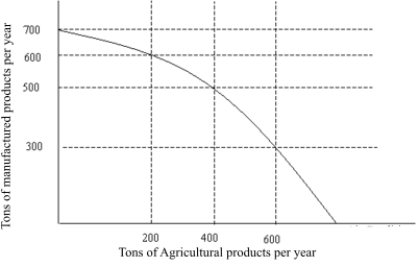 Figure 2.1
-On the production possibilities curve in Figure 2.1 the opportunity costs of increasing agricultural production from 200 tons to 400 tons is:
Figure 2.1
-On the production possibilities curve in Figure 2.1 the opportunity costs of increasing agricultural production from 200 tons to 400 tons is: (Multiple Choice)
4.9/5  (66)
(66) The principle of diminishing returns does not apply to labor when all inputs are allowed to vary because:
(Multiple Choice)
4.9/5 (74)
(74) 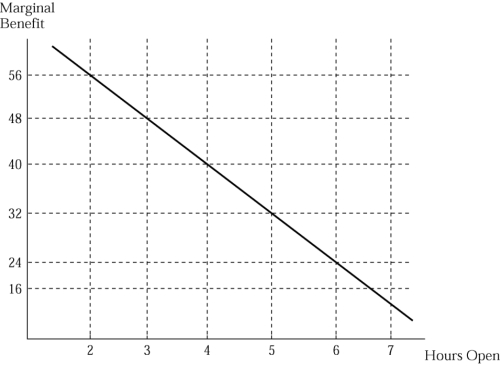 Figure 2.4
-Joe runs a business and needs to decide how many hours to stay open. Figure 2.4 illustrates his marginal benefit of staying open for each additional hour. Suppose that we observe Joe staying open 3 hours per day. If he is following the marginal principle, what must his marginal cost be?
Figure 2.4
-Joe runs a business and needs to decide how many hours to stay open. Figure 2.4 illustrates his marginal benefit of staying open for each additional hour. Suppose that we observe Joe staying open 3 hours per day. If he is following the marginal principle, what must his marginal cost be? (Multiple Choice)
4.7/5 (75)
(75) The extra benefit resulting from a small increase in an activity is called the:
(Multiple Choice)
4.8/5 (82)
(82) Recall Application 1, "Don't Forget the Costs of Time and Invested Funds," to answer the following questions.
-According to the application,if this year Betty spends $100,000 of her own money on materials, the interest rate is 5%, has living expenses of $20,000 and could have made $50,000 in her former line of employment, then Betty's opportunity cost of operating the business this year is:
(Multiple Choice)
4.8/5 (81)
(81) Different people eat different amounts of food when they go to buffet restaurants, even though they all pay the same price. Explain how this relates to the marginal principle.
(Essay)
4.9/5 (67)
(67) If each of us could produce everything we needed for ourselves, we would be considered to be _______.
(Short Answer)
4.7/5 (80)
(80) 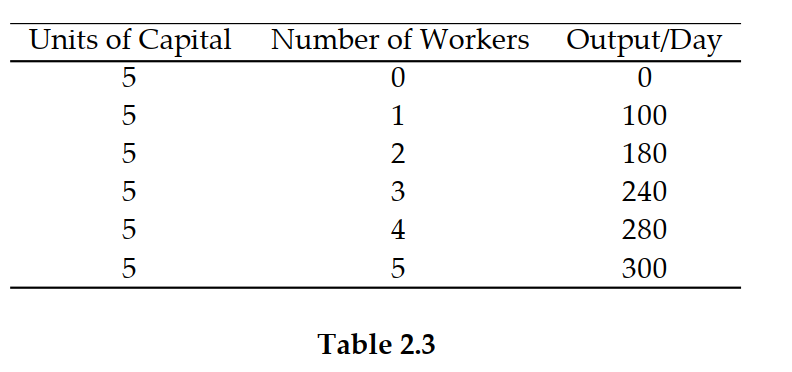 -Refer to Table 2.3. The marginal product of the 4th worker is:
 (Multiple Choice)
5.0/5 (77)
(77) The saying that "There is no such thing as a free lunch" refers to:
(Multiple Choice)
4.7/5 (73)
(73) When applying the marginal principle, you should pick the level at which the activity's marginal benefit equals its marginal cost.
(True/False)
4.9/5 (71)
(71) Increase the level of an activity if its marginal benefit exceeds its marginal cost; reduce the level of an activity if its marginal cost exceeds its marginal benefit. This is known as the _______.
(Short Answer)
4.9/5 (71)
(71) Suppose you earn $50,000 per year in 2009. If your income increases by 8 percent while inflation increases by 10% in 2010, then calculate how much your real income has increased between 2009 and 2010.
(Essay)
5.0/5 (84)
(84) When prices rise, increases in real income are greater than increases in nominal income.
(True/False)
4.8/5 (74)
(74) Suppose your bank pays you 5% interest per year on your savings account while prices increase by 3% per year over that time. Approximately how much nominal value do you gain by keeping $100 in the bank for a year?
(Multiple Choice)
4.7/5 (70)
(70) Suppose your bank pays you 6% interest per year on your savings account. If prices increase by 3% per year over that time, approximately how much nominal value do you gain by keeping $100 in the bank for a year?
(Multiple Choice)
4.9/5 (77)
(77) In order to go to college, James incurs an opportunity cost even though all he gave up was a full time job as a clerk at Wally World.
(True/False)
4.8/5 (72)
(72) If real salaries increase but nominal salaries do not, this means that:
(Multiple Choice)
4.9/5 (76)
(76) Is it possible for nominal wages to decrease while real wages increase?
(Essay)
4.9/5 (87)
(87) What do economists mean when they say that there is "no such thing as a free lunch"?
(Essay)
4.7/5 (74)
(74) 
Filters
- Essay(0)
- Multiple Choice(0)
- Short Answer(0)
- True False(0)
- Matching(0)