



 Chat with AI
Exam 2: The Key Principles of Economics

Exam 1: Introduction: What Is Economics144 Questions
Exam 2: The Key Principles of Economics195 Questions
Exam 3: Exchange and Markets135 Questions
Exam 4: Demand, Supply, and Market Equilibrium279 Questions
Exam 5: Measuring a Nations Production and Income161 Questions
Exam 6: Unemployment and Inflation206 Questions
Exam 7: The Economy at Full Employment165 Questions
Exam 8: Why Do Economies Grow203 Questions
Exam 9: Aggregate Demand and Aggregate Supply189 Questions
Exam 10: Fiscal Policy166 Questions
Exam 11: The Income-Expenditure Model265 Questions
Exam 12: Investment and Financial Markets179 Questions
Exam 13: Money and the Banking System184 Questions
Exam 14: The Federal Reserve and Monetary Policy203 Questions
Exam 15: Modern Macroeconomics: From the Short Run to the Long Run176 Questions
Exam 16: The Dynamics of Inflation and Unemployment186 Questions
Exam 17: Macroeconomic Policy Debates143 Questions
Exam 18: International Trade and Public Policy226 Questions
Exam 19: The World of International Finance189 Questions
Select questions type


The principle that what matters to people is the real value or purchasing power of money is the:
(Multiple Choice)
4.9/5  (89)
(89) The opportunity cost of going to a particular college is not the same for everyone.
(True/False)
4.9/5 (80)
(80) 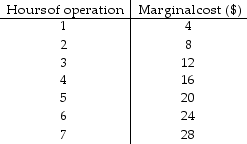 Table 2.2
-Julianne runs a business and needs to decide how many hours to stay open. Table 2.2 illustrates her marginal costs of staying open for each additional hour. Suppose that we observe Julianne staying open 5 hours per day. If she is following the marginal principle, what must her marginal benefit be?
Table 2.2
-Julianne runs a business and needs to decide how many hours to stay open. Table 2.2 illustrates her marginal costs of staying open for each additional hour. Suppose that we observe Julianne staying open 5 hours per day. If she is following the marginal principle, what must her marginal benefit be? (Multiple Choice)
4.8/5 (75)
(75) The opportunity cost of something is what you sacrifice to get it.
(True/False)
4.8/5 (77)
(77) The government uses the buying power of wages rather than face value or nominal value in reporting changes in "real wages" in the economy.
(True/False)
4.8/5 (76)
(76) An increase in the wages received by lawyers in general will result in an increase in the opportunity cost of law school.
(True/False)
4.9/5 (74)
(74) When economists use the term "marginal," they usually refer to
(Multiple Choice)
4.7/5 (78)
(78)  -Julianne runs a business and needs to decide how many hours to stay open. Table 2.2 illustrates her marginal costs of staying open for each additional hour. Suppose that we observe Julianne staying open 3 hours per day. If she is following the marginal principle, what must her marginal benefit be?
 (Multiple Choice)
4.7/5 (65)
(65) An increase in the benefit from undertaking an activity will result in an increase in the opportunity cost of that activity.
(True/False)
4.8/5 (83)
(83) If real salaries decrease but nominal salaries do not, this means that:
(Multiple Choice)
4.9/5 (80)
(80)  -Julianne runs a business and needs to decide how many hours to stay open. Table 2.2 illustrates her marginal costs of staying open for each additional hour. Suppose that Julianne's marginal benefit of staying open per hour is $3. If she is following the marginal principle, how many hours should Julianne stay open?
 (Multiple Choice)
4.8/5 (80)
(80) The principle of voluntary exchange is the concept that a voluntary exchange between two people makes both people better off.
(True/False)
4.7/5 (91)
(91) When deciding whether to engage in an activity or how much to do, people should follow:
(Multiple Choice)
4.9/5 (84)
(84) 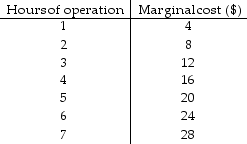 Table 2.2
-Julianne runs a business and needs to decide how many hours to stay open. Table 2.2 illustrates her marginal costs of staying open for each additional hour. Suppose that Julianne's marginal benefit of staying open per hour is $16. If she is following the marginal principle, how many hours should Julianne stay open?
Table 2.2
-Julianne runs a business and needs to decide how many hours to stay open. Table 2.2 illustrates her marginal costs of staying open for each additional hour. Suppose that Julianne's marginal benefit of staying open per hour is $16. If she is following the marginal principle, how many hours should Julianne stay open? (Multiple Choice)
4.9/5 (93)
(93)  -Julianne runs a business and needs to decide how many hours to stay open. Table 2.2 illustrates her marginal costs of staying open for each additional hour. Suppose that Julianne's marginal benefit of staying open per hour is $12. If she is following the marginal principle, how many hours should Julianne stay open?
 (Multiple Choice)
4.8/5 (76)
(76) 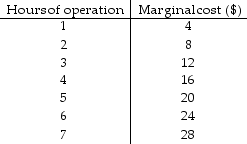 Table 2.2
-Julianne runs a business and needs to decide how many hours to stay open. Table 2.2 illustrates her marginal costs of staying open for each additional hour. Suppose that Julianne's marginal benefit of staying open per hour is $28. If she is following the marginal principle, how many hours should Julianne stay open?
Table 2.2
-Julianne runs a business and needs to decide how many hours to stay open. Table 2.2 illustrates her marginal costs of staying open for each additional hour. Suppose that Julianne's marginal benefit of staying open per hour is $28. If she is following the marginal principle, how many hours should Julianne stay open? (Multiple Choice)
4.9/5 (74)
(74) You borrow money to buy a house in 2006 at a variable interest rate of 6.5%. Your interest rate is always 2% more than the rate of inflation. By 2009, the inflation rate has risen to 8.5%. Considering only your mortgage, is inflation good news or bad news for you?
(Multiple Choice)
4.7/5 (85)
(85) 
Filters
- Essay(0)
- Multiple Choice(0)
- Short Answer(0)
- True False(0)
- Matching(0)