



 Chat with AI
Exam 3: Exchange and Markets

Exam 1: Introduction: What Is Economics144 Questions
Exam 2: The Key Principles of Economics195 Questions
Exam 3: Exchange and Markets135 Questions
Exam 4: Demand, Supply, and Market Equilibrium279 Questions
Exam 5: Measuring a Nations Production and Income161 Questions
Exam 6: Unemployment and Inflation206 Questions
Exam 7: The Economy at Full Employment165 Questions
Exam 8: Why Do Economies Grow203 Questions
Exam 9: Aggregate Demand and Aggregate Supply189 Questions
Exam 10: Fiscal Policy166 Questions
Exam 11: The Income-Expenditure Model265 Questions
Exam 12: Investment and Financial Markets179 Questions
Exam 13: Money and the Banking System184 Questions
Exam 14: The Federal Reserve and Monetary Policy203 Questions
Exam 15: Modern Macroeconomics: From the Short Run to the Long Run176 Questions
Exam 16: The Dynamics of Inflation and Unemployment186 Questions
Exam 17: Macroeconomic Policy Debates143 Questions
Exam 18: International Trade and Public Policy226 Questions
Exam 19: The World of International Finance189 Questions
Select questions type


 Table 3.2
-Consider two individuals, Rose and Sharon, who produce fish and coconuts. Rose and Sharon's hourly productivity are shown in Table 3.2. Sharon's opportunity cost of producing 1 coconut is:
Table 3.2
-Consider two individuals, Rose and Sharon, who produce fish and coconuts. Rose and Sharon's hourly productivity are shown in Table 3.2. Sharon's opportunity cost of producing 1 coconut is: (Multiple Choice)
4.8/5  (80)
(80)  Table 3.1
-Table 3.1 illustrates Willy and Blythe's hourly production for apples and carrots. From the table, we can conclude that:
Table 3.1
-Table 3.1 illustrates Willy and Blythe's hourly production for apples and carrots. From the table, we can conclude that: (Multiple Choice)
4.8/5 (85)
(85) When it comes to pollution, economists believe that the government must:
(Multiple Choice)
4.7/5 (81)
(81) 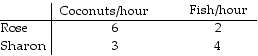 Table 3.2
-Consider two individuals, Rose and Sharon, who produce fish and coconuts. Rose and Sharon's hourly productivity are shown in Table 3.2. Which of the following is true?
Table 3.2
-Consider two individuals, Rose and Sharon, who produce fish and coconuts. Rose and Sharon's hourly productivity are shown in Table 3.2. Which of the following is true? (Multiple Choice)
4.8/5 (62)
(62) A product produced in the home country and sold in another country is:
(Multiple Choice)
4.8/5 (86)
(86)  Table 3.2
-Consider two individuals, Rose and Sharon, who produce fish and coconuts. Rose and Sharon's hourly productivity are shown in Table 3.2. Rose's opportunity cost of producing 1 fish is:
Table 3.2
-Consider two individuals, Rose and Sharon, who produce fish and coconuts. Rose and Sharon's hourly productivity are shown in Table 3.2. Rose's opportunity cost of producing 1 fish is: (Multiple Choice)
5.0/5 (84)
(84) Recall Application 1, "Candy Cane Makers Move to Mexico for Cheap Sugar," to answer the following questions:
-According to the application, the US sugar import restrictions aim to:
(Multiple Choice)
4.8/5 (75)
(75) When a person producing a particular product has a lower opportunity cost than another person, that person is considered to have a _______ over the other.
(Short Answer)
4.8/5 (88)
(88) If Tom can produce 20 multiple choice questions or 30 true/false questions in an hour, and Mary can produce 15 multiple choice questions or 15 true/false questions in an hour, then Mary has a comparative advantage in writing true/false questions.
(True/False)
4.7/5 (90)
(90) Recall Application 3, "The Shakers and the Market for Garden Seeds," to answer the following questions:
-Based on the application, one can infer that the economic system adopted by each Shaker community more closely resembles that of a:
(Multiple Choice)
4.9/5 (80)
(80) 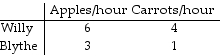 Table 3.1
-Table 3.1 illustrates Willy and Blythe's hourly production for apples and carrots. Based on the table, Blythe's opportunity cost of 1 apple is:
Table 3.1
-Table 3.1 illustrates Willy and Blythe's hourly production for apples and carrots. Based on the table, Blythe's opportunity cost of 1 apple is: (Multiple Choice)
4.9/5 (73)
(73) Recall Application 1, "Candy Cane Makers Move to Mexico for Cheap Sugar," to answer the following questions:
-According to the application, US producers moved their candy cane production overseas due to:
(Multiple Choice)
4.9/5 (78)
(78) Adam Smith used the metaphor "invisible hand" to explain that:
(Multiple Choice)
4.9/5 (85)
(85) If Tom can produce 20 multiple choice questions or 30 true/false questions in an hour, and Mary can produce 15 multiple choice questions or 15 true/false questions in an hour, then Mary has a comparative advantage in writing multiple choice questions.
(True/False)
4.9/5 (81)
(81) Recall Application 2, "Gold Farming for World of Warcraft," to answer the following questions:
-Suppose a US "World of Warcraft" player's opportunity cost is $8.00 an hour and can collect 25 coins per hour playing in the game. If the price of the virtual coins was $0.20 each, the player would find it worth their while to:
(Multiple Choice)
4.8/5 (76)
(76) A product produced overseas and sold in another country is an export.
(True/False)
4.7/5 (82)
(82) 
Filters
- Essay(0)
- Multiple Choice(0)
- Short Answer(0)
- True False(0)
- Matching(0)