



 Chat with AI
Exam 3: Exchange and Markets

Exam 1: Introduction: What Is Economics144 Questions
Exam 2: The Key Principles of Economics195 Questions
Exam 3: Exchange and Markets135 Questions
Exam 4: Demand, Supply, and Market Equilibrium279 Questions
Exam 5: Measuring a Nations Production and Income161 Questions
Exam 6: Unemployment and Inflation206 Questions
Exam 7: The Economy at Full Employment165 Questions
Exam 8: Why Do Economies Grow203 Questions
Exam 9: Aggregate Demand and Aggregate Supply189 Questions
Exam 10: Fiscal Policy166 Questions
Exam 11: The Income-Expenditure Model265 Questions
Exam 12: Investment and Financial Markets179 Questions
Exam 13: Money and the Banking System184 Questions
Exam 14: The Federal Reserve and Monetary Policy203 Questions
Exam 15: Modern Macroeconomics: From the Short Run to the Long Run176 Questions
Exam 16: The Dynamics of Inflation and Unemployment186 Questions
Exam 17: Macroeconomic Policy Debates143 Questions
Exam 18: International Trade and Public Policy226 Questions
Exam 19: The World of International Finance189 Questions
Select questions type


 Table 3.1
-Table 3.1 illustrates Willy and Blythe's hourly production for apples and carrots. From the table, we can conclude that:
Table 3.1
-Table 3.1 illustrates Willy and Blythe's hourly production for apples and carrots. From the table, we can conclude that: (Multiple Choice)
4.8/5  (76)
(76) When the government provides its citizens an unemployment insurance program, it is providing its citizens:
(Multiple Choice)
4.7/5 (86)
(86) Consider two individuals, Phil and Oprah, who produce toy trucks and flowers. Phil and Oprah's hourly productivity are as follows:  Who has the absolute advantage or comparative advantage in the production of flowers or trucks?
 (Essay)
4.8/5 (76)
(76) Can an individual with no absolute advantage find himself with a comparative in producing a good or a service?
(Essay)
4.9/5 (77)
(77) If two people both produce goods and each has a comparative advantage, and they exchange goods with each other for mutual benefit, it is called a _______.
(Short Answer)
4.8/5 (89)
(89) When there is imperfect information, a role of government is to disseminate information and promote informed choice.
(True/False)
4.8/5 (91)
(91)  Table 3.2
-Consider two individuals, Rose and Sharon, who produce fish and coconuts. Rose and Sharon's hourly productivity are shown in Table 3.2. Rose's opportunity cost of producing 1 coconut is:
Table 3.2
-Consider two individuals, Rose and Sharon, who produce fish and coconuts. Rose and Sharon's hourly productivity are shown in Table 3.2. Rose's opportunity cost of producing 1 coconut is: (Multiple Choice)
4.7/5 (88)
(88)  Table 3.2
-Consider two individuals, Rose and Sharon, who produce fish and coconuts. Rose and Sharon's hourly productivity are shown in Table 3.2. Which of the following is true?
Table 3.2
-Consider two individuals, Rose and Sharon, who produce fish and coconuts. Rose and Sharon's hourly productivity are shown in Table 3.2. Which of the following is true? (Multiple Choice)
4.8/5 (91)
(91) An example of a market failure due to a firm not fully bearing the costs of its production decision is:
(Multiple Choice)
4.9/5 (85)
(85) In modern economies, individuals in markets make most of the decisions about:
(Multiple Choice)
4.8/5 (88)
(88) Suppose a new use for aluminum has been discovered, making aluminum more expensive. In a market system:
(Multiple Choice)
4.9/5 (89)
(89) If a person has an absolute advantage in some activity, she must have a comparative advantage in that activity as well.
(True/False)
4.9/5 (75)
(75) To make new commercial ventures more attractive for entrepreneurs, _______ can be used to reduce risk.
(Short Answer)
4.8/5 (64)
(64) 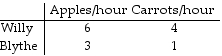 Table 3.1
-Table 3.1 illustrates Willy and Blythe's hourly production for apples and carrots. Based on the table, Blythe's opportunity cost of 1 carrot is:
Table 3.1
-Table 3.1 illustrates Willy and Blythe's hourly production for apples and carrots. Based on the table, Blythe's opportunity cost of 1 carrot is: (Multiple Choice)
4.9/5 (72)
(72) 
Filters
- Essay(0)
- Multiple Choice(0)
- Short Answer(0)
- True False(0)
- Matching(0)