



 Chat with AI
Exam 3: Exchange and Markets

Exam 1: Introduction: What Is Economics144 Questions
Exam 2: The Key Principles of Economics195 Questions
Exam 3: Exchange and Markets135 Questions
Exam 4: Demand, Supply, and Market Equilibrium279 Questions
Exam 5: Measuring a Nations Production and Income161 Questions
Exam 6: Unemployment and Inflation206 Questions
Exam 7: The Economy at Full Employment165 Questions
Exam 8: Why Do Economies Grow203 Questions
Exam 9: Aggregate Demand and Aggregate Supply189 Questions
Exam 10: Fiscal Policy166 Questions
Exam 11: The Income-Expenditure Model265 Questions
Exam 12: Investment and Financial Markets179 Questions
Exam 13: Money and the Banking System184 Questions
Exam 14: The Federal Reserve and Monetary Policy203 Questions
Exam 15: Modern Macroeconomics: From the Short Run to the Long Run176 Questions
Exam 16: The Dynamics of Inflation and Unemployment186 Questions
Exam 17: Macroeconomic Policy Debates143 Questions
Exam 18: International Trade and Public Policy226 Questions
Exam 19: The World of International Finance189 Questions
Select questions type


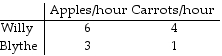 Table 3.1
-Table 3.1 illustrates Willy and Blythe's hourly production for apples and carrots. Based on the table, Willy's opportunity cost of 1 carrot is:
Table 3.1
-Table 3.1 illustrates Willy and Blythe's hourly production for apples and carrots. Based on the table, Willy's opportunity cost of 1 carrot is: (Multiple Choice)
4.8/5  (71)
(71) Suppose a car is completely produced and assembled in Germany and is sold to the United States. In this example, if the United States restricts the purchase of the car from Germany, then the country whose overall welfare would be reduced by this policy would be:
(Multiple Choice)
4.7/5 (68)
(68) The market system works by getting each person, motivated by his or her own self- interest, to produce products for other people.
(True/False)
4.7/5 (87)
(87) Suppose that in the time it takes for him to bake a cake, Bob can produce sew 5 pairs of jeans. In the time it takes for Joe to bake a cake, he can produce sew 8 pairs of jeans day. In this example, who has the absolute advantage in baking a cake?
(Multiple Choice)
4.9/5 (71)
(71)  Table 3.3
-Consider two individuals, Bob and Jerry, who produce guitars and banjos. Bob and Jerry's weekly productivity are shown in Table 3.3. Which of the following is true?
Table 3.3
-Consider two individuals, Bob and Jerry, who produce guitars and banjos. Bob and Jerry's weekly productivity are shown in Table 3.3. Which of the following is true? (Multiple Choice)
4.8/5 (82)
(82) Suppose a product suddenly loses popularity and the firms producing the product begin to realize large losses. In response, entrepreneurs would:
(Multiple Choice)
4.9/5 (73)
(73) Recall Application 2, "Gold Farming for World of Warcraft," to answer the following questions:
-According to the application, the purchase of virtual gold coins were done by online gamers who had:
(Multiple Choice)
4.9/5 (75)
(75) When the market does not produce the most efficient outcomes, it is known as:
(Multiple Choice)
4.8/5 (76)
(76) An individual or country that has a comparative advantage in the production of one good:
(Multiple Choice)
4.7/5 (79)
(79) During World War II, trade among camps caused the price of beef in camps with mainly Sikh prisoners who did not eat beef to:
(Multiple Choice)
4.7/5 (80)
(80) Suppose a product suddenly loses popularity and the firms producing the product begin to realize large losses. As firms exit the market, the equilibrium price in the market will
(Multiple Choice)
4.8/5 (82)
(82)  Table 3.1
-Table 3.1 illustrates Willy and Blythe's hourly production for apples and carrots. From the table, we can conclude that:
Table 3.1
-Table 3.1 illustrates Willy and Blythe's hourly production for apples and carrots. From the table, we can conclude that: (Multiple Choice)
4.8/5 (78)
(78) If Tom can produce 20 multiple choice questions or 30 true/false questions in an hour, and Mary can produce 15 multiple choice questions or 15 true/false questions in an hour, then Tom has a comparative advantage in writing multiple choice questions.
(True/False)
4.9/5 (75)
(75) Producer A has a comparative advantage over Producer B if, in producing a good:
(Multiple Choice)
4.9/5 (67)
(67) Imagine two countries, Bruceland and Davidia. Bruceland is producing everything at a lower absolute cost than Davidia. If the two countries trade what is the reason?
(Essay)
5.0/5 (93)
(93) The reason why the government taxes the gasoline used by pollution- causing automobiles is because it is trying to:
(Multiple Choice)
4.8/5 (71)
(71) Recall Application 1, "Candy Cane Makers Move to Mexico for Cheap Sugar," to answer the following questions:
-According to the application, even though about 90% of the worlds candy canes are consumed in the US and domestic producers dominated the market, domestic producers moved production to Mexico because:
(Multiple Choice)
4.9/5 (82)
(82)  Table 3.3
-Consider two individuals, Bob and Jerry, who produce guitars and banjos. Bob and Jerry's weekly productivity are shown in Table 3.3. Which of the following is true?
Table 3.3
-Consider two individuals, Bob and Jerry, who produce guitars and banjos. Bob and Jerry's weekly productivity are shown in Table 3.3. Which of the following is true? (Multiple Choice)
4.9/5 (90)
(90) 
Filters
- Essay(0)
- Multiple Choice(0)
- Short Answer(0)
- True False(0)
- Matching(0)