



 Chat with AI
Exam 12: U.S Inflation, Unemployment, and Business Cycle

Exam 1: What Is Economics472 Questions
Exam 2: The Economic Problem432 Questions
Exam 3: Demand and Supply503 Questions
Exam 4: Measuring Gdp and Economic Growth393 Questions
Exam 5: Monitoring Jobs and Inflation398 Questions
Exam 6: Economic Growth343 Questions
Exam 7: Finance, Saving, and Investment233 Questions
Exam 8: Money, the Price Level, and Inflation583 Questions
Exam 9: The Exchange Rate and the Balance of Payments482 Questions
Exam 10: Aggregate Supply and Aggregate Demand411 Questions
Exam 11: Expenditure Multipliers: the Keynesian Model444 Questions
Exam 12: U.S Inflation, Unemployment, and Business Cycle391 Questions
Exam 13: Fiscal Policy251 Questions
Exam 14: Monetary Policy216 Questions
Exam 15: International Trade Policy187 Questions
Review101 Questions
Select questions type


Which of the following pieces of evidence is most consistent with the real business cycle theory?
(Multiple Choice)
5.0/5  (81)
(81)  -Which of the above figures best shows the start of a demand-pull inflation?
 (Multiple Choice)
4.8/5 (82)
(82) Which theory assumes that business cycles occur because of changes in business confidence?
(Multiple Choice)
4.9/5 (93)
(93) 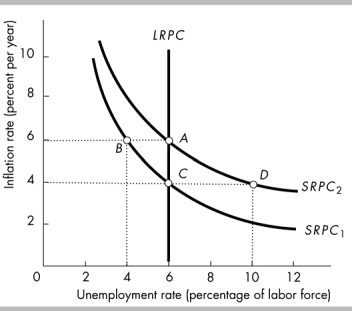 -In the above figure, the economy is at point A. The inflation rate unexpectedly falls by two percentage points. As a result, the economy moves to point
 (Multiple Choice)
4.8/5 (74)
(74) Suppose that an economist finds that in most recessions, which are times when employment is low, that real interest rates are extremely high. This finding would pose the biggest problem for the
(Multiple Choice)
4.7/5 (87)
(87) During a cost-push inflation spiral, the money wage rate ___________and the quantity of money ___________
(Multiple Choice)
4.8/5 (81)
(81) Which of the following could start a demand-pull inflation?
(Multiple Choice)
4.9/5 (76)
(76) A key difference between the new classical and the new Keynesian views of the business cycle is the role played by
(Multiple Choice)
4.7/5 (87)
(87) Which of the following are TRUE?
I. New Keynesian economists believe that money wage rates are influenced by rational expectations of the price level.
II. New classical economists believe that money wage rates are influenced by rational expectations of the price level.
III. New classical economists believe expected changes in aggregate demand trigger business cycles.
(Multiple Choice)
4.9/5 (79)
(79) In the long run, what is the tradeoff between inflation and unemployment? Explain your answer using Phillips curve analysis.
(Essay)
4.9/5 (83)
(83)  -In the above figure, suppose the economy starts at point A. The short-run response to an increase in the growth rate of the quantity of money in the monetarist business cycle theory is for the price level to __________and real GDP to__________ .
 (Multiple Choice)
4.8/5 (85)
(85) A cost-push inflation spiral results if the Fedʹs response to stagflation is to keep
(Multiple Choice)
4.9/5 (92)
(92) According to which theory of the business cycle do changes in the quantity of money never play a role in helping to explaining fluctuations in real variables?
(Multiple Choice)
4.8/5 (76)
(76) Suppose the data show that an unexpected change in tax rates caused a recent recession. These data support which model of the business cycle?
(Multiple Choice)
4.8/5 (75)
(75) The real business cycle theory views fluctuations in the quantity of money as the main source of business cycles.
(True/False)
4.9/5 (75)
(75) The short-run Phillips curve gives much the same information as
(Multiple Choice)
4.9/5 (79)
(79) 
Filters
- Essay(0)
- Multiple Choice(0)
- Short Answer(0)
- True False(0)
- Matching(0)