



 Chat with AI
Exam 11: Expenditure Multipliers: the Keynesian Model


At the equilibrium level of aggregate expenditure, what does aggregate planned expenditure equal? What happens at other levels of real GDP to bring about an equilibrium?

 (66)
 Verified
At the equilibrium level of aggregate expenditure, aggregate planned expenditure is equal to real GDP. At levels of real GDP where aggregate planned expenditure is greater than real GDP, business inventories are less than their target levels. In this situation, businesses increase their production, so output increases and real GDP increases. At levels of real GDP where aggregate planned expenditure is less than real GDP, business inventories are greater than their target levels. In this situation, businesses decrease their production, so output decreases and real GDP decreases.
In the economy of Keynesian Island, autonomous consumption expenditure is $50 million, and the marginal propensity to consume is 0.8. Investment is $160 million, government expenditure is $190 million, and net taxes are $250 million. Investment, government purchases, and taxes are constant they do not vary with income. The island does not trade with the rest of the world.
a) Draw the aggregate expenditure curve.
b) What is equilibrium real GDP for Keynesian Island?
c) What is the size of the multiplier in Keynesian Islandʹs economy?
d) If the government increases its purchases by $200 million, what will be the change in the economyʹs equilibrium real GDP?
(78) Verified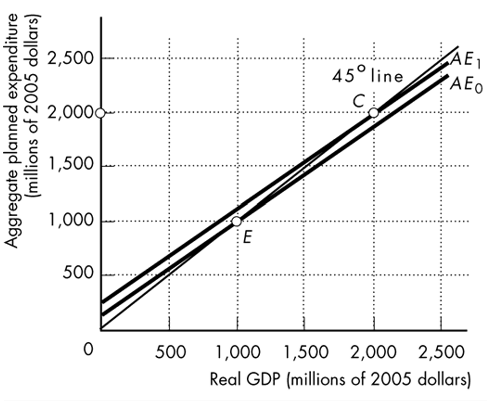
a) See the figure above. The aggregate expenditure line is AE0. Because the island does not trade with the rest of the world, net exports are zero. When net exports are zero, aggregate expenditure, is given by AE = C + I + G. Consumption equals $50 million plus 0.8 of disposable income, so the consumption function is
C = $50 million + 0.8Y - T), where $50 million is autonomous consumption, 0.8 is the marginal propensity to consume, and Y - T is disposable income, real income minus net taxes. Real income also equals real GDP.) Because net taxes are constant, the consumption function is C = $50 million + 08Y - $250 million). Using the formula in the equation for aggregate expenditure gives AE = $50 million + 0.8Y - $250 million) + $160 million + $190 million, so aggregate expenditure is given by AE = $200 million + 0.8Y.
b) Equilibrium expenditure is the level of aggregate expenditure that occurs when aggregate planned expenditure, AE, equals real GDP. In the economy of Keynesian Island equilibrium is at point E in the figure, when real GDP and aggregate expenditure equal $1,000 million. Equilibrium expenditure also can be calculated by solving the equation Y = $200 million + 0.8Y for Y. Start by subtracting 0.8Y from both sides to give 0.2Y = $200 million. Then divide both sides by 0.2 to obtain Y = $200 million/0.2, so that Y, which is real GDP, equals $1,000 million.
c) The multiplier is the amount by which a change in autonomous expenditure is multiplied to determine the change in equilibrium expenditure and real GDP. The multiplier equals 1/1 - slope of the AE curve). The slope of the AE curve is 0.80, so in the economy of Keynesian Island, the multiplier is 1/1 - 0.8) = 5.
d) If the government increases its expenditure by $200 million, the aggregate expenditure curve shifts up by the amount of additional purchases to the aggregate expenditure line AE1. The new formula for aggregate expenditure is AE = $400 million + 0.8Y.) The economyʹs equilibrium real GDP increases by the amount of the additional expenditure multiplied by the multiplier. So the increase in real GDP is $200 million × 5, which equals $1,000 million. So the new equilibrium level of real GDP is $2,000 million, point C in the figure above.
When the consumption function lies above the 45 -degree line, households
(82) VerifiedA
If the multiplier is 4 and there are no imports or income taxes, the marginal propensity to consume is
(83) How do firms respond to unplanned inventory changes? What is the effect on their production and GDP?
(86) In general, the steeper the aggregate expenditure curve, the
(67) When prices are fixed and there are no imports or income taxes, the value of the multiplier is
(86) The presence of imports ______________the size of the U.S. multiplier because with an increase of U.S. real GDP, ______________.
(95)  -In the above figure, at a disposable income level of $2 trillion, saving equals
 (78) Because of the multiplier, a one-time change in expenditure will
(73)  -In the above figure, line ABC is called
If aggregate planned expenditure is less than real GDP, in the short run
(73) The difference between planned and unplanned spending is_________ .
(88) ʺAggregate planned expenditure is the sum of planned consumption expenditure, investment, government expenditure on goods and services, and exports minus imports.ʺ Is the previous statement correct or incorrect?
(73) In the third quarter of 2008, investment in the U.S. totaled $1.4 trillion and in 2007, investment was
$1)3 trillion. The change in investment
(82) When disposal income is $5.0 trillion, consumption expenditure is $4.5 trillion. When disposal income is $6.0 trillion, consumption expenditure is $5.0 trillion. What is the marginal propensity to consume?
(76) 
Filters
- Essay(0)
- Multiple Choice(0)
- Short Answer(0)
- True False(0)
- Matching(0)