



 Chat with AI
Exam 11: Expenditure Multipliers: the Keynesian Model

Exam 1: What Is Economics472 Questions
Exam 2: The Economic Problem432 Questions
Exam 3: Demand and Supply503 Questions
Exam 4: Measuring Gdp and Economic Growth393 Questions
Exam 5: Monitoring Jobs and Inflation398 Questions
Exam 6: Economic Growth343 Questions
Exam 7: Finance, Saving, and Investment233 Questions
Exam 8: Money, the Price Level, and Inflation583 Questions
Exam 9: The Exchange Rate and the Balance of Payments482 Questions
Exam 10: Aggregate Supply and Aggregate Demand411 Questions
Exam 11: Expenditure Multipliers: the Keynesian Model444 Questions
Exam 12: U.S Inflation, Unemployment, and Business Cycle391 Questions
Exam 13: Fiscal Policy251 Questions
Exam 14: Monetary Policy216 Questions
Exam 15: International Trade Policy187 Questions
Review101 Questions
Select questions type


Explain what happens to equilibrium expenditure if autonomous expenditure increases by $100 million.
(Essay)
4.9/5  (82)
(82) 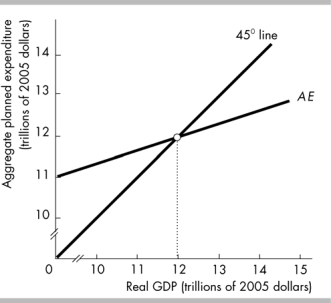 -In the above figure, if the level of real GDP is $13 trillion,
 (Multiple Choice)
4.8/5 (79)
(79) In the economy of St. Maynard Island, autonomous consumption expenditure is $185 million, and the marginal propensity to consume is 0.75. Investment is $150 million, government expenditure is $100 million, and net taxes are $80 million. Investment, government expenditure, and taxes are constant they do not vary with income. The island does not trade with the rest of the world.
a) Draw the aggregate expenditure curve.
b) What is the islandʹs autonomous aggregate expenditure?
c) What is the size of the multiplier in St. Maynard Islandʹs economy?
d) What is the islandʹs aggregate planned expenditure and what is happening to inventories when real GDP is
$1,100 million?
e) What is the economyʹs equilibrium aggregate expenditure?
(Essay)
4.9/5 (68)
(68) In 2007, investment in France increased by 7 billion euros, consumption increased by 4 billion euros and government spending increased by 1.5 billion euros. Assume the price level was constant and the economy was at full employment. As a result, suppose that equilibrium expenditure increased by 21 billion euros. In this example,__________ is the induced expenditure and__________ is autonomous expenditure.
(Multiple Choice)
4.9/5 (77)
(77) As globalization has increased, the trend in the U.S. marginal propensity to import has been for it to
(Multiple Choice)
4.9/5 (87)
(87) An increase in the value of the multiplier can be caused by
(Multiple Choice)
4.7/5 (80)
(80) The multiplier is the amount by which__________ is multiplied to determine__________ .
(Multiple Choice)
4.8/5 (79)
(79) Suppose disposable income increases from $5 trillion to $6 trillion. As a result, consumption expenditure increases from $4 trillion to_________ . This result means the MPC equals_________ .
(Multiple Choice)
5.0/5 (76)
(76) Discuss the relationship between the business cycle and changes in autonomous expenditures.
(Essay)
4.7/5 (80)
(80) In a diagram with the___________ consumption function, the 45 -degree line indicates all points where
(Multiple Choice)
4.9/5 (78)
(78) List the components of aggregate expenditure and describe how each of them change as real GDP increases.
(Essay)
4.8/5 (72)
(72) In the Keynesian model of aggregate expenditure, real GDP is determined by the
(Multiple Choice)
4.8/5 (76)
(76) When disposable income increases from $7 trillion to $7.5 trillion, consumption expenditure increase from $6.5 trillion to $6.9 trillion. The MPS is equal to
(Multiple Choice)
4.8/5 (98)
(98) Real GDP (dollars) Consumption expenditure (dollars) Investment (dollars) Government expenditure (dollars) 3,000 2,500 500 500 4,000 3,250 500 500 5,000 4,000 500 500 6,000 4,750 500 500 7,000 5,500 500 500 8,000 6,250 500 500
-In the above table, there are no taxes and no imports or exports. The value of the multiplier for this economy is
(Multiple Choice)
4.8/5 (77)
(77) 
Filters
- Essay(0)
- Multiple Choice(0)
- Short Answer(0)
- True False(0)
- Matching(0)