



 Chat with AI
Exam 4: Measuring Gdp and Economic Growth


Explain how our economic welfare depends upon our level of real GDP per person but there might not be a one-to-one relationship between economic welfare and real GDP per person. Give examples of things that can effect one but not the other.

 (81)
 Verified
Although GDP has a significant impact on our economic welfare, it is not a perfect measure of economic welfare. GDP omits some factors that affect our economic welfare. GDP does not include household production, all the tasks performed around the house. It omits underground production, the part of the economy hidden from the government. Real GDP does not include the value of peopleʹs leisure time. And, GDP does not make allowances for environmental quality, health and life expectancy, or political freedom and social justice. All of these factors influence the quality of our life and hence our economic welfare. Indeed, occasionally a change will affect GDP and economic welfare in different directions. For instance, if people decide they want more leisure and hence retire early, GDP will decrease because fewer people are working, but economic welfare will increase. Or, if there is an increase in production that creates massive amounts of pollution, GDP increases even though economic welfare likely decreases.
Define and distinguish between final goods and intermediate goods.
(86) VerifiedFinal goods are those goods that are purchased by their final user. Essentially, these goods and services) have been completed and do not need to go through further processes of completion. Examples of final goods include restaurant meals, lamps, railroad engines, and books. Intermediate goods and services are goods or services produced by one firm, bought by another, and then used as a component in the manufacture of another good or service. Basically, intermediate goods and services are used as a part of another good or service. Lumber used by a carpenter to build a table or paper used by a publisher to publish a book are examples of intermediate goods.
Of the following, which is correct?
(91) VerifiedA
If a larger fraction of the adult population is working in the marketplace, household production
(81) If depreciation is less than gross investment, then net investment is
(82) 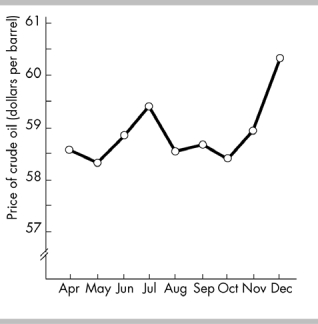 -Using the above figure, during which of the following periods does the price of crude oil have a downward trend?
 (84) Which of the following is NOT one of the components for computing GDP based upon the income approach?
(71) All of the following are included in gross private domestic investment expenditure EXCEPT a
(76) A graph shows the wages of factory workers. The slope of the line is positive for periods when the wage rate is
(79) An example of ʺinvestmentʺ in computing real GDP using the expenditure approach is the purchase of
(82) All of the following are components of the expenditure approach to measuring GDP EXCEPT
(69) Let C represent consumption expenditure, S saving, I gross private domestic investment, G government expenditure on goods and services, and X - M net exports of goods and services. Then GDP equals
(83) 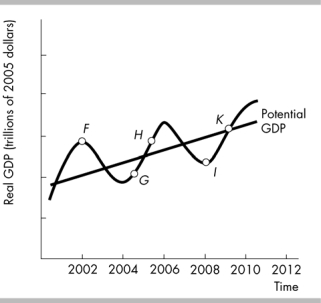 -In the above figure, which point represents the under use of resources?
 (81) The omission of household production causes actual economic production to be underestimated.
(73) Pollution is a by-product of some production processes, so on this count real GDP as measured
(81) ʺLife expectancy is exceptionally high in Japan. Scores for political freedom and civil liberties approach those of peer countries in Europe...equality of opportunity is extremely weak. The country also possesses one of the longer working weeks.ʺ Japanʹs GDP was estimated to be $4.2 trillion purchasing power parity) and the population was 127.4 million.
ʺDriven by its attractive climate, Brazil performs substantially better on Life Satisfaction than Material Wealth. High international demand for Brazilʹs commodities and raw materials has produced a sustained economic expansion since 2004, which in turn has led to job creation, wage growth and relatively low inflation. Brazilians report that they control their own lives to a substantial degree.ʺ Brazilʹs GDP was estimated to be $1.7 trillion purchasing power parity) and 190 million in 2006.
-According to the information, Japanʹs real GDP per person
(95) 
Filters
- Essay(0)
- Multiple Choice(0)
- Short Answer(0)
- True False(0)
- Matching(0)