



 Chat with AI
Exam 12: U.S Inflation, Unemployment, and Business Cycle

Exam 1: What Is Economics472 Questions
Exam 2: The Economic Problem432 Questions
Exam 3: Demand and Supply503 Questions
Exam 4: Measuring Gdp and Economic Growth393 Questions
Exam 5: Monitoring Jobs and Inflation398 Questions
Exam 6: Economic Growth343 Questions
Exam 7: Finance, Saving, and Investment233 Questions
Exam 8: Money, the Price Level, and Inflation583 Questions
Exam 9: The Exchange Rate and the Balance of Payments482 Questions
Exam 10: Aggregate Supply and Aggregate Demand411 Questions
Exam 11: Expenditure Multipliers: the Keynesian Model444 Questions
Exam 12: U.S Inflation, Unemployment, and Business Cycle391 Questions
Exam 13: Fiscal Policy251 Questions
Exam 14: Monetary Policy216 Questions
Exam 15: International Trade Policy187 Questions
Review101 Questions
Select questions type


Increases in government expenditure can create cost-push inflation.)
(True/False)
4.8/5  (74)
(74) Which of the following pieces of evidence is most consistent with the monetarist theory?
(Multiple Choice)
4.8/5 (78)
(78) Suppose that the economy is at full employment and aggregate demand increases by more than it is anticipated to increase. Other things remaining the same, ___________.
(Multiple Choice)
4.9/5 (80)
(80) In a demand-pull inflation, the AD curve shifts___________ and the SAS curve shifts___________ .
(Multiple Choice)
4.9/5 (85)
(85)  -In the above figure, if the economy moves from point A to point E,
 (Multiple Choice)
4.9/5 (79)
(79) The factor that leads to business cycle events within real business cycle theory is
(Multiple Choice)
4.9/5 (86)
(86) Which of the following is NOT a potential start of a demand-pull inflation?
(Multiple Choice)
4.9/5 (77)
(77) Suppose that managers forecasted a large decline in expected sales and profits and so their confidence plummets. According to the __________, this forecast might start a business cycle.
(Multiple Choice)
4.9/5 (69)
(69) 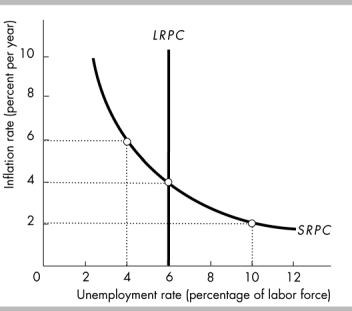 -The figure above shows an economyʹs Phillips curves. Currently, the inflation rate is 6 percent a year. The natural unemployment rate is___________ percent and the expected inflation rate is___________ Percent a year.
 (Multiple Choice)
4.8/5 (70)
(70) ʺThe long-run Phillips curve is vertical at the expected inflation rate.ʺ Is the previous statement correct or incorrect?
(Essay)
4.8/5 (77)
(77) A one-time increase in the price of oil followed by a one-time increase in aggregate demand produce
(Multiple Choice)
4.8/5 (89)
(89) When the price level is rising and simultaneously real GDP is decreasing,
(Multiple Choice)
4.8/5 (71)
(71) For a given level of anticipated inflation and natural unemployment rate, the short -run Phillips curve shows the relationship between
(Multiple Choice)
4.7/5 (81)
(81) 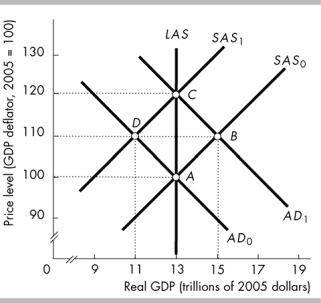 -In the above figure, the economy is initially at point A. If workers and firms correctly anticipate the increase in aggregate demand and the resulting inflation rate, the economy will move to point
 (Multiple Choice)
4.8/5 (81)
(81) To stop a demand-pull inflation using monetary policy, you would recommend that the Fed
(Multiple Choice)
4.8/5 (79)
(79) When the AD and SAS curves intersect at a level of real GDP which exceeds potential GDP and there is no government policy undertaken, which of the following will occur?
(Multiple Choice)
4.9/5 (83)
(83) 
Filters
- Essay(0)
- Multiple Choice(0)
- Short Answer(0)
- True False(0)
- Matching(0)