



 Chat with AI
Exam 12: U.S Inflation, Unemployment, and Business Cycle

Exam 1: What Is Economics472 Questions
Exam 2: The Economic Problem432 Questions
Exam 3: Demand and Supply503 Questions
Exam 4: Measuring Gdp and Economic Growth393 Questions
Exam 5: Monitoring Jobs and Inflation398 Questions
Exam 6: Economic Growth343 Questions
Exam 7: Finance, Saving, and Investment233 Questions
Exam 8: Money, the Price Level, and Inflation583 Questions
Exam 9: The Exchange Rate and the Balance of Payments482 Questions
Exam 10: Aggregate Supply and Aggregate Demand411 Questions
Exam 11: Expenditure Multipliers: the Keynesian Model444 Questions
Exam 12: U.S Inflation, Unemployment, and Business Cycle391 Questions
Exam 13: Fiscal Policy251 Questions
Exam 14: Monetary Policy216 Questions
Exam 15: International Trade Policy187 Questions
Review101 Questions
Select questions type


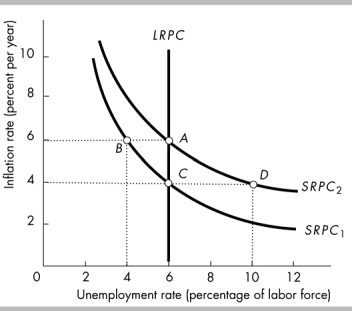 -In the above figure, the economy is at point A. The inflation rate falls by two percentage points and people correctly expected the fall. As a result, the economy moves to point
 (Multiple Choice)
4.7/5  (76)
(76) If Samantha predicts future inflation based on rational expectations, then
(Multiple Choice)
4.9/5 (68)
(68) If the real interest rate is 4 percent and workers expect real wages to be 2 percent year higher next year, according to real business cycle theory, workers will work
(Multiple Choice)
4.9/5 (74)
(74) If the Fed responds to an initial increase in aggregate demand by increasing the quantity of money,
(Multiple Choice)
4.8/5 (62)
(62) The __________states that the main source of economic fluctuations is volatile business confidence.
(Multiple Choice)
5.0/5 (86)
(86) Which of the following would shift the aggregate demand curve leftward year after year?
(Multiple Choice)
4.8/5 (87)
(87) What was the U.S. experience with demand pull inflation during the 1960s and early 1970s?
(Essay)
4.8/5 (78)
(78) Which of the following leads to an rightward shift in the short-run Phillips curve?
I. a reduction in the expected inflation rate
II. an increase in the natural unemployment rate
(Multiple Choice)
4.9/5 (70)
(70) The short-run Phillips curve intersects the long-run Phillips curve at the expected inflation rate.
(True/False)
4.7/5 (78)
(78) The key difference between the new classical theory of the business cycle and the new Keynesian theory of the business cycle is that the new classical theory believes that__________ while the new Keynesian theory believes that __________.
(Multiple Choice)
4.8/5 (65)
(65) The short-run Phillips curve is vertical at the natural unemployment rate.
(True/False)
4.8/5 (76)
(76) In monetarist business cycle theory, increases in money growth temporarily__________ real GDP and __________the price level.
(Multiple Choice)
4.8/5 (86)
(86) Which of the diagrams in the above figure best illustrates a long-run Phillips curve?
(Multiple Choice)
4.9/5 (75)
(75) The monetarist theory of the business cycle views fluctuations in the growth rate of the quantity of money as the main source of economic fluctuations.
(True/False)
4.7/5 (66)
(66) Suppose that a shock causes the aggregate demand curve to shift rightward. If the Fed does nothing,
(Multiple Choice)
4.8/5 (92)
(92) A criticism of the real business cycle RBC) theory is that
(Multiple Choice)
4.8/5 (87)
(87) An unexpected decrease in aggregate demand will trigger a recession in the __________theory of the business cycle.
(Multiple Choice)
4.9/5 (71)
(71) For a persistent demand-pull inflation to occur, government expenditure must persistently increase.
(True/False)
4.8/5 (73)
(73) Real business cycle theory says that the factor leading to the business cycle is changes in
(Multiple Choice)
4.7/5 (83)
(83) 
Filters
- Essay(0)
- Multiple Choice(0)
- Short Answer(0)
- True False(0)
- Matching(0)