



 Chat with AI
Exam 12: U.S Inflation, Unemployment, and Business Cycle

Exam 1: What Is Economics472 Questions
Exam 2: The Economic Problem432 Questions
Exam 3: Demand and Supply503 Questions
Exam 4: Measuring Gdp and Economic Growth393 Questions
Exam 5: Monitoring Jobs and Inflation398 Questions
Exam 6: Economic Growth343 Questions
Exam 7: Finance, Saving, and Investment233 Questions
Exam 8: Money, the Price Level, and Inflation583 Questions
Exam 9: The Exchange Rate and the Balance of Payments482 Questions
Exam 10: Aggregate Supply and Aggregate Demand411 Questions
Exam 11: Expenditure Multipliers: the Keynesian Model444 Questions
Exam 12: U.S Inflation, Unemployment, and Business Cycle391 Questions
Exam 13: Fiscal Policy251 Questions
Exam 14: Monetary Policy216 Questions
Exam 15: International Trade Policy187 Questions
Review101 Questions
Select questions type


The Phillips curve describes the relationship between real GDP and inflation.
(True/False)
4.9/5  (81)
(81) According to real business cycle RBC) theory, a change in the quantity of money leads to
(Multiple Choice)
4.8/5 (76)
(76) A decrease in the expected inflation rate leads to__________in the long -run Phillips curve and__________ in the short-run Phillips curve.
(Multiple Choice)
4.9/5 (77)
(77) According to the real business cycle theory, technological change
(Multiple Choice)
4.8/5 (77)
(77) According to the new classical model, changes in aggregate demand change real GDP
(Multiple Choice)
4.8/5 (86)
(86) 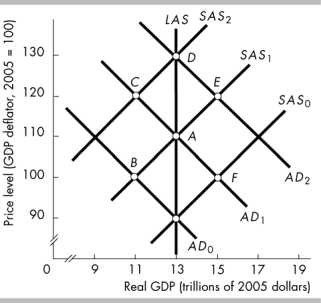 -The figure above shows the aggregate demand, short-run aggregate supply, and long-run aggregate supply curves for the U.S. economy. The economy is currently at point A. A cost-push rise in the price level will initially move the economy to point ___________and to point___________ .
 (Multiple Choice)
4.9/5 (73)
(73) Which of the following could lead to demand-pull inflation?
(Multiple Choice)
4.8/5 (84)
(84)  -In the above figure, which path represents a demand-pull inflation?
 (Multiple Choice)
4.8/5 (72)
(72) In the short run, an unexpected increase in the inflation rate leads to
(Multiple Choice)
4.8/5 (85)
(85) Which of the following is the factor the creates business cycles in the real business cycle theory?
(Multiple Choice)
4.9/5 (78)
(78) A larger than expected increase in aggregate demand will lead to __________in the __________of the business cycle.
(Multiple Choice)
4.8/5 (89)
(89) The short-run Phillips curve shows the tradeoff between , holding the expected inflation rate and the natural unemployment rate constant.
(Multiple Choice)
4.9/5 (67)
(67) Suppose the expected inflation rate is 12 percent and the unemployment rate is 5 percent. If the expected inflation rate increases to 13 percent,
(Multiple Choice)
4.8/5 (94)
(94) The short-run Phillips curve and the long-run Phillips curve intersect at the___________ and___________
(Multiple Choice)
4.8/5 (73)
(73) 
Filters
- Essay(0)
- Multiple Choice(0)
- Short Answer(0)
- True False(0)
- Matching(0)