



 Chat with AI
Exam 36: Reproduction and Development

Exam 1: Introduction: Evolution and the Foundations of Biology36 Questions
Exam 2: The Chemical Context of Life135 Questions
Exam 3: Carbon and the Molecular Diversity of Life136 Questions
Exam 4: A Tour of the Cell75 Questions
Exam 5: Membrane Transport and Cell Signaling86 Questions
Exam 6: An Introduction to Metabolism79 Questions
Exam 7: Cellular Respiration and Fermentation99 Questions
Exam 8: Photosynthesis68 Questions
Exam 9: The Cell Cycle57 Questions
Exam 10: Meiosis and Sexual Life Cycles59 Questions
Exam 11: Mendel and the Gene Idea57 Questions
Exam 12: The Chromosomal Basis of Inheritance43 Questions
Exam 13: The Molecular Basis of Inheritance62 Questions
Exam 14: Gene Expression: From Gene to Protein77 Questions
Exam 15: Regulation of Gene Expression48 Questions
Exam 16: Development,stem Cells,and Cancer34 Questions
Exam 17: Viruses35 Questions
Exam 18: Genomes and Their Evolution31 Questions
Exam 19: Descent With Modification61 Questions
Exam 20: Phylogeny72 Questions
Exam 21: The Evolution of Populations81 Questions
Exam 22: The Origin of Species75 Questions
Exam 23: Broad Patterns of Evolution60 Questions
Exam 24: Early Life and the Diversification of Prokaryotes99 Questions
Exam 25: The Origin and Diversification of Eukaryotes80 Questions
Exam 26: The Colonization of Land by Plants and Fungi128 Questions
Exam 27: The Rise of Animal Diversity93 Questions
Exam 28: Plant Structure and Growth67 Questions
Exam 29: Resource Acquisition,nutrition,and Transport in Vascular Plants115 Questions
Exam 30: Reproduction and Domestication of Flowering Plants72 Questions
Exam 31: Plant Responses to Internal and External Signals74 Questions
Exam 32: Homeostasis and Endocrine Signaling116 Questions
Exam 33: Animal Nutrition75 Questions
Exam 34: Circulation and Gas Exchange94 Questions
Exam 35: The Immune System96 Questions
Exam 36: Reproduction and Development123 Questions
Exam 37: Neurons,synapses,and Signaling77 Questions
Exam 38: Nervous and Sensory Systems105 Questions
Exam 39: Motor Mechanisms and Behavior83 Questions
Exam 40: Population Ecology and the Distribution of Organisms93 Questions
Exam 41: Ecological Communities59 Questions
Exam 42: Ecosystems and Energy86 Questions
Exam 43: Conservation Biology and Global Change71 Questions
Select questions type


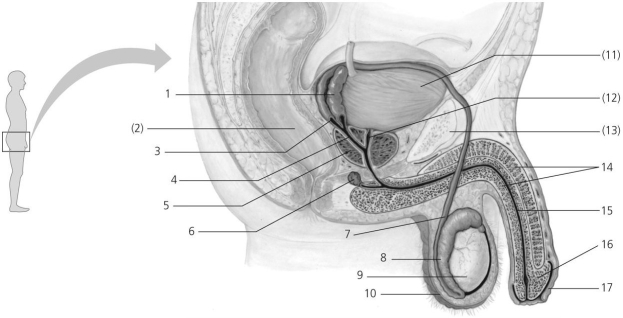 Figure 36.2
-In Figure 36.2,which numbers correspond to the vas deferens?
Figure 36.2
-In Figure 36.2,which numbers correspond to the vas deferens? (Multiple Choice)
4.8/5  (78)
(78) Select the choice that correctly associates the organ with its embryonic sources.
(Multiple Choice)
5.0/5 (96)
(96) The secretion of follicle-stimulating hormone from the anterior pituitary gland is reduced by
(Multiple Choice)
4.8/5 (89)
(89) Figure 36.2
-In Figure 36.2,which number corresponds to a structure that is found in males but not females?
Figure 36.2
-In Figure 36.2,which number corresponds to a structure that is found in males but not females? (Multiple Choice)
4.8/5 (81)
(81) An oocyte released from a human ovary enters the oviduct as a result of
(Multiple Choice)
4.8/5 (84)
(84) Fertilization of human eggs usually takes place in the ________,whereas implantation occurs in the ________.
(Multiple Choice)
4.9/5 (81)
(81) The hypothalamic hormone that stimulates hormone secretion by the anterior pituitary gland is
(Multiple Choice)
4.9/5 (84)
(84) Springtails are a type of arthropod.Male springtails drop tiny beads of semen attached to stalks.Females that are ready to reproduce search out these drops and take them into their genital opening.This is an example of
(Multiple Choice)
4.8/5 (82)
(82) One of the evolutionary "enigmas," or unsolved puzzles,of sexual reproduction is that
(Multiple Choice)
4.8/5 (89)
(89) Labor contractions can be increased by the medical use of a synthetic drug that mimics the action of
(Multiple Choice)
4.7/5 (81)
(81) 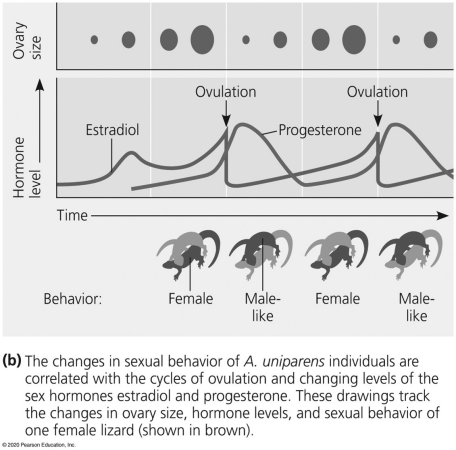 -The lizard species A.uniparens experiences varying sexual reproductive behaviors depending on hormone levels.The data in Figure 36.4b are shown for the brown lizard in the images.What do you think would happen to the brown lizard if progesterone levels stayed consistently low?
 (Multiple Choice)
4.9/5 (83)
(83) The hormone progesterone is produced by which structure and acts on which organ?
(Multiple Choice)
4.9/5 (88)
(88) In close comparisons,external fertilization often yields more offspring than does internal fertilization.However,internal fertilization offers the advantage that
(Multiple Choice)
4.8/5 (77)
(77) In mammals,the nuclei resulting from the union of the sperm and the egg are first truly diploid at the end of the
(Multiple Choice)
4.9/5 (80)
(80) What embryo-produced hormone maintains progesterone and estrogen secretion by the corpus luteum through the first trimester of pregnancy?
(Multiple Choice)
4.8/5 (68)
(68) 
Filters
- Essay(0)
- Multiple Choice(0)
- Short Answer(0)
- True False(0)
- Matching(0)