



 Chat with AI
Exam 36: Reproduction and Development

Exam 1: Introduction: Evolution and the Foundations of Biology36 Questions
Exam 2: The Chemical Context of Life135 Questions
Exam 3: Carbon and the Molecular Diversity of Life136 Questions
Exam 4: A Tour of the Cell75 Questions
Exam 5: Membrane Transport and Cell Signaling86 Questions
Exam 6: An Introduction to Metabolism79 Questions
Exam 7: Cellular Respiration and Fermentation99 Questions
Exam 8: Photosynthesis68 Questions
Exam 9: The Cell Cycle57 Questions
Exam 10: Meiosis and Sexual Life Cycles59 Questions
Exam 11: Mendel and the Gene Idea57 Questions
Exam 12: The Chromosomal Basis of Inheritance43 Questions
Exam 13: The Molecular Basis of Inheritance62 Questions
Exam 14: Gene Expression: From Gene to Protein77 Questions
Exam 15: Regulation of Gene Expression48 Questions
Exam 16: Development,stem Cells,and Cancer34 Questions
Exam 17: Viruses35 Questions
Exam 18: Genomes and Their Evolution31 Questions
Exam 19: Descent With Modification61 Questions
Exam 20: Phylogeny72 Questions
Exam 21: The Evolution of Populations81 Questions
Exam 22: The Origin of Species75 Questions
Exam 23: Broad Patterns of Evolution60 Questions
Exam 24: Early Life and the Diversification of Prokaryotes99 Questions
Exam 25: The Origin and Diversification of Eukaryotes80 Questions
Exam 26: The Colonization of Land by Plants and Fungi128 Questions
Exam 27: The Rise of Animal Diversity93 Questions
Exam 28: Plant Structure and Growth67 Questions
Exam 29: Resource Acquisition,nutrition,and Transport in Vascular Plants115 Questions
Exam 30: Reproduction and Domestication of Flowering Plants72 Questions
Exam 31: Plant Responses to Internal and External Signals74 Questions
Exam 32: Homeostasis and Endocrine Signaling116 Questions
Exam 33: Animal Nutrition75 Questions
Exam 34: Circulation and Gas Exchange94 Questions
Exam 35: The Immune System96 Questions
Exam 36: Reproduction and Development123 Questions
Exam 37: Neurons,synapses,and Signaling77 Questions
Exam 38: Nervous and Sensory Systems105 Questions
Exam 39: Motor Mechanisms and Behavior83 Questions
Exam 40: Population Ecology and the Distribution of Organisms93 Questions
Exam 41: Ecological Communities59 Questions
Exam 42: Ecosystems and Energy86 Questions
Exam 43: Conservation Biology and Global Change71 Questions
Select questions type


Like many other fishes,bluehead wrasses utilize harem mating as they reproduce sexually.However,unlike most fishes,
(Multiple Choice)
4.7/5  (89)
(89) In sea urchins,the "fast block" and the longer-lasting "slow block" to polyspermy,respectively,are
(Multiple Choice)
4.8/5 (87)
(87) The formation of the fertilization membrane requires an increase in the availability of
(Multiple Choice)
4.9/5 (78)
(78) Among mammals,the male and female genital structures that consist mostly of erectile tissue include the
(Multiple Choice)
4.8/5 (96)
(96) 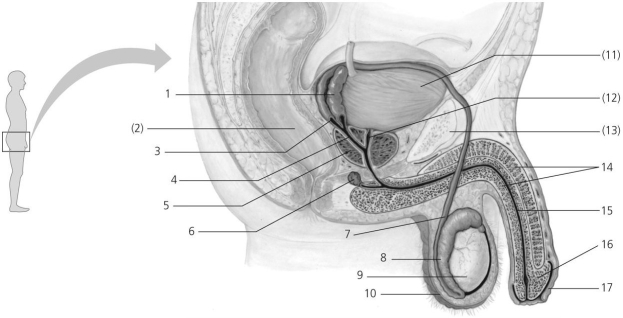 Figure 36.2
-In Figure 36.2,which number corresponds to the location where sperm mature?
Figure 36.2
-In Figure 36.2,which number corresponds to the location where sperm mature? (Multiple Choice)
4.7/5 (69)
(69) Horseshoe crabs,genetically related to scorpions and spiders,are capable of only one type of fertilization.Female horseshoe crabs dig a shallow hole near the ocean shoreline that can fill with water.They then lay their eggs in that hole,and male horseshoe crabs mount the females and deposit their sperm over the eggs.This is an example of
(Multiple Choice)
4.8/5 (79)
(79) Evidence that parthenogenetic whiptail lizards are derived from sexually reproducing ancestors includes
(Multiple Choice)
4.8/5 (71)
(71) So-called "combination" birth control pills function in contraception by
(Multiple Choice)
4.8/5 (73)
(73) Figure 36.2
-In Figure 36.2,which number corresponds to the structure that is severed in a vasectomy?
Figure 36.2
-In Figure 36.2,which number corresponds to the structure that is severed in a vasectomy? (Multiple Choice)
5.0/5 (92)
(92) Of the following contraception methods,the highest risk of accidental pregnancy accompanies
(Multiple Choice)
5.0/5 (86)
(86) 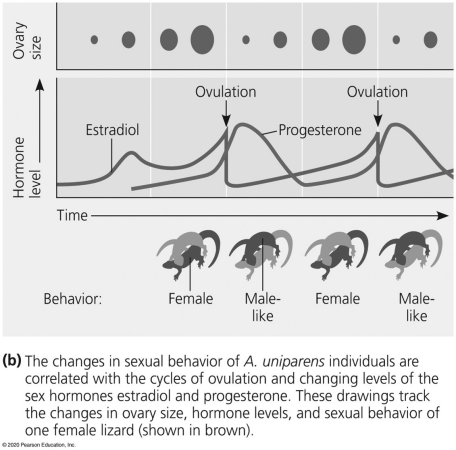 -The lizard species A.uniparens experiences varying sexual reproductive behaviors depending on hormone levels.The data in Figure 36.b are shown for the brown lizard in the images.What can you conclude from the data in the figure regarding this process?
 (Multiple Choice)
4.8/5 (77)
(77) A reproductive difference between sea urchins and humans is that
(Multiple Choice)
4.8/5 (85)
(85) A well-used method to determine if a tarantula (a spider)is male or female is to look at the skin that the tarantula sheds.If the molt (shed skin)shows evidence of small organs that are used to store sperm,one can determine that the specimen is a female.This particular organ is an example of
(Multiple Choice)
4.8/5 (72)
(72) 
Filters
- Essay(0)
- Multiple Choice(0)
- Short Answer(0)
- True False(0)
- Matching(0)