



 Chat with AI
Exam 10: Meiosis and Sexual Life Cycles

Exam 1: Introduction: Evolution and the Foundations of Biology36 Questions
Exam 2: The Chemical Context of Life135 Questions
Exam 3: Carbon and the Molecular Diversity of Life136 Questions
Exam 4: A Tour of the Cell75 Questions
Exam 5: Membrane Transport and Cell Signaling86 Questions
Exam 6: An Introduction to Metabolism79 Questions
Exam 7: Cellular Respiration and Fermentation99 Questions
Exam 8: Photosynthesis68 Questions
Exam 9: The Cell Cycle57 Questions
Exam 10: Meiosis and Sexual Life Cycles59 Questions
Exam 11: Mendel and the Gene Idea57 Questions
Exam 12: The Chromosomal Basis of Inheritance43 Questions
Exam 13: The Molecular Basis of Inheritance62 Questions
Exam 14: Gene Expression: From Gene to Protein77 Questions
Exam 15: Regulation of Gene Expression48 Questions
Exam 16: Development,stem Cells,and Cancer34 Questions
Exam 17: Viruses35 Questions
Exam 18: Genomes and Their Evolution31 Questions
Exam 19: Descent With Modification61 Questions
Exam 20: Phylogeny72 Questions
Exam 21: The Evolution of Populations81 Questions
Exam 22: The Origin of Species75 Questions
Exam 23: Broad Patterns of Evolution60 Questions
Exam 24: Early Life and the Diversification of Prokaryotes99 Questions
Exam 25: The Origin and Diversification of Eukaryotes80 Questions
Exam 26: The Colonization of Land by Plants and Fungi128 Questions
Exam 27: The Rise of Animal Diversity93 Questions
Exam 28: Plant Structure and Growth67 Questions
Exam 29: Resource Acquisition,nutrition,and Transport in Vascular Plants115 Questions
Exam 30: Reproduction and Domestication of Flowering Plants72 Questions
Exam 31: Plant Responses to Internal and External Signals74 Questions
Exam 32: Homeostasis and Endocrine Signaling116 Questions
Exam 33: Animal Nutrition75 Questions
Exam 34: Circulation and Gas Exchange94 Questions
Exam 35: The Immune System96 Questions
Exam 36: Reproduction and Development123 Questions
Exam 37: Neurons,synapses,and Signaling77 Questions
Exam 38: Nervous and Sensory Systems105 Questions
Exam 39: Motor Mechanisms and Behavior83 Questions
Exam 40: Population Ecology and the Distribution of Organisms93 Questions
Exam 41: Ecological Communities59 Questions
Exam 42: Ecosystems and Energy86 Questions
Exam 43: Conservation Biology and Global Change71 Questions
Select questions type


If a cell has completed the first meiotic division and is just beginning meiosis II,which of the following statements describes the genetic or chromosomal contents of this cell?

Free
(Multiple Choice)
4.7/5  (84)
(84) Correct Answer: Verified
A
Which of the following elements do all sexual life cycles in eukaryotic organisms have in common?
Free
(Multiple Choice)
4.9/5 (84)
(84) Correct Answer:Verified
VerifiedC
During mitosis or meiosis,sister chromatids are held together by proteins referred to as cohesins.Such molecules must have which of the following properties?
Free
(Multiple Choice)
4.8/5 (69)
(69) Correct Answer:Verified
VerifiedC
If chiasmata can be seen in a cell under a microscope,which of the following meiotic processes must have occurred?
(Multiple Choice)
4.9/5 (84)
(84) During which process does independent assortment of chromosomes occur?
(Multiple Choice)
4.9/5 (64)
(64) 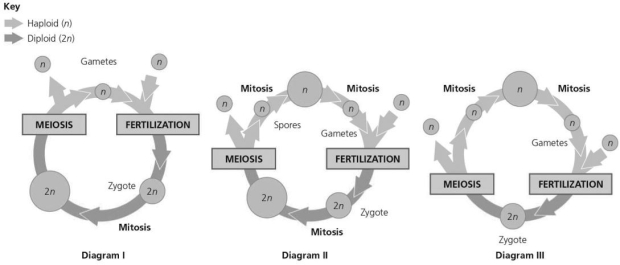 Figure 10.6
-Refer to the life cycles illustrated in Figure 10.6 above.Which of the life cycles is (are)typical for animals?
Figure 10.6
-Refer to the life cycles illustrated in Figure 10.6 above.Which of the life cycles is (are)typical for animals? (Multiple Choice)
4.7/5 (86)
(86) After telophase II of meiosis,the chromosomal makeup of each daughter cell is
(Multiple Choice)
4.8/5 (91)
(91) For a species with a haploid number of 23 chromosomes,how many different combinations of maternal and paternal chromosomes are possible for the gametes?
(Multiple Choice)
4.8/5 (76)
(76) Independent assortment of chromosomes during meiosis is a result of
(Multiple Choice)
4.9/5 (79)
(79) Which of the following types of organisms has both diploid and haploid forms that exist as separate individuals?
(Multiple Choice)
4.8/5 (92)
(92) Which of the following events might result in a human zygote with 45 chromosomes?
(Multiple Choice)
4.9/5 (81)
(81) How do cells at the completion of meiosis compare with cells that have replicated their DNA and are just about to begin meiosis?
(Multiple Choice)
4.9/5 (93)
(93) Which of the following statements correctly describes the differences between sexual and asexual reproduction?
(Multiple Choice)
4.7/5 (77)
(77) If the DNA content of a diploid cell in the G1 phase of the cell cycle is 24 fg (femtograms),then the DNA content of the same cell at metaphase of meiosis II would be
(Multiple Choice)
4.9/5 (82)
(82) Which of the following statements regarding sexual life cycles is correct?
(Multiple Choice)
4.8/5 (82)
(82) In a human karyotype,chromosomes are arranged in 23 pairs.If we choose one of these pairs,such as pair 14,which of the following characteristics are most likely for the two chromosomes of the pair to have in common?
(Multiple Choice)
5.0/5 (77)
(77) In a life cycle such as that shown in diagram II of Figure 10.6 above,if the zygote's chromosome number is 10,which of the following will be true?
(Multiple Choice)
4.8/5 (87)
(87) 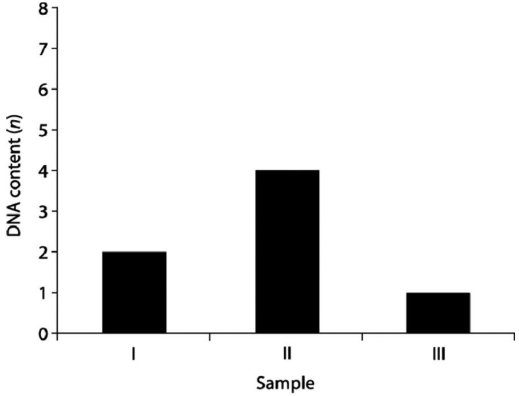 -You have isolated DNA from three different cell types of an organism,determined the relative DNA content for each type,and plotted the results on the graph shown in the figure above.Which sample(s)of DNA might be from a germ cell arrested in prophase I of meiosis?
 (Multiple Choice)
4.8/5 (77)
(77) 
Filters
- Essay(0)
- Multiple Choice(0)
- Short Answer(0)
- True False(0)
- Matching(0)