



 Chat with AI
Exam 10: Meiosis and Sexual Life Cycles

Exam 1: Introduction: Evolution and the Foundations of Biology36 Questions
Exam 2: The Chemical Context of Life135 Questions
Exam 3: Carbon and the Molecular Diversity of Life136 Questions
Exam 4: A Tour of the Cell75 Questions
Exam 5: Membrane Transport and Cell Signaling86 Questions
Exam 6: An Introduction to Metabolism79 Questions
Exam 7: Cellular Respiration and Fermentation99 Questions
Exam 8: Photosynthesis68 Questions
Exam 9: The Cell Cycle57 Questions
Exam 10: Meiosis and Sexual Life Cycles59 Questions
Exam 11: Mendel and the Gene Idea57 Questions
Exam 12: The Chromosomal Basis of Inheritance43 Questions
Exam 13: The Molecular Basis of Inheritance62 Questions
Exam 14: Gene Expression: From Gene to Protein77 Questions
Exam 15: Regulation of Gene Expression48 Questions
Exam 16: Development,stem Cells,and Cancer34 Questions
Exam 17: Viruses35 Questions
Exam 18: Genomes and Their Evolution31 Questions
Exam 19: Descent With Modification61 Questions
Exam 20: Phylogeny72 Questions
Exam 21: The Evolution of Populations81 Questions
Exam 22: The Origin of Species75 Questions
Exam 23: Broad Patterns of Evolution60 Questions
Exam 24: Early Life and the Diversification of Prokaryotes99 Questions
Exam 25: The Origin and Diversification of Eukaryotes80 Questions
Exam 26: The Colonization of Land by Plants and Fungi128 Questions
Exam 27: The Rise of Animal Diversity93 Questions
Exam 28: Plant Structure and Growth67 Questions
Exam 29: Resource Acquisition,nutrition,and Transport in Vascular Plants115 Questions
Exam 30: Reproduction and Domestication of Flowering Plants72 Questions
Exam 31: Plant Responses to Internal and External Signals74 Questions
Exam 32: Homeostasis and Endocrine Signaling116 Questions
Exam 33: Animal Nutrition75 Questions
Exam 34: Circulation and Gas Exchange94 Questions
Exam 35: The Immune System96 Questions
Exam 36: Reproduction and Development123 Questions
Exam 37: Neurons,synapses,and Signaling77 Questions
Exam 38: Nervous and Sensory Systems105 Questions
Exam 39: Motor Mechanisms and Behavior83 Questions
Exam 40: Population Ecology and the Distribution of Organisms93 Questions
Exam 41: Ecological Communities59 Questions
Exam 42: Ecosystems and Energy86 Questions
Exam 43: Conservation Biology and Global Change71 Questions
Select questions type


Why are cells arrested at metaphase in the preparation of a karyotype?
(Multiple Choice)
4.9/5  (83)
(83) After telophase I of meiosis,the chromosomal makeup of each daughter cell is
(Multiple Choice)
4.8/5 (81)
(81) In the life cycle of fungi and some protists,which of the following processes leads to the formation of gametes?
(Multiple Choice)
4.7/5 (80)
(80) Which of the following statements correctly describes an organism's genome?
(Multiple Choice)
4.8/5 (87)
(87) To visualize and identify meiotic cells at metaphase I with a microscope,what would you look for?
(Multiple Choice)
4.9/5 (85)
(85) Chromatids are separated from each other during which of the following processes?
(Multiple Choice)
4.8/5 (71)
(71)  -A certain (hypothetical)organism is diploid,has either blue or orange wings as the consequence of one of its genes on chromosome 12,and has either long or short antennae as the result of a second gene on chromosome 19,as shown in the figure above.If a female of this species has one chromosome 12 with a blue gene and another chromosome 12 with an orange gene,and has both number 19 chromosomes with short genes,she will produce which of the following egg types?
 (Multiple Choice)
4.9/5 (90)
(90) Which of the following is true of an organism that has a chromosome number of 2n = 16?
(Multiple Choice)
4.8/5 (68)
(68) In a cell undergoing meiosis,if synaptonemal complexes form or are still present,what process or processes have occurred?
(Multiple Choice)
4.9/5 (78)
(78) Which of the following statements correctly describes the characteristics of recombinant chromosomes?
(Multiple Choice)
4.8/5 (69)
(69)
-A certain (hypothetical)organism is diploid,has either blue or orange wings as the consequence of one of its genes on chromosome 12,and has either long or short antennae as the result of a second gene on chromosome 19,as shown in the figure above.A female with a paternal set of one orange and one long gene chromosome and a maternal set composed of one blue and one short gene chromosome is expected to produce which of the following types of eggs after meiosis?
-A certain (hypothetical)organism is diploid,has either blue or orange wings as the consequence of one of its genes on chromosome 12,and has either long or short antennae as the result of a second gene on chromosome 19,as shown in the figure above.A female with a paternal set of one orange and one long gene chromosome and a maternal set composed of one blue and one short gene chromosome is expected to produce which of the following types of eggs after meiosis? (Multiple Choice)
4.9/5 (83)
(83) Homologous chromosomes move toward opposite poles of a dividing cell during
(Multiple Choice)
4.8/5 (71)
(71) 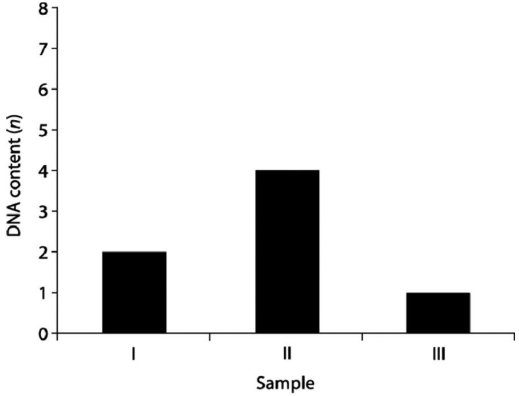 -You have isolated DNA from three different cell types of an organism,determined the relative DNA content for each type,and plotted the results on the graph shown in the figure above.Which sample(s)of DNA might be from a cell at the end of anaphase II of meiosis?
 (Multiple Choice)
4.9/5 (81)
(81) There is a group of invertebrate animals called rotifers,among which a particular group of species reproduces,as far as is known,only asexually.These rotifers,however,have survived a long evolutionary history without evidence of having been overcome by excessive mutations.Because the rotifers develop from eggs,but asexually,what can you predict about these organisms?
(Multiple Choice)
4.8/5 (91)
(91) In a cell undergoing meiosis,if homologous chromosomes are aligned at the equator of the meiotic spindle,what process has occurred?
(Multiple Choice)
4.8/5 (82)
(82) If a sexually reproducing organism has a diploid number of 36,how many individual chromosomes would any of its gametes have?
(Multiple Choice)
4.7/5 (91)
(91) Which of the following is the smallest unit of life that would contain a complete copy of the entire human genome?
(Multiple Choice)
4.8/5 (84)
(84) 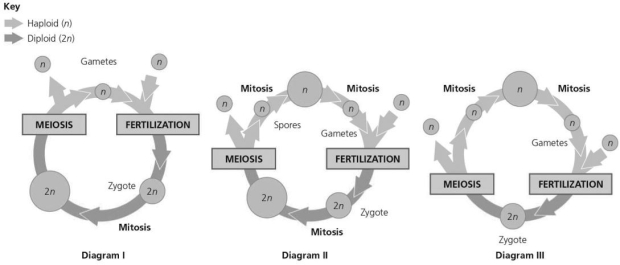 Figure 10.6
-Refer to the life cycles illustrated in Figure 10.6 above.Which of the life cycles is (are)typical for plants and some algae?
Figure 10.6
-Refer to the life cycles illustrated in Figure 10.6 above.Which of the life cycles is (are)typical for plants and some algae? (Multiple Choice)
4.7/5 (81)
(81) 
Filters
- Essay(0)
- Multiple Choice(0)
- Short Answer(0)
- True False(0)
- Matching(0)