



 Chat with AI
Exam 36: Reproduction and Development

Exam 1: Introduction: Evolution and the Foundations of Biology36 Questions
Exam 2: The Chemical Context of Life135 Questions
Exam 3: Carbon and the Molecular Diversity of Life136 Questions
Exam 4: A Tour of the Cell75 Questions
Exam 5: Membrane Transport and Cell Signaling86 Questions
Exam 6: An Introduction to Metabolism79 Questions
Exam 7: Cellular Respiration and Fermentation99 Questions
Exam 8: Photosynthesis68 Questions
Exam 9: The Cell Cycle57 Questions
Exam 10: Meiosis and Sexual Life Cycles59 Questions
Exam 11: Mendel and the Gene Idea57 Questions
Exam 12: The Chromosomal Basis of Inheritance43 Questions
Exam 13: The Molecular Basis of Inheritance62 Questions
Exam 14: Gene Expression: From Gene to Protein77 Questions
Exam 15: Regulation of Gene Expression48 Questions
Exam 16: Development,stem Cells,and Cancer34 Questions
Exam 17: Viruses35 Questions
Exam 18: Genomes and Their Evolution31 Questions
Exam 19: Descent With Modification61 Questions
Exam 20: Phylogeny72 Questions
Exam 21: The Evolution of Populations81 Questions
Exam 22: The Origin of Species75 Questions
Exam 23: Broad Patterns of Evolution60 Questions
Exam 24: Early Life and the Diversification of Prokaryotes99 Questions
Exam 25: The Origin and Diversification of Eukaryotes80 Questions
Exam 26: The Colonization of Land by Plants and Fungi128 Questions
Exam 27: The Rise of Animal Diversity93 Questions
Exam 28: Plant Structure and Growth67 Questions
Exam 29: Resource Acquisition,nutrition,and Transport in Vascular Plants115 Questions
Exam 30: Reproduction and Domestication of Flowering Plants72 Questions
Exam 31: Plant Responses to Internal and External Signals74 Questions
Exam 32: Homeostasis and Endocrine Signaling116 Questions
Exam 33: Animal Nutrition75 Questions
Exam 34: Circulation and Gas Exchange94 Questions
Exam 35: The Immune System96 Questions
Exam 36: Reproduction and Development123 Questions
Exam 37: Neurons,synapses,and Signaling77 Questions
Exam 38: Nervous and Sensory Systems105 Questions
Exam 39: Motor Mechanisms and Behavior83 Questions
Exam 40: Population Ecology and the Distribution of Organisms93 Questions
Exam 41: Ecological Communities59 Questions
Exam 42: Ecosystems and Energy86 Questions
Exam 43: Conservation Biology and Global Change71 Questions
Select questions type


Which of the following patterns of reproduction are found only among invertebrate animals?
(Multiple Choice)
4.9/5  (70)
(70) Assume that successful reproduction in a rare salamander species,wherein all individuals are females,relies on those females having access to sperm from males of another species but that the resulting embryos show no signs of a genetic contribution from the sperm.In this case,the sperm appear to be used only for
(Multiple Choice)
4.8/5 (85)
(85) Imagine a woman is in the final week of her pregnancy.Her doctor gives her an injection of oxytocin.The likely result of this is that the pregnant woman would
(Multiple Choice)
4.9/5 (90)
(90) Among nonmammalian vertebrates,the cloaca is an anatomical structure that functions as a
(Multiple Choice)
4.8/5 (78)
(78) For the 10 days following ovulation in a nonpregnant menstrual cycle,the corpus luteum is the main source of which hormone?
(Multiple Choice)
4.8/5 (95)
(95) The spermathecae is used by what kind of species for sperm storage?
(Multiple Choice)
4.9/5 (75)
(75) Use the information below to answer the following questions.
Normally the Y chromosome contains the SRY gene,and the X chromosomes lacks the SRY gene.The SRY gene directs the development of adult male characteristics such as a penis and testes,deeper voice,facial hair,and larger muscles.However,during meiosis,chromosomes exchange genetic material with one another through a process called homologous recombination.One outcome of homologous recombination is for an X chromosome to gain the SRY gene (referred to as X(SRY+)).Conversely,through the same process,it is possible for the Y chromosome to lose the SRY gene (referred to as Y(SRY-)).
-What biological (chromosomal)gender and adult human characteristics would a zygote having an XX(SRY+)genotype have?
(Multiple Choice)
4.8/5 (85)
(85) A colony of a new species of bees is examined,and they are all determined to be genetically identical females.What reproductive process could have led to this result?
(Multiple Choice)
4.8/5 (83)
(83) During the early part of the cleavage stage in many animal species,the rapidly developing cells skip
(Multiple Choice)
4.9/5 (86)
(86) From earliest to latest,the overall sequence of early development proceeds in which of the following sequences?
(Multiple Choice)
4.7/5 (82)
(82) 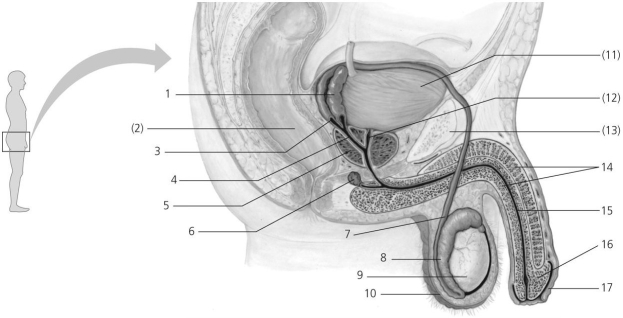 Figure 36.2
-What would be the effect if structure 6 in Figure 36.2 was surgically removed?
Figure 36.2
-What would be the effect if structure 6 in Figure 36.2 was surgically removed? (Multiple Choice)
4.9/5 (75)
(75) Environmental cues that influence the timing of reproduction generally do so by
(Multiple Choice)
4.8/5 (77)
(77) For lactation to take place,the synthesis of breast milk and its release from the mammary gland,respectively,are caused by
(Multiple Choice)
4.7/5 (78)
(78) Among human males,both semen and urine normally travel along the
(Multiple Choice)
4.7/5 (75)
(75) Below are four factors that may be important for an animal to reproduce.Which factor(s)are required by animals that reproduce using internal fertilization?
I.cooperative copulatory behavior
II.compatible reproductive systems
III.a moist environment for spawning
IV.sperm
(Multiple Choice)
4.9/5 (92)
(92) Use the information below to answer the following questions.
Normally the Y chromosome contains the SRY gene,and the X chromosomes lacks the SRY gene.The SRY gene directs the development of adult male characteristics such as a penis and testes,deeper voice,facial hair,and larger muscles.However,during meiosis,chromosomes exchange genetic material with one another through a process called homologous recombination.One outcome of homologous recombination is for an X chromosome to gain the SRY gene (referred to as X(SRY+)).Conversely,through the same process,it is possible for the Y chromosome to lose the SRY gene (referred to as Y(SRY-)).
-What biological (chromosomal)gender and adult human characteristics would a zygote having an XX genotype have,assuming the recombination event described did not take place?
(Multiple Choice)
4.8/5 (73)
(73) 
Filters
- Essay(0)
- Multiple Choice(0)
- Short Answer(0)
- True False(0)
- Matching(0)