



 Chat with AI
Exam 36: Reproduction and Development

Exam 1: Introduction: Evolution and the Foundations of Biology36 Questions
Exam 2: The Chemical Context of Life135 Questions
Exam 3: Carbon and the Molecular Diversity of Life136 Questions
Exam 4: A Tour of the Cell75 Questions
Exam 5: Membrane Transport and Cell Signaling86 Questions
Exam 6: An Introduction to Metabolism79 Questions
Exam 7: Cellular Respiration and Fermentation99 Questions
Exam 8: Photosynthesis68 Questions
Exam 9: The Cell Cycle57 Questions
Exam 10: Meiosis and Sexual Life Cycles59 Questions
Exam 11: Mendel and the Gene Idea57 Questions
Exam 12: The Chromosomal Basis of Inheritance43 Questions
Exam 13: The Molecular Basis of Inheritance62 Questions
Exam 14: Gene Expression: From Gene to Protein77 Questions
Exam 15: Regulation of Gene Expression48 Questions
Exam 16: Development,stem Cells,and Cancer34 Questions
Exam 17: Viruses35 Questions
Exam 18: Genomes and Their Evolution31 Questions
Exam 19: Descent With Modification61 Questions
Exam 20: Phylogeny72 Questions
Exam 21: The Evolution of Populations81 Questions
Exam 22: The Origin of Species75 Questions
Exam 23: Broad Patterns of Evolution60 Questions
Exam 24: Early Life and the Diversification of Prokaryotes99 Questions
Exam 25: The Origin and Diversification of Eukaryotes80 Questions
Exam 26: The Colonization of Land by Plants and Fungi128 Questions
Exam 27: The Rise of Animal Diversity93 Questions
Exam 28: Plant Structure and Growth67 Questions
Exam 29: Resource Acquisition,nutrition,and Transport in Vascular Plants115 Questions
Exam 30: Reproduction and Domestication of Flowering Plants72 Questions
Exam 31: Plant Responses to Internal and External Signals74 Questions
Exam 32: Homeostasis and Endocrine Signaling116 Questions
Exam 33: Animal Nutrition75 Questions
Exam 34: Circulation and Gas Exchange94 Questions
Exam 35: The Immune System96 Questions
Exam 36: Reproduction and Development123 Questions
Exam 37: Neurons,synapses,and Signaling77 Questions
Exam 38: Nervous and Sensory Systems105 Questions
Exam 39: Motor Mechanisms and Behavior83 Questions
Exam 40: Population Ecology and the Distribution of Organisms93 Questions
Exam 41: Ecological Communities59 Questions
Exam 42: Ecosystems and Energy86 Questions
Exam 43: Conservation Biology and Global Change71 Questions
Select questions type


Obesity is directly related to low testosterone levels.Why would this be of concern for a male-female couple interested in having a baby?
(Multiple Choice)
4.7/5  (86)
(86) A contraceptive pill that continuously inhibits the release of gonadotropin-releasing hormone (GnRH)from the hypothalamus will
(Multiple Choice)
4.9/5 (71)
(71) Contact of a sperm with signal molecules in the coat of an egg causes the sperm to undergo
(Multiple Choice)
4.9/5 (88)
(88) Why might scientists want to figure out how to change sexually reproducing plants that are in high demand in agriculture into asexually reproducing plants?
(Multiple Choice)
4.8/5 (84)
(84) Most of the noncellular fluid in ejaculated human semen is composed of
(Multiple Choice)
4.8/5 (78)
(78) Use the information below to answer the following questions.
Normally the Y chromosome contains the SRY gene,and the X chromosomes lacks the SRY gene.The SRY gene directs the development of adult male characteristics such as a penis and testes,deeper voice,facial hair,and larger muscles.However,during meiosis,chromosomes exchange genetic material with one another through a process called homologous recombination.One outcome of homologous recombination is for an X chromosome to gain the SRY gene (referred to as X(SRY+)).Conversely,through the same process,it is possible for the Y chromosome to lose the SRY gene (referred to as Y(SRY-)).
-What biological (chromosomal)gender and adult human characteristics would a zygote having an XY(SRY-)genotype have?
(Multiple Choice)
4.7/5 (102)
(102) Prior to ovulation,the primary steroid hormone secreted by the growing follicle is
(Multiple Choice)
4.8/5 (89)
(89) In correct chronological order,the three phases of the human ovarian cycle are
(Multiple Choice)
4.7/5 (80)
(80) Uterine fibroid tumors are benign tumors that grow in the wall of the uterus.These tumors may alter the shape of the uterine cavity,thereby potentially affecting
(Multiple Choice)
4.9/5 (91)
(91) In excreted urine,a reliable "marker" that a pregnancy has initiated is
(Multiple Choice)
4.9/5 (68)
(68) Regeneration,the regrowth of lost body parts,normally follows
(Multiple Choice)
4.7/5 (77)
(77) 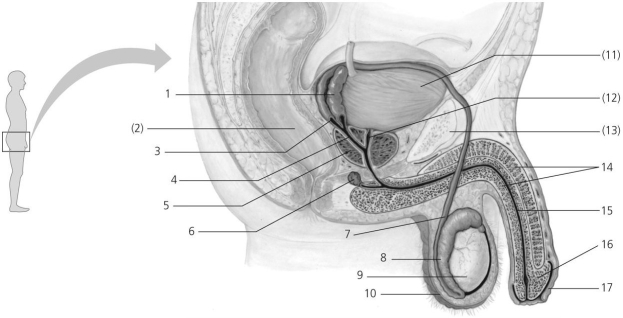 Figure 36.2
-Sertoli cells are important for nourishing sperm.Where in Figure 36.2 are they located?
Figure 36.2
-Sertoli cells are important for nourishing sperm.Where in Figure 36.2 are they located? (Multiple Choice)
4.8/5 (77)
(77) Increasing the temperature of the human scrotum by 2°C (i.e. ,near the normal body core temperature)and holding it there would
(Multiple Choice)
4.9/5 (65)
(65) 
Filters
- Essay(0)
- Multiple Choice(0)
- Short Answer(0)
- True False(0)
- Matching(0)