



 Chat with AI
Exam 28: Wages,Unions,and Labor

Exam 1: What Economics Is About168 Questions
Exam 2: Production Possibilities Frontier Framework152 Questions
Exam 3: Supply and Demand: Theory227 Questions
Exam 4: Prices: Free, Controlled, and Relative107 Questions
Exam 5: Supply, Demand, and Price: Applications83 Questions
Exam 6: Macroeconomic Measurements: Prices and Unemployment129 Questions
Exam 7: Macroeconomic Measurements: GDP and Real GDP138 Questions
Exam 8: Aggregate Demand and Aggregate Supply208 Questions
Exam 9: Classical Macroeconomics and the Self Regulating Economy167 Questions
Exam 10: Keynesian Macroeconomics and Economic Instability: A Critique of the Self-Regulating Economy198 Questions
Exam 11: Fiscal Policy and the Federal Budget164 Questions
Exam 12: Money, Banking,and the Financial System124 Questions
Exam 13: The Federal Reserve System184 Questions
Exam 14: Money and the Economy125 Questions
Exam 15: Monetary Policy176 Questions
Exam 16: Expectations Theory and the Economy146 Questions
Exam 17: Economic Growth: Resources, Technology, Ideas, and Institutions82 Questions
Exam 18: The Financial Crisis of 2007-200970 Questions
Exam 19: Debates in Macroeconomics Over the Role and Effects of Government69 Questions
Exam 20: Elasticity198 Questions
Exam 21: Consumer Choice: Maximizing Utility and Behavioral Economics176 Questions
Exam 22: Production and Costs247 Questions
Exam 23: Perfect Competition191 Questions
Exam 24: Monopoly191 Questions
Exam 25: Monopolistic Competition, Oligopoly, and Game Theory167 Questions
Exam 26: Government and Product Markets: Antitrust and Regulation165 Questions
Exam 27: Factor Markets: With Emphasis on the Labor Market181 Questions
Exam 28: Wages,Unions,and Labor134 Questions
Exam 29: The Distribution of Income and Poverty93 Questions
Exam 30: Interest, Rent, and Profit199 Questions
Exam 31: Market Failure: Externalities, Public Goods, and Asymmetric Information185 Questions
Exam 32: Public Choice and Special-Interest-Group Politics131 Questions
Exam 33: Building Theories to Explain Everyday Life: From Observations to Questions to Theories to Predictions60 Questions
Exam 34: International Trade152 Questions
Exam 35: International Finance119 Questions
Exam 36: Globalization and International Impacts on the Economy136 Questions
Exam 37: The Economic Case For and Against Government: Five Topics Considered82 Questions
Exam 38: Stocks, Bonds, Futures, and Options108 Questions
Exam 39: Agriculture: Problems, Policies, and Unintended Effects149 Questions
Select questions type


Exhibit 28-7
 -Refer to Exhibit 28-7.The marginal factor cost of increasing employment from 40 to 50 workers is
 (Multiple Choice)
4.9/5  (73)
(73) Exhibit 28-5
 -Refer to Exhibit 28-5.In which of the following cases has the increase in the wage from W1 to W2 been brought about by a country-wide legalization of union shops?
 (Multiple Choice)
4.8/5 (83)
(83) Describe the difference between the traditional (or orthodox)view of labor unions and the labor-union-as-collective-voice view of labor unions with respect to the impact that unions have on productivity and efficiency.
(Essay)
4.8/5 (81)
(81) In your text there is an exhibit that shows (for selected industries)the median weekly earnings of workers represented by labor unions and the median weekly earnings of workers not represented by labor unions.The point to be made by this comparison is that in some cases,
(Multiple Choice)
4.9/5 (67)
(67) In 18th century England,higher wages of weavers appears to have led to the invention of the power loom.
(True/False)
4.9/5 (80)
(80) Successful collective bargaining (on the part of a labor union)will
(Multiple Choice)
4.9/5 (86)
(86) Which of the following is a possible objective of labor unions?
(Multiple Choice)
4.8/5 (83)
(83) Exhibit 28-8
 -Refer to Exhibit 28-8.If the monopsonist could perfectly discriminate by paying each worker a different wage rate,the number of workers employed would be
 (Multiple Choice)
4.8/5 (71)
(71) The general and likely purpose of a (labor)strike is to convince management that
(Multiple Choice)
4.9/5 (75)
(75) Assuming the wage-employment tradeoff exists,if labor in a particular geographic area is homogeneous and the unionized workers successfully negotiate a higher wage rate,then
(Multiple Choice)
4.9/5 (82)
(82) What is the difference between a union shop and a closed shop? Are either (or both)legal in the United States?
(Essay)
5.0/5 (74)
(74) Exhibit 28-7
-Refer to Exhibit 28-7.As the firm increases employment from 50 to 60 workers,by how much does total labor cost increase?
-Refer to Exhibit 28-7.As the firm increases employment from 50 to 60 workers,by how much does total labor cost increase? (Multiple Choice)
5.0/5 (75)
(75) Exhibit 28-8
-Refer to Exhibit 28-8.If the profit-maximizing monopsonist were to pay its workers what the marginal worker's services are worth to it,the wage rate would be
-Refer to Exhibit 28-8.If the profit-maximizing monopsonist were to pay its workers what the marginal worker's services are worth to it,the wage rate would be (Multiple Choice)
4.9/5 (71)
(71) Labor unions try to meet their objectives by influencing the elasticity of demand for labor and the demand for labor.To influence these factors,they try to do all the following except
(Multiple Choice)
4.8/5 (86)
(86) An American labor union worker has a picket sign that reads "Say No to Tokyo,Buy American." Most likely,the worker is trying to
(Multiple Choice)
4.9/5 (85)
(85) If workers can do the work in both the unionized sector and the nonunionized sector,then an increase in the wage rate paid in the unionized sector (relative to the wage rate paid in the nonunionized sector),which is brought about by a permanent leftward shift in the labor supply curve,will lead to
(Multiple Choice)
4.8/5 (86)
(86) Labor unions obtain higher wages for their members by reducing the profits of the business owners in the short run and in the long run.
(True/False)
4.8/5 (80)
(80) Most likely,if a labor union wanted to employ all its membership it would negotiate for a __________ than if it wanted to maximize the income of a limited number of union members.
(Multiple Choice)
4.7/5 (77)
(77) Exhibit 28-2
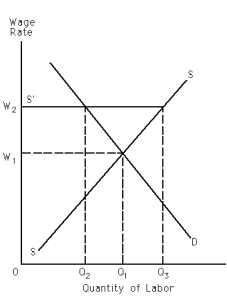 -Refer to Exhibit 28-2.One of the things that the labor union probably can do to convince management that the supply curve is S'S instead of SS is
 (Multiple Choice)
4.8/5 (92)
(92) 
Filters
- Essay(0)
- Multiple Choice(0)
- Short Answer(0)
- True False(0)
- Matching(0)