



 Chat with AI
Exam 22: Production and Costs

Exam 1: What Economics Is About168 Questions
Exam 2: Production Possibilities Frontier Framework152 Questions
Exam 3: Supply and Demand: Theory227 Questions
Exam 4: Prices: Free, Controlled, and Relative107 Questions
Exam 5: Supply, Demand, and Price: Applications83 Questions
Exam 6: Macroeconomic Measurements: Prices and Unemployment129 Questions
Exam 7: Macroeconomic Measurements: GDP and Real GDP138 Questions
Exam 8: Aggregate Demand and Aggregate Supply208 Questions
Exam 9: Classical Macroeconomics and the Self Regulating Economy167 Questions
Exam 10: Keynesian Macroeconomics and Economic Instability: A Critique of the Self-Regulating Economy198 Questions
Exam 11: Fiscal Policy and the Federal Budget164 Questions
Exam 12: Money, Banking,and the Financial System124 Questions
Exam 13: The Federal Reserve System184 Questions
Exam 14: Money and the Economy125 Questions
Exam 15: Monetary Policy176 Questions
Exam 16: Expectations Theory and the Economy146 Questions
Exam 17: Economic Growth: Resources, Technology, Ideas, and Institutions82 Questions
Exam 18: The Financial Crisis of 2007-200970 Questions
Exam 19: Debates in Macroeconomics Over the Role and Effects of Government69 Questions
Exam 20: Elasticity198 Questions
Exam 21: Consumer Choice: Maximizing Utility and Behavioral Economics176 Questions
Exam 22: Production and Costs247 Questions
Exam 23: Perfect Competition191 Questions
Exam 24: Monopoly191 Questions
Exam 25: Monopolistic Competition, Oligopoly, and Game Theory167 Questions
Exam 26: Government and Product Markets: Antitrust and Regulation165 Questions
Exam 27: Factor Markets: With Emphasis on the Labor Market181 Questions
Exam 28: Wages,Unions,and Labor134 Questions
Exam 29: The Distribution of Income and Poverty93 Questions
Exam 30: Interest, Rent, and Profit199 Questions
Exam 31: Market Failure: Externalities, Public Goods, and Asymmetric Information185 Questions
Exam 32: Public Choice and Special-Interest-Group Politics131 Questions
Exam 33: Building Theories to Explain Everyday Life: From Observations to Questions to Theories to Predictions60 Questions
Exam 34: International Trade152 Questions
Exam 35: International Finance119 Questions
Exam 36: Globalization and International Impacts on the Economy136 Questions
Exam 37: The Economic Case For and Against Government: Five Topics Considered82 Questions
Exam 38: Stocks, Bonds, Futures, and Options108 Questions
Exam 39: Agriculture: Problems, Policies, and Unintended Effects149 Questions
Select questions type


The law of diminishing marginal returns states that as ever larger amounts of a variable input are combined with

Free
(Multiple Choice)
4.7/5  (71)
(71) Correct Answer: Verified
C
Economic profit is the difference between total revenue and implicit costs.
Free
(True/False)
4.9/5 (74)
(74) Correct Answer:Verified
VerifiedFalse
If a firm earns normal profit,then it has generated revenues
Free
(Multiple Choice)
4.9/5 (87)
(87) Correct Answer:Verified
VerifiedA
Exhibit 22-2
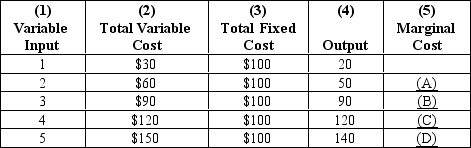 -Refer to Exhibit 22-2.What is the average variable cost of producing 90 units of output?
 (Multiple Choice)
4.8/5 (79)
(79) The owner of a firm signs a binding one-year lease on a factory for $10,000 rent a month and pays the first month's rent.The $10,000 rent is
(Multiple Choice)
5.0/5 (73)
(73) Situation 22-4
 -Refer to Situation 22-4. What are Joe's economic profits?
 (Multiple Choice)
4.8/5 (72)
(72) Exhibit 22-3
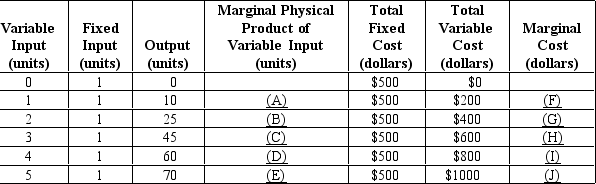 -Refer to Exhibit 22-3.What level of output exhibits the lowest average total cost?
 (Multiple Choice)
4.8/5 (71)
(71) Exhibit 22-4
 -Refer to Exhibit 22-4.Curve C is a(n)__________ cost curve.
 (Multiple Choice)
4.9/5 (87)
(87) The change in total cost that results from a change in output is __________ cost.
(Multiple Choice)
4.9/5 (76)
(76) Exhibit 22-13
 -Refer to Exhibit 22-13. What dollar amounts go in blanks (P)and (Q)?
 (Multiple Choice)
4.7/5 (88)
(88) Diseconomies of scale are said to exist when inputs are increased by some percentage and output increases by a(n)__________ percentage,causing unit costs to __________.
(Multiple Choice)
4.8/5 (86)
(86) The law of diminishing marginal returns holds for a situation in which
(Multiple Choice)
4.9/5 (74)
(74) Exhibit 22-1
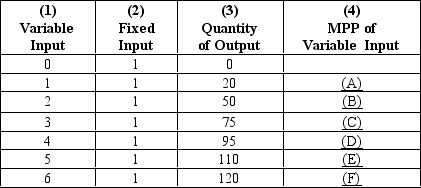 -Refer to Exhibit 22-l.The numbers that go in blanks (C)and (D)are,respectively,
 (Multiple Choice)
5.0/5 (84)
(84) If the marginal cost curve for a firm first declines and then rises,it follows that the MPP of the variable input
(Multiple Choice)
5.0/5 (70)
(70) The reason marginal cost is equal to the change in total cost divided by the change in output,or the change in total variable cost divided by the change in output,is because
(Multiple Choice)
4.9/5 (83)
(83) Suppose that minimum efficient scale as a percentage of U.S.consumption is 5 percent in industry X and it is 10 percent in industry Y.It follows that we would expect to find
(Multiple Choice)
4.9/5 (92)
(92) Exhibit 22-11
 -Refer to Exhibit 22-11.Average total cost of the sixth unit of output is
 (Multiple Choice)
4.9/5 (89)
(89) 
Filters
- Essay(0)
- Multiple Choice(0)
- Short Answer(0)
- True False(0)
- Matching(0)