



 Chat with AI
Exam 22: Production and Costs

Exam 1: What Economics Is About168 Questions
Exam 2: Production Possibilities Frontier Framework152 Questions
Exam 3: Supply and Demand: Theory227 Questions
Exam 4: Prices: Free, Controlled, and Relative107 Questions
Exam 5: Supply, Demand, and Price: Applications83 Questions
Exam 6: Macroeconomic Measurements: Prices and Unemployment129 Questions
Exam 7: Macroeconomic Measurements: GDP and Real GDP138 Questions
Exam 8: Aggregate Demand and Aggregate Supply208 Questions
Exam 9: Classical Macroeconomics and the Self Regulating Economy167 Questions
Exam 10: Keynesian Macroeconomics and Economic Instability: A Critique of the Self-Regulating Economy198 Questions
Exam 11: Fiscal Policy and the Federal Budget164 Questions
Exam 12: Money, Banking,and the Financial System124 Questions
Exam 13: The Federal Reserve System184 Questions
Exam 14: Money and the Economy125 Questions
Exam 15: Monetary Policy176 Questions
Exam 16: Expectations Theory and the Economy146 Questions
Exam 17: Economic Growth: Resources, Technology, Ideas, and Institutions82 Questions
Exam 18: The Financial Crisis of 2007-200970 Questions
Exam 19: Debates in Macroeconomics Over the Role and Effects of Government69 Questions
Exam 20: Elasticity198 Questions
Exam 21: Consumer Choice: Maximizing Utility and Behavioral Economics176 Questions
Exam 22: Production and Costs247 Questions
Exam 23: Perfect Competition191 Questions
Exam 24: Monopoly191 Questions
Exam 25: Monopolistic Competition, Oligopoly, and Game Theory167 Questions
Exam 26: Government and Product Markets: Antitrust and Regulation165 Questions
Exam 27: Factor Markets: With Emphasis on the Labor Market181 Questions
Exam 28: Wages,Unions,and Labor134 Questions
Exam 29: The Distribution of Income and Poverty93 Questions
Exam 30: Interest, Rent, and Profit199 Questions
Exam 31: Market Failure: Externalities, Public Goods, and Asymmetric Information185 Questions
Exam 32: Public Choice and Special-Interest-Group Politics131 Questions
Exam 33: Building Theories to Explain Everyday Life: From Observations to Questions to Theories to Predictions60 Questions
Exam 34: International Trade152 Questions
Exam 35: International Finance119 Questions
Exam 36: Globalization and International Impacts on the Economy136 Questions
Exam 37: The Economic Case For and Against Government: Five Topics Considered82 Questions
Exam 38: Stocks, Bonds, Futures, and Options108 Questions
Exam 39: Agriculture: Problems, Policies, and Unintended Effects149 Questions
Select questions type


Given that fixed costs are constant as output increases,average fixed costs are also constant.
(True/False)
4.9/5  (81)
(81) Five months ago Wilson opened up a health club.Which of the following is an implicit cost related to the health club?
(Multiple Choice)
4.9/5 (76)
(76) Exhibit 22-10
 -Refer to Exhibit 22-10.Marisol encounters diminishing marginal returns in hour
 (Multiple Choice)
4.8/5 (73)
(73) Exhibit 22-6
 -Refer to Exhibit 22-6.The curve labeled "K" represents the firm's __________ cost curve.
 (Multiple Choice)
4.8/5 (69)
(69) Exhibit 22-13
 -Refer to Exhibit 22-13. What dollar amounts go in blanks (V)and (W)?
 (Multiple Choice)
4.8/5 (66)
(66) Which of the following is an example of market coordination?
(Multiple Choice)
4.9/5 (68)
(68) Describe the difference between market coordination and managerial coordination.Give an example of each to support your answer.
(Essay)
4.8/5 (86)
(86) Exhibit 22-5
 -Refer to Exhibit 22-5.Constant returns to scale are present between
 (Multiple Choice)
4.7/5 (78)
(78) A person who does not ignore a sunk cost increases the probability that
(Multiple Choice)
4.8/5 (79)
(79) Costs that do not change with output are called __________ costs.
(Multiple Choice)
4.9/5 (79)
(79) As the marginal physical product of U.S.workers _________________,the marginal cost of goods produced in the U.S.______________ and unit costs _____________. This makes American goods ________________ competitive in the global marketplace.
(Multiple Choice)
4.8/5 (84)
(84) If AFC is $9 at a quantity of output of 100 units,and ATC is $11 at the same quantity of output,it follows that
(Multiple Choice)
4.8/5 (67)
(67) Exhibit 22-2
 -Refer to Exhibit 22-2.What is the average total cost of producing 120 units of output?
 (Multiple Choice)
4.8/5 (73)
(73) Exhibit 22-10
-Refer to Exhibit 22-10.Which of the students has the highest marginal productivity for the fifth hour of studying?
-Refer to Exhibit 22-10.Which of the students has the highest marginal productivity for the fifth hour of studying? (Multiple Choice)
5.0/5 (94)
(94) Exhibit 22-12
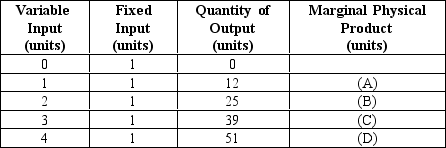 -Refer to Exhibit 22-12 above.The numbers that go in blanks (A),(B),(C),and (D),respectively,are
 (Multiple Choice)
4.9/5 (73)
(73) Exhibit 22-3
 -Refer to Exhibit 22-3.The total cost of producing 45 units of output is
 (Multiple Choice)
4.9/5 (81)
(81) Explain the difference between the law of diminishing marginal returns and diseconomies of scale.
(Essay)
4.7/5 (81)
(81) 
Filters
- Essay(0)
- Multiple Choice(0)
- Short Answer(0)
- True False(0)
- Matching(0)