



 Chat with AI
Exam 22: Production and Costs

Exam 1: What Economics Is About168 Questions
Exam 2: Production Possibilities Frontier Framework152 Questions
Exam 3: Supply and Demand: Theory227 Questions
Exam 4: Prices: Free, Controlled, and Relative107 Questions
Exam 5: Supply, Demand, and Price: Applications83 Questions
Exam 6: Macroeconomic Measurements: Prices and Unemployment129 Questions
Exam 7: Macroeconomic Measurements: GDP and Real GDP138 Questions
Exam 8: Aggregate Demand and Aggregate Supply208 Questions
Exam 9: Classical Macroeconomics and the Self Regulating Economy167 Questions
Exam 10: Keynesian Macroeconomics and Economic Instability: A Critique of the Self-Regulating Economy198 Questions
Exam 11: Fiscal Policy and the Federal Budget164 Questions
Exam 12: Money, Banking,and the Financial System124 Questions
Exam 13: The Federal Reserve System184 Questions
Exam 14: Money and the Economy125 Questions
Exam 15: Monetary Policy176 Questions
Exam 16: Expectations Theory and the Economy146 Questions
Exam 17: Economic Growth: Resources, Technology, Ideas, and Institutions82 Questions
Exam 18: The Financial Crisis of 2007-200970 Questions
Exam 19: Debates in Macroeconomics Over the Role and Effects of Government69 Questions
Exam 20: Elasticity198 Questions
Exam 21: Consumer Choice: Maximizing Utility and Behavioral Economics176 Questions
Exam 22: Production and Costs247 Questions
Exam 23: Perfect Competition191 Questions
Exam 24: Monopoly191 Questions
Exam 25: Monopolistic Competition, Oligopoly, and Game Theory167 Questions
Exam 26: Government and Product Markets: Antitrust and Regulation165 Questions
Exam 27: Factor Markets: With Emphasis on the Labor Market181 Questions
Exam 28: Wages,Unions,and Labor134 Questions
Exam 29: The Distribution of Income and Poverty93 Questions
Exam 30: Interest, Rent, and Profit199 Questions
Exam 31: Market Failure: Externalities, Public Goods, and Asymmetric Information185 Questions
Exam 32: Public Choice and Special-Interest-Group Politics131 Questions
Exam 33: Building Theories to Explain Everyday Life: From Observations to Questions to Theories to Predictions60 Questions
Exam 34: International Trade152 Questions
Exam 35: International Finance119 Questions
Exam 36: Globalization and International Impacts on the Economy136 Questions
Exam 37: The Economic Case For and Against Government: Five Topics Considered82 Questions
Exam 38: Stocks, Bonds, Futures, and Options108 Questions
Exam 39: Agriculture: Problems, Policies, and Unintended Effects149 Questions
Select questions type


__________ scale exist when inputs are increased by some percentage and output increases by a smaller percentage,whereas __________ scale exist when inputs are increased by some percentage and output increases by the same percentage.
(Multiple Choice)
4.7/5  (87)
(87) Accounting profit equals economic profit if __________ equals __________.
(Multiple Choice)
4.9/5 (74)
(74) Economies of scale are exclusively a long-run phenomenon,while the law of diminishing returns applies to both the short-run and to the long-run.
(True/False)
4.8/5 (88)
(88) There is a monitorless team (firm)of 10 persons.The 10 persons agree to work together and split the revenue (they earn)equally.In this setting,the cost of shirking to an individual is
(Multiple Choice)
4.8/5 (81)
(81) Exhibit 22-1
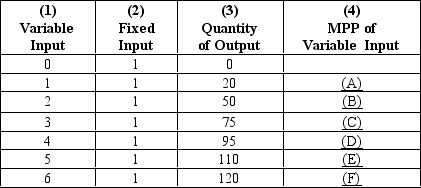 -Refer to Exhibit 22-1.Diminishing marginal returns set in with the addition of which unit of the variable input?
 (Multiple Choice)
4.9/5 (72)
(72) If the marginal cost (MC)curve is rising and is above the average fixed cost (AFC)curve,then
(Multiple Choice)
4.9/5 (69)
(69) Cy recently went into the business of producing and selling cardboard boxes.For this business,which of the following is most likely to be a fixed cost?
(Multiple Choice)
4.8/5 (80)
(80) Exhibit 22-14
 Assume that labor is the only variable input.
-Refer to Exhibit 22-14.What is the marginal cost of producing this good with 3 and 4 laborers working [blanks (G)and (H)],respectively?
Assume that labor is the only variable input.
-Refer to Exhibit 22-14.What is the marginal cost of producing this good with 3 and 4 laborers working [blanks (G)and (H)],respectively? (Multiple Choice)
4.9/5 (66)
(66) Economies of scale are said to exist when inputs are increased by some percentage and output increases by a(n)__________ percentage,causing unit costs to __________.
(Multiple Choice)
4.8/5 (79)
(79) Exhibit 22-5
 -Refer to Exhibit 22-5.Diseconomies of scale are present between
 (Multiple Choice)
4.8/5 (70)
(70) Noble Prizewinner Ronald Coase argued that firms exist in order to reduce transaction costs.
(True/False)
4.9/5 (86)
(86) One of the reasons why economies of scale exist is that the opportunity for labor specialization increases as the size of the firm grows.
(True/False)
4.9/5 (75)
(75) There is a link between production and cost.We know this because
(Multiple Choice)
4.9/5 (88)
(88) Exhibit 22-3
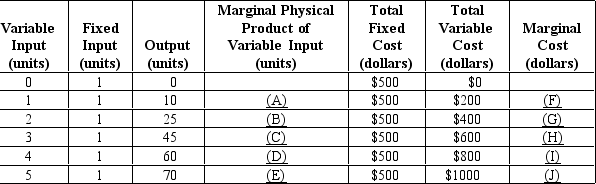 -Refer to Exhibit 22-3.The average fixed cost of producing 25 units of output is
 (Multiple Choice)
4.8/5 (70)
(70) Exhibit 22-11
 -Refer to Exhibit 22-11.Marginal cost of the first unit of output is
 (Multiple Choice)
4.9/5 (81)
(81) Which of the following is true of average fixed costs in the long run?
(Multiple Choice)
4.9/5 (75)
(75) Exhibit 22-13
 -Refer to Exhibit 22-13. What dollar amounts go in blanks (E)and (F)?
 (Multiple Choice)
4.9/5 (86)
(86) 
Filters
- Essay(0)
- Multiple Choice(0)
- Short Answer(0)
- True False(0)
- Matching(0)