



 Chat with AI
Exam 4: Prices: Free, Controlled, and Relative

Exam 1: What Economics Is About168 Questions
Exam 2: Production Possibilities Frontier Framework152 Questions
Exam 3: Supply and Demand: Theory227 Questions
Exam 4: Prices: Free, Controlled, and Relative107 Questions
Exam 5: Supply, Demand, and Price: Applications83 Questions
Exam 6: Macroeconomic Measurements: Prices and Unemployment129 Questions
Exam 7: Macroeconomic Measurements: GDP and Real GDP138 Questions
Exam 8: Aggregate Demand and Aggregate Supply208 Questions
Exam 9: Classical Macroeconomics and the Self Regulating Economy167 Questions
Exam 10: Keynesian Macroeconomics and Economic Instability: A Critique of the Self-Regulating Economy198 Questions
Exam 11: Fiscal Policy and the Federal Budget164 Questions
Exam 12: Money, Banking,and the Financial System124 Questions
Exam 13: The Federal Reserve System184 Questions
Exam 14: Money and the Economy125 Questions
Exam 15: Monetary Policy176 Questions
Exam 16: Expectations Theory and the Economy146 Questions
Exam 17: Economic Growth: Resources, Technology, Ideas, and Institutions82 Questions
Exam 18: The Financial Crisis of 2007-200970 Questions
Exam 19: Debates in Macroeconomics Over the Role and Effects of Government69 Questions
Exam 20: Elasticity198 Questions
Exam 21: Consumer Choice: Maximizing Utility and Behavioral Economics176 Questions
Exam 22: Production and Costs247 Questions
Exam 23: Perfect Competition191 Questions
Exam 24: Monopoly191 Questions
Exam 25: Monopolistic Competition, Oligopoly, and Game Theory167 Questions
Exam 26: Government and Product Markets: Antitrust and Regulation165 Questions
Exam 27: Factor Markets: With Emphasis on the Labor Market181 Questions
Exam 28: Wages,Unions,and Labor134 Questions
Exam 29: The Distribution of Income and Poverty93 Questions
Exam 30: Interest, Rent, and Profit199 Questions
Exam 31: Market Failure: Externalities, Public Goods, and Asymmetric Information185 Questions
Exam 32: Public Choice and Special-Interest-Group Politics131 Questions
Exam 33: Building Theories to Explain Everyday Life: From Observations to Questions to Theories to Predictions60 Questions
Exam 34: International Trade152 Questions
Exam 35: International Finance119 Questions
Exam 36: Globalization and International Impacts on the Economy136 Questions
Exam 37: The Economic Case For and Against Government: Five Topics Considered82 Questions
Exam 38: Stocks, Bonds, Futures, and Options108 Questions
Exam 39: Agriculture: Problems, Policies, and Unintended Effects149 Questions
Select questions type


Exhibit 4-3
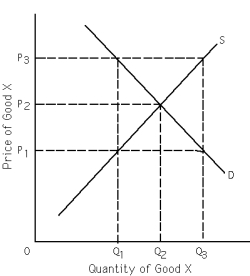 -Refer to Exhibit 4-3.Which of the following is true?
Free
(Multiple Choice)
4.9/5  (78)
(78) Correct Answer: Verified
A
If the relative price of one unit of good X is 5 units of good Y,then it follows that the absolute price of good X can be __________ and the absolute price of good Y can be __________.
Free
(Multiple Choice)
4.8/5 (75)
(75) Correct Answer:Verified
VerifiedB
If the relative price of one unit of good Y is 0.25 units of good Z,then it follows that the absolute price of good Z can be __________ and the absolute price of good Y can be __________.
Free
(Multiple Choice)
4.8/5 (86)
(86) Correct Answer:Verified
VerifiedE
The absolute price of a good is the price of that good in terms of another good.
(True/False)
4.9/5 (95)
(95) If the price of good X is $90 and the price of good Y is $30,it follows that the relative price of one unit of good Y is ___________ unit(s)of good X.
(Multiple Choice)
4.9/5 (88)
(88) Situation 4-1
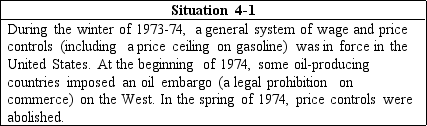 -Refer to Situation 4-1.Because price controls were in effect at the time the embargo occurred,an economist would predict that
 (Multiple Choice)
4.9/5 (79)
(79) Exhibit 4-3
-Refer to Exhibit 4-3.Which of the following is true?
-Refer to Exhibit 4-3.Which of the following is true? (Multiple Choice)
4.8/5 (96)
(96) Exhibit 4-2
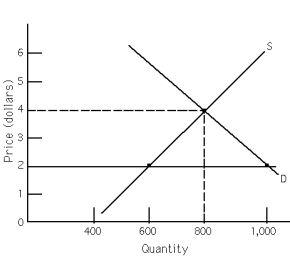 -Exhibit 4-2 represents the orange juice market.The horizontal line at $2 shows a price ceiling imposed by the government.Which of the following statements is true at this price?
 (Multiple Choice)
4.8/5 (85)
(85) If the absolute price of a computer is $1,500 and the relative price of a dining room table is 2 computers,it follows that the absolute price of a dining room table is
(Multiple Choice)
4.8/5 (74)
(74) A minimum wage law (that sets the minimum wage above the equilibrium wage)can be expected to
(Multiple Choice)
4.7/5 (77)
(77) Exhibit 4-4
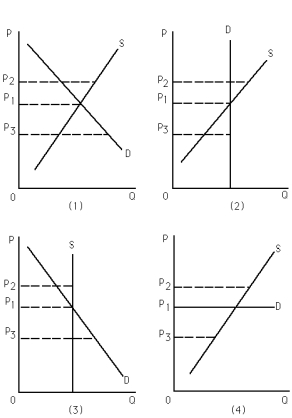 -Refer to Exhibit 4-4.Which of the following is false?
 (Multiple Choice)
4.8/5 (81)
(81) Exhibit 4-8
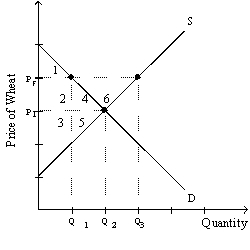 -Refer to Exhibit 4-8. Suppose that wheat producers lobby the government for a price floor and receive one. This price floor is set at PF. What is the quantity of wheat purchased at PF?
 (Multiple Choice)
4.9/5 (86)
(86) In 1973 and 1979,the U.S.federal government imposed price ceilings on gasoline which resulted in surpluses of gasoline.
(True/False)
4.8/5 (88)
(88) A price floor (set above the equilibrium price)on rice will
(Multiple Choice)
4.8/5 (83)
(83) Jake is an excellent barber.However,all customers who come to him for a haircut must buy a bottle of shampoo.This type of arrangement is known as
(Multiple Choice)
4.8/5 (87)
(87) Exhibit 4-8
-Refer to Exhibit 4-8. Suppose that wheat producers lobby the government for a price floor and receive one. This price floor is set at PF. What is the size of the total surplus at PF?
-Refer to Exhibit 4-8. Suppose that wheat producers lobby the government for a price floor and receive one. This price floor is set at PF. What is the size of the total surplus at PF? (Multiple Choice)
4.9/5 (85)
(85) In the market for a given product,when a price floor is set above the equilibrium price the result will be
(Multiple Choice)
4.8/5 (88)
(88) Exhibit 4-4
-Refer to Exhibit 4-4.Which of the following is false?
-Refer to Exhibit 4-4.Which of the following is false? (Multiple Choice)
4.9/5 (79)
(79) 
Filters
- Essay(0)
- Multiple Choice(0)
- Short Answer(0)
- True False(0)
- Matching(0)