



 Chat with AI
Exam 23: Perfect Competition

Exam 1: What Economics Is About168 Questions
Exam 2: Production Possibilities Frontier Framework152 Questions
Exam 3: Supply and Demand: Theory227 Questions
Exam 4: Prices: Free, Controlled, and Relative107 Questions
Exam 5: Supply, Demand, and Price: Applications83 Questions
Exam 6: Macroeconomic Measurements: Prices and Unemployment129 Questions
Exam 7: Macroeconomic Measurements: GDP and Real GDP138 Questions
Exam 8: Aggregate Demand and Aggregate Supply208 Questions
Exam 9: Classical Macroeconomics and the Self Regulating Economy167 Questions
Exam 10: Keynesian Macroeconomics and Economic Instability: A Critique of the Self-Regulating Economy198 Questions
Exam 11: Fiscal Policy and the Federal Budget164 Questions
Exam 12: Money, Banking,and the Financial System124 Questions
Exam 13: The Federal Reserve System184 Questions
Exam 14: Money and the Economy125 Questions
Exam 15: Monetary Policy176 Questions
Exam 16: Expectations Theory and the Economy146 Questions
Exam 17: Economic Growth: Resources, Technology, Ideas, and Institutions82 Questions
Exam 18: The Financial Crisis of 2007-200970 Questions
Exam 19: Debates in Macroeconomics Over the Role and Effects of Government69 Questions
Exam 20: Elasticity198 Questions
Exam 21: Consumer Choice: Maximizing Utility and Behavioral Economics176 Questions
Exam 22: Production and Costs247 Questions
Exam 23: Perfect Competition191 Questions
Exam 24: Monopoly191 Questions
Exam 25: Monopolistic Competition, Oligopoly, and Game Theory167 Questions
Exam 26: Government and Product Markets: Antitrust and Regulation165 Questions
Exam 27: Factor Markets: With Emphasis on the Labor Market181 Questions
Exam 28: Wages,Unions,and Labor134 Questions
Exam 29: The Distribution of Income and Poverty93 Questions
Exam 30: Interest, Rent, and Profit199 Questions
Exam 31: Market Failure: Externalities, Public Goods, and Asymmetric Information185 Questions
Exam 32: Public Choice and Special-Interest-Group Politics131 Questions
Exam 33: Building Theories to Explain Everyday Life: From Observations to Questions to Theories to Predictions60 Questions
Exam 34: International Trade152 Questions
Exam 35: International Finance119 Questions
Exam 36: Globalization and International Impacts on the Economy136 Questions
Exam 37: The Economic Case For and Against Government: Five Topics Considered82 Questions
Exam 38: Stocks, Bonds, Futures, and Options108 Questions
Exam 39: Agriculture: Problems, Policies, and Unintended Effects149 Questions
Select questions type


For a perfectly competitive firm,MR = MC at 250 units of output.At 250 units,ATC is greater than AVC.It necessarily follows that

Free
(Multiple Choice)
4.9/5  (69)
(69) Correct Answer: Verified
E
Assume that a constant-cost industry experiences an increase in demand.In the long run,this will
Free
(Multiple Choice)
4.9/5 (82)
(82) Correct Answer:Verified
VerifiedB
A perfectly competitive firm should increase its level of production as long as
Free
(Multiple Choice)
4.9/5 (75)
(75) Correct Answer:Verified
VerifiedC
Consider the following data: equilibrium price = $10,quantity of output produced = 100 units,average total cost = $13,and average variable cost = $7.What will the firm do and why?
(Multiple Choice)
4.9/5 (81)
(81) The perfectly competitive firm's short-run supply curve is that portion of its MC curve that lies above its AFC curve.
(True/False)
4.8/5 (86)
(86) Which of the following statements about a perfectly competitive firm is necessarily false?
(Multiple Choice)
4.9/5 (81)
(81) Assume that a decreasing-cost industry experiences an increase in demand.In the long run,this will
(Multiple Choice)
4.9/5 (79)
(79) One of the economic reasons for the U.S.postal service issuing and selling collector's stamps is that
(Multiple Choice)
4.9/5 (83)
(83) When an industry is described as a decreasing-cost,increasing-cost,or constant-cost industry,the "cost" that is being referred to is
(Multiple Choice)
4.9/5 (73)
(73) In the theory of perfect competition,the market demand curve is __________ and the firm's demand curve is __________.
(Multiple Choice)
4.9/5 (86)
(86) Equilibrium price is $10 in a perfectly competitive market.For a perfectly competitive firm,MR = MC at 233 units of output.At 233 units,ATC is $12,and AVC is $9.The best policy for this firm is to __________ in the short run.Also,total fixed cost equals __________ for this firm.
(Multiple Choice)
4.8/5 (86)
(86) Exhibit 23-6
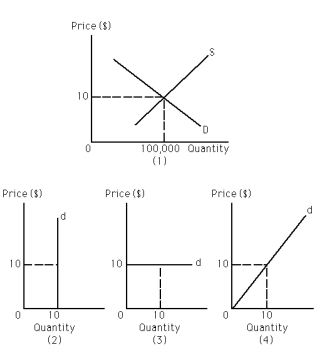 -Refer to Exhibit 23-6.A perfectly competitive firm operating in the market depicted in graph (1)is producing 311 units of output at the profit-maximizing level.What is the marginal revenue of the 312th unit?
 (Multiple Choice)
4.8/5 (79)
(79) A firm operating in a perfectly competitive market finds itself producing at an output level for which marginal revenue is lower than marginal cost.In order to maximize profits (or minimize losses),the firm should
(Multiple Choice)
4.9/5 (81)
(81) Equilibrium price is $19 in a perfectly competitive market.For a perfectly competitive firm,MR = MC at 120 units of output.At 120 units,ATC is $11,and AVC is $8.The best policy for this firm is to __________ in the short run.Also,this firm earns __________ of __________ if it produces and sells 120 units.Finally,the difference between total revenue and total fixed cost for this firm is __________.
(Multiple Choice)
4.7/5 (87)
(87) When a firm produces the quantity of output where price equals marginal cost,it has achieved resource allocative efficiency.
(True/False)
4.7/5 (80)
(80) List and describe the four assumptions that underlie the theory of perfect competition.
(Essay)
4.9/5 (89)
(89) When the perfectly competitive firm produces the quantity of output at which marginal revenue equals marginal cost,it naturally
(Multiple Choice)
4.7/5 (74)
(74) 
Filters
- Essay(0)
- Multiple Choice(0)
- Short Answer(0)
- True False(0)
- Matching(0)