



 Chat with AI
Exam 4: Prices: Free, Controlled, and Relative

Exam 1: What Economics Is About168 Questions
Exam 2: Production Possibilities Frontier Framework152 Questions
Exam 3: Supply and Demand: Theory227 Questions
Exam 4: Prices: Free, Controlled, and Relative107 Questions
Exam 5: Supply, Demand, and Price: Applications83 Questions
Exam 6: Macroeconomic Measurements: Prices and Unemployment129 Questions
Exam 7: Macroeconomic Measurements: GDP and Real GDP138 Questions
Exam 8: Aggregate Demand and Aggregate Supply208 Questions
Exam 9: Classical Macroeconomics and the Self Regulating Economy167 Questions
Exam 10: Keynesian Macroeconomics and Economic Instability: A Critique of the Self-Regulating Economy198 Questions
Exam 11: Fiscal Policy and the Federal Budget164 Questions
Exam 12: Money, Banking,and the Financial System124 Questions
Exam 13: The Federal Reserve System184 Questions
Exam 14: Money and the Economy125 Questions
Exam 15: Monetary Policy176 Questions
Exam 16: Expectations Theory and the Economy146 Questions
Exam 17: Economic Growth: Resources, Technology, Ideas, and Institutions82 Questions
Exam 18: The Financial Crisis of 2007-200970 Questions
Exam 19: Debates in Macroeconomics Over the Role and Effects of Government69 Questions
Exam 20: Elasticity198 Questions
Exam 21: Consumer Choice: Maximizing Utility and Behavioral Economics176 Questions
Exam 22: Production and Costs247 Questions
Exam 23: Perfect Competition191 Questions
Exam 24: Monopoly191 Questions
Exam 25: Monopolistic Competition, Oligopoly, and Game Theory167 Questions
Exam 26: Government and Product Markets: Antitrust and Regulation165 Questions
Exam 27: Factor Markets: With Emphasis on the Labor Market181 Questions
Exam 28: Wages,Unions,and Labor134 Questions
Exam 29: The Distribution of Income and Poverty93 Questions
Exam 30: Interest, Rent, and Profit199 Questions
Exam 31: Market Failure: Externalities, Public Goods, and Asymmetric Information185 Questions
Exam 32: Public Choice and Special-Interest-Group Politics131 Questions
Exam 33: Building Theories to Explain Everyday Life: From Observations to Questions to Theories to Predictions60 Questions
Exam 34: International Trade152 Questions
Exam 35: International Finance119 Questions
Exam 36: Globalization and International Impacts on the Economy136 Questions
Exam 37: The Economic Case For and Against Government: Five Topics Considered82 Questions
Exam 38: Stocks, Bonds, Futures, and Options108 Questions
Exam 39: Agriculture: Problems, Policies, and Unintended Effects149 Questions
Select questions type


Exhibit 4-5
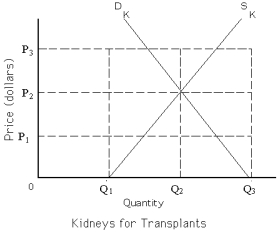 -Refer to Exhibit 4-5.Suppose the government imposes a price ceiling at P = $0.The result will be a
 (Multiple Choice)
4.9/5  (76)
(76) If the price of good X is $100 and the price of good Y is $40,it follows that the relative price of one unit of good Y is ___________ unit(s)of good X.
(Multiple Choice)
4.9/5 (75)
(75) Suppose that the price of butter is $3 per pound and the price of margarine is $2 per pound. If the price of butter rises to $3.90 and the price of margarine rises to $2.20,then the absolute price of butter has _______________ and the relative price of butter has _______________.
(Multiple Choice)
4.8/5 (61)
(61) It is possible for the absolute price of a good to rise at the same time that the good is becoming relatively cheaper.
(True/False)
4.7/5 (84)
(84) Exhibit 4-7
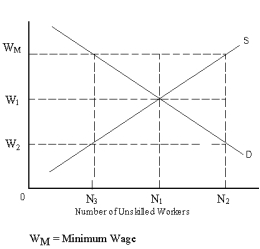 -Refer to Exhibit 4-7.How many unskilled workers are employed at the minimum wage?
 (Multiple Choice)
4.9/5 (76)
(76) Exhibit 4-2
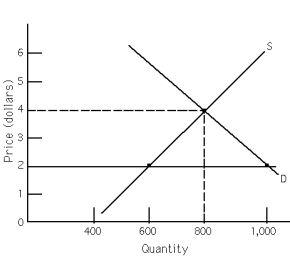 -Exhibit 4-2 represents the orange juice market.The horizontal line represents a price ceiling imposed by the government.Which of the following is true?
 (Multiple Choice)
4.9/5 (78)
(78) One of the effects of a price floor (set above equilibrium price)is
(Multiple Choice)
4.8/5 (91)
(91) Exhibit 4-1
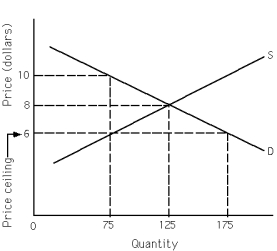 -Refer to Exhibit 4-1.Some buyers will offer sellers $7 per unit instead of the $6 price ceiling because
 (Multiple Choice)
4.9/5 (84)
(84) Exhibit 4-7
-Refer to Exhibit 4-7.The number of unskilled workers who want to work at the minimum wage is
-Refer to Exhibit 4-7.The number of unskilled workers who want to work at the minimum wage is (Multiple Choice)
4.8/5 (79)
(79) Exhibit 4-9
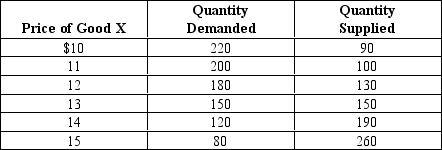 -Refer to Exhibit 4-9. Suppose that the government imposes a price ceiling at a price of $11. How many fewer units would be exchanged with the price ceiling than in a free market?
 (Multiple Choice)
4.9/5 (96)
(96) Exhibit 4-9
-Refer to Exhibit 4-9. Suppose that the government imposes a price ceiling at a price of $10. _________ units would be exchanged in a free market,and ____________ units would be exchanged with the price ceiling in effect.
-Refer to Exhibit 4-9. Suppose that the government imposes a price ceiling at a price of $10. _________ units would be exchanged in a free market,and ____________ units would be exchanged with the price ceiling in effect. (Multiple Choice)
4.9/5 (85)
(85) Exhibit 4-5
-Refer to Exhibit 4-5.If a free market were allowed in the transplanted kidney market,then the equilibrium price would be P2.The number of kidneys transplanted would increase by _________ compared to the number transplanted at a price ceiling of P= $0.
-Refer to Exhibit 4-5.If a free market were allowed in the transplanted kidney market,then the equilibrium price would be P2.The number of kidneys transplanted would increase by _________ compared to the number transplanted at a price ceiling of P= $0. (Multiple Choice)
4.8/5 (81)
(81) A price floor is usually set _____________ the equilibrium price.
(Multiple Choice)
4.8/5 (68)
(68) Situation 4-1
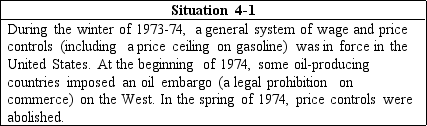 -Refer to Situation 4-1.An economist would predict that once price controls were abolished in the spring of 1974,
 (Multiple Choice)
4.8/5 (75)
(75) Exhibit 4-3
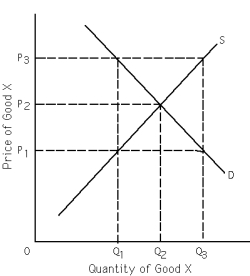 -Refer to Exhibit 4-3.If P1 is a price ceiling,the highest price for good Y,which is tied (a tie-in sale)to good X,is
 (Multiple Choice)
4.9/5 (77)
(77) Exhibit 4-8
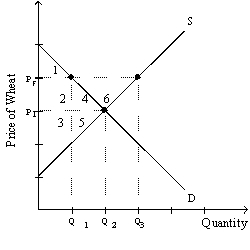 -Refer to Exhibit 4-8. Suppose that wheat producers lobby the government for a price floor and receive one. This price floor is set at PF. What has happened to the consumers' surplus as a result of the imposition of the price floor?
 (Multiple Choice)
4.9/5 (82)
(82) A deadweight loss is the loss to society of not producing the supply-and-demand determined level of output.
(True/False)
4.9/5 (81)
(81) 
Filters
- Essay(0)
- Multiple Choice(0)
- Short Answer(0)
- True False(0)
- Matching(0)