



 Chat with AI
Exam 28: Wages,Unions,and Labor

Exam 1: What Economics Is About168 Questions
Exam 2: Production Possibilities Frontier Framework152 Questions
Exam 3: Supply and Demand: Theory227 Questions
Exam 4: Prices: Free, Controlled, and Relative107 Questions
Exam 5: Supply, Demand, and Price: Applications83 Questions
Exam 6: Macroeconomic Measurements: Prices and Unemployment129 Questions
Exam 7: Macroeconomic Measurements: GDP and Real GDP138 Questions
Exam 8: Aggregate Demand and Aggregate Supply208 Questions
Exam 9: Classical Macroeconomics and the Self Regulating Economy167 Questions
Exam 10: Keynesian Macroeconomics and Economic Instability: A Critique of the Self-Regulating Economy198 Questions
Exam 11: Fiscal Policy and the Federal Budget164 Questions
Exam 12: Money, Banking,and the Financial System124 Questions
Exam 13: The Federal Reserve System184 Questions
Exam 14: Money and the Economy125 Questions
Exam 15: Monetary Policy176 Questions
Exam 16: Expectations Theory and the Economy146 Questions
Exam 17: Economic Growth: Resources, Technology, Ideas, and Institutions82 Questions
Exam 18: The Financial Crisis of 2007-200970 Questions
Exam 19: Debates in Macroeconomics Over the Role and Effects of Government69 Questions
Exam 20: Elasticity198 Questions
Exam 21: Consumer Choice: Maximizing Utility and Behavioral Economics176 Questions
Exam 22: Production and Costs247 Questions
Exam 23: Perfect Competition191 Questions
Exam 24: Monopoly191 Questions
Exam 25: Monopolistic Competition, Oligopoly, and Game Theory167 Questions
Exam 26: Government and Product Markets: Antitrust and Regulation165 Questions
Exam 27: Factor Markets: With Emphasis on the Labor Market181 Questions
Exam 28: Wages,Unions,and Labor134 Questions
Exam 29: The Distribution of Income and Poverty93 Questions
Exam 30: Interest, Rent, and Profit199 Questions
Exam 31: Market Failure: Externalities, Public Goods, and Asymmetric Information185 Questions
Exam 32: Public Choice and Special-Interest-Group Politics131 Questions
Exam 33: Building Theories to Explain Everyday Life: From Observations to Questions to Theories to Predictions60 Questions
Exam 34: International Trade152 Questions
Exam 35: International Finance119 Questions
Exam 36: Globalization and International Impacts on the Economy136 Questions
Exam 37: The Economic Case For and Against Government: Five Topics Considered82 Questions
Exam 38: Stocks, Bonds, Futures, and Options108 Questions
Exam 39: Agriculture: Problems, Policies, and Unintended Effects149 Questions
Select questions type


What relationship exists between marginal factor cost (MFC)and wage for a monopsony firm? Explain why this is so.
(Essay)
4.9/5  (66)
(66) Exhibit 28-12
 -Refer to Exhibit 28-12.As the firm increases employment from 4 to 5 workers,its marginal factor cost (MFC)is
 (Multiple Choice)
4.8/5 (67)
(67) In the case of a monopsony,higher wage rates (over some range)do not necessarily imply fewer persons working.
(True/False)
4.9/5 (77)
(77) In the United States,the percentage of national income that goes to labor (union plus nonunion)was higher when union membership was relatively high and unions were strong,compared to when union membership was relatively low.
(True/False)
4.7/5 (76)
(76) Labor union A faces a greater cutback in labor for a given wage increase than does labor union B.It follows that the
(Multiple Choice)
4.9/5 (89)
(89) Exhibit 28-8
 -Refer to Exhibit 28-8.In the absence of collective bargaining,what quantity of labor would the profit-maximizing monoposonist hire?
 (Multiple Choice)
4.8/5 (79)
(79) Among the stated objectives of the National Collegiate Athletic Association (NCAA)regulations is to
(Multiple Choice)
4.7/5 (99)
(99) Exhibit 28-7
 -Refer to Exhibit 28-7.For each quantity of labor hired (after the first worker),marginal factor cost (MFC)will
 (Multiple Choice)
4.8/5 (87)
(87) Exhibit 28-10
 -Refer to Exhibit 28-10.If the firm in the exhibit is a monopsony,it will hire __________ quantity of labor and pay its workers the wage rate of __________.
 (Multiple Choice)
4.8/5 (78)
(78) Exhibit 28-8
-Refer to Exhibit 28-8.In the absence of collective bargaining,what wage rate would the profit-maximizing monoposonist pay?
-Refer to Exhibit 28-8.In the absence of collective bargaining,what wage rate would the profit-maximizing monoposonist pay? (Multiple Choice)
5.0/5 (77)
(77) Exhibit 28-8
-Refer to Exhibit 28-8.Suppose that initially there is no collective bargaining and the monoposonist maximizes profit.Then the workers form a union and negotiate a wage of W?.What will happen to the total wage bill?
-Refer to Exhibit 28-8.Suppose that initially there is no collective bargaining and the monoposonist maximizes profit.Then the workers form a union and negotiate a wage of W?.What will happen to the total wage bill? (Multiple Choice)
4.8/5 (80)
(80) Exhibit 28-6
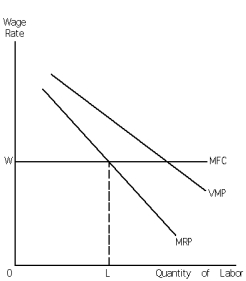 -Unions typically argue that state right-to-work laws
 (Multiple Choice)
4.8/5 (73)
(73) Exhibit 28-12
-Refer to Exhibit 28-12.For each quantity of labor hired (after the first worker),marginal factor cost will be
-Refer to Exhibit 28-12.For each quantity of labor hired (after the first worker),marginal factor cost will be (Multiple Choice)
4.8/5 (78)
(78) Exhibit 28-11
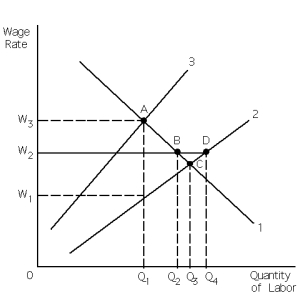 -Refer to Exhibit 28-11.The firm in the exhibit is a monopsony.We have deliberately not identified the three curves in the exhibit.They are simply curves 1,2,and 3.If (union)collective bargaining with the monopsony guarantees the wage rate that workers will be paid is W2,then the factor supply curve is
 (Multiple Choice)
4.9/5 (75)
(75) Exhibit 28-7
-Refer to Exhibit 28-7.As the firm increases employment from 30 to 40 workers,its total labor cost
-Refer to Exhibit 28-7.As the firm increases employment from 30 to 40 workers,its total labor cost (Multiple Choice)
4.9/5 (75)
(75) A monopsonist firm faces an upward sloping supply of labor curve and its marginal factor cost curve lies below its labor supply curve.
(True/False)
4.8/5 (79)
(79) 
Filters
- Essay(0)
- Multiple Choice(0)
- Short Answer(0)
- True False(0)
- Matching(0)