



 Chat with AI
Exam 28: Wages,Unions,and Labor

Exam 1: What Economics Is About168 Questions
Exam 2: Production Possibilities Frontier Framework152 Questions
Exam 3: Supply and Demand: Theory227 Questions
Exam 4: Prices: Free, Controlled, and Relative107 Questions
Exam 5: Supply, Demand, and Price: Applications83 Questions
Exam 6: Macroeconomic Measurements: Prices and Unemployment129 Questions
Exam 7: Macroeconomic Measurements: GDP and Real GDP138 Questions
Exam 8: Aggregate Demand and Aggregate Supply208 Questions
Exam 9: Classical Macroeconomics and the Self Regulating Economy167 Questions
Exam 10: Keynesian Macroeconomics and Economic Instability: A Critique of the Self-Regulating Economy198 Questions
Exam 11: Fiscal Policy and the Federal Budget164 Questions
Exam 12: Money, Banking,and the Financial System124 Questions
Exam 13: The Federal Reserve System184 Questions
Exam 14: Money and the Economy125 Questions
Exam 15: Monetary Policy176 Questions
Exam 16: Expectations Theory and the Economy146 Questions
Exam 17: Economic Growth: Resources, Technology, Ideas, and Institutions82 Questions
Exam 18: The Financial Crisis of 2007-200970 Questions
Exam 19: Debates in Macroeconomics Over the Role and Effects of Government69 Questions
Exam 20: Elasticity198 Questions
Exam 21: Consumer Choice: Maximizing Utility and Behavioral Economics176 Questions
Exam 22: Production and Costs247 Questions
Exam 23: Perfect Competition191 Questions
Exam 24: Monopoly191 Questions
Exam 25: Monopolistic Competition, Oligopoly, and Game Theory167 Questions
Exam 26: Government and Product Markets: Antitrust and Regulation165 Questions
Exam 27: Factor Markets: With Emphasis on the Labor Market181 Questions
Exam 28: Wages,Unions,and Labor134 Questions
Exam 29: The Distribution of Income and Poverty93 Questions
Exam 30: Interest, Rent, and Profit199 Questions
Exam 31: Market Failure: Externalities, Public Goods, and Asymmetric Information185 Questions
Exam 32: Public Choice and Special-Interest-Group Politics131 Questions
Exam 33: Building Theories to Explain Everyday Life: From Observations to Questions to Theories to Predictions60 Questions
Exam 34: International Trade152 Questions
Exam 35: International Finance119 Questions
Exam 36: Globalization and International Impacts on the Economy136 Questions
Exam 37: The Economic Case For and Against Government: Five Topics Considered82 Questions
Exam 38: Stocks, Bonds, Futures, and Options108 Questions
Exam 39: Agriculture: Problems, Policies, and Unintended Effects149 Questions
Select questions type


If union action leads to a rise in the relative price of factors that are substitutes for union labor,
(Multiple Choice)
4.8/5  (92)
(92) Exhibit 28-7
 -Refer to Exhibit 28-7.The marginal factor cost of increasing employment from 20 to 30 workers
 (Multiple Choice)
4.9/5 (80)
(80) When firm A hires one worker it pays $8 an hour and its total labor cost is $8.When it hires a second worker,it has to pay $8.50 to each of its two workers and its total labor cost is $17.When it hires a third worker,it has to pay $9 to each of its three workers and its total labor cost is $27.For firm A,
(Multiple Choice)
4.9/5 (81)
(81) An economist states,"In the case of monopsony,a minimum wage can increase the number of persons working,but in the case of perfect competition,a minimum wage decreases the number of persons working." This economist
(Multiple Choice)
4.9/5 (71)
(71) A profit-maximizing monopsonist will pay a wage rate that is less than the marginal factor cost.
(True/False)
4.8/5 (78)
(78) In a monopsony model of the labor market,as more labor is hired,the marginal factor cost of labor
(Multiple Choice)
4.8/5 (75)
(75) Exhibit 28-10
 -Refer to Exhibit 28-10.If the firm in the exhibit is a monopsony,then the curve represented by the number 2 is its __________ curve,and the curve represented by the number 3 is its __________ curve.
 (Multiple Choice)
4.9/5 (79)
(79) It is possible for an increase in minimum wage to increase the number of workers hired in a competitive labor market,but not in a monopsony setting.
(True/False)
4.9/5 (79)
(79) Exhibit 28-12
 -Refer to Exhibit 28-12. The profit-maximizing number of workers to hire for this firm is
 (Multiple Choice)
4.7/5 (80)
(80) The total wage bill of a union will be maximized when the elasticity of demand for labor is unit elastic.
(True/False)
5.0/5 (85)
(85) If a labor union specifies that certain jobs can only be done by certain people (for example,only electricians can do electrical work),it is likely trying to
(Multiple Choice)
4.8/5 (74)
(74) A firm that is the sole buyer in a factor market is known as a
(Multiple Choice)
4.8/5 (76)
(76) Within the perfectly competitive market structure,consider a labor union that manages to obtain higher wages for its members.At the time the union obtains higher wages,the perfectly competitive firms are earning positive economic profits.It follows that
(Multiple Choice)
4.7/5 (86)
(86) Exhibit 28-11
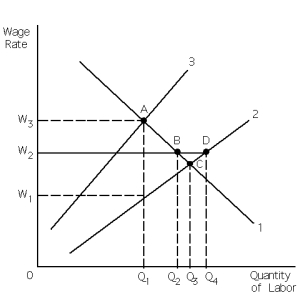 -Refer to Exhibit 28-11.The firm in the exhibit is a monopsony.We have deliberately not identified the three curves in the exhibit.They are simply curves 1,2,and 3.If (union)collective bargaining with the monopsony guarantees the wage rate that workers will be paid is W2,then how many more workers will the monopsony hire than it would hire if it could pay its chosen (or preferred)wage?
 (Multiple Choice)
4.8/5 (58)
(58) It is unlikely that very many (pure)monopsony firms exist today,given that workers are increasingly mobile.
(True/False)
4.9/5 (86)
(86) Exhibit 28-6
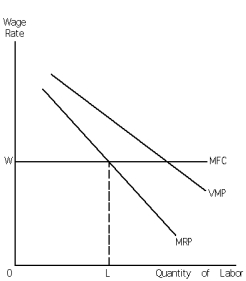 -Refer to Exhibit 28-6.L and W are the equilibrium quantity of labor employed and the wage rate respectively.A person arguing that a worker is being exploited if she is paid less than the value of her marginal product would say that the exhibit is an illustration of the fact that
 (Multiple Choice)
4.8/5 (70)
(70) Exhibit 28-3
 -Refer to Exhibit 28-3.In the absence of collective bargaining,if the profit-maximizing monopsonist were to pay workers what their services were worth to it,it would pay
 (Multiple Choice)
4.9/5 (78)
(78) 
Filters
- Essay(0)
- Multiple Choice(0)
- Short Answer(0)
- True False(0)
- Matching(0)