



 Chat with AI
Exam 7: Enzyme Mechanisms

Exam 1: Principles of Biochemistry100 Questions
Exam 2: Physical Biochemistry: Energy Conversion, Water, and Membranes100 Questions
Exam 3: Nucleic Acid Structure and Function100 Questions
Exam 4: Protein Structure100 Questions
Exam 5: Methods in Protein Biochemistry100 Questions
Exam 6: Protein Function114 Questions
Exam 7: Enzyme Mechanisms106 Questions
Exam 8: Cell Signaling Systems102 Questions
Exam 9: Glycolysis: a Paradigm of Metabolic Regulation100 Questions
Exam 10: The Citrate Cycle100 Questions
Exam 11: Oxidative Phosphorylation99 Questions
Exam 12: Photosynthesis100 Questions
Exam 13: Carbohydrate Structure and Function100 Questions
Exam 14: Carbohydrate Metabolism100 Questions
Exam 15: Lipid Structure and Function100 Questions
Exam 16: Lipid Metabolism100 Questions
Exam 17: Amino Acid Metabolism100 Questions
Exam 18: Nucleotide Metabolism99 Questions
Exam 19: Metabolic Integration101 Questions
Exam 20: DNA Replication, Repair, and Recombination99 Questions
Exam 21: RNA Synthesis, Processing, and Gene Silencing100 Questions
Exam 22: Protein Synthesis, Posttranslational Modification, and Transport100 Questions
Exam 23: Gene Regulation100 Questions
Select questions type


A mutation results in the change of Ser to Asp in the substrate binding pocket of chymotrypsin. Most likely, the mutant enzyme will
(Multiple Choice)
4.8/5  (74)
(74) Describe two conformational changes that occur when aspartate transcarbamoylase shifts from the R state to the T state.
(Essay)
4.8/5 (72)
(72) If an enzyme carries out acid-base catalysis, which of the following amino acids could act as general acid?
(Multiple Choice)
4.8/5 (70)
(70) The substrate binding pocket of is best at accommodating substrates with small side chains.
(Multiple Choice)
4.9/5 (68)
(68) A plot of vo versus [S] for aspartyl transcarbamoylase displays three sigmoidal lines. If the line in the middle represents the enzyme activity in the absence of any allosteric effectors, then the line to the __________ represents the enzyme in the __________ when bound to __________.
(Multiple Choice)
4.8/5 (79)
(79) Both the substrate and the tetrahedral intermediate, when associated with chymotrypsin,
(Multiple Choice)
4.8/5 (78)
(78) Complete the following statement: The NH groups of Ser195 and Gly193 in chymotrypsin are able to stabilize the intermediate of the reaction by
(Short Answer)
4.8/5 (88)
(88) An enzyme can increase the rate of a reaction inside a cell by the energy of the __________.
(Multiple Choice)
4.9/5 (85)
(85) Refer to the reaction coordinate diagram below. The change in the activation energy of the reaction because of the presence of an enzyme is illustrated by the energy of minus the energy of _. 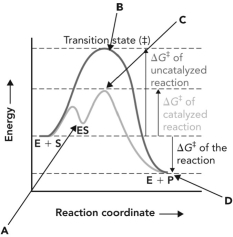
(Multiple Choice)
4.7/5 (88)
(88) All of the following are common catalytic reaction mechanisms in enzyme active sites EXCEPT catalysis.
(Multiple Choice)
4.9/5 (64)
(64) For a reaction of S P, the rate constant of the reaction is equal to
(Multiple Choice)
4.8/5 (85)
(85) Which amino acid acts as a general acid and a general base in the mechanism of chymotrypsin?
(Multiple Choice)
4.8/5 (73)
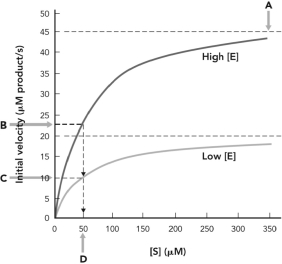
(73) 
An enzyme that requires the coenzyme nicotinamide adenine dinucleotide belongs to which enzyme class?
(Multiple Choice)
4.7/5 (71)
(71) A plot of v0 versus substrate concentration for aspartate transcarbamoylase displays a sigmoidal curve. Explain how the plot would change in the presence of CTP.
(Essay)
4.9/5 (96)
(96) Place the following HMG-CoA reductase steps in the correct order:
A. Reduction of aldehyde
B. Breakdown of hemithioacetal
C. Reduction of thioester
D. Cofactor exchange
(Multiple Choice)
4.9/5 (85)
(85) Binding of glucose to hexokinase causes a conformational change in the enzyme. This is an example of the __________ model of enzyme catalysis.
(Multiple Choice)
4.8/5 (77)
(77) When compared with the T state of aspartate transcarbamoylase, the R state
(Multiple Choice)
4.8/5 (79)
(79) 
Filters
- Essay(0)
- Multiple Choice(0)
- Short Answer(0)
- True False(0)
- Matching(0)