



 Chat with AI
Exam 17: Amino Acid Metabolism

Exam 1: Principles of Biochemistry100 Questions
Exam 2: Physical Biochemistry: Energy Conversion, Water, and Membranes100 Questions
Exam 3: Nucleic Acid Structure and Function100 Questions
Exam 4: Protein Structure100 Questions
Exam 5: Methods in Protein Biochemistry100 Questions
Exam 6: Protein Function114 Questions
Exam 7: Enzyme Mechanisms106 Questions
Exam 8: Cell Signaling Systems102 Questions
Exam 9: Glycolysis: a Paradigm of Metabolic Regulation100 Questions
Exam 10: The Citrate Cycle100 Questions
Exam 11: Oxidative Phosphorylation99 Questions
Exam 12: Photosynthesis100 Questions
Exam 13: Carbohydrate Structure and Function100 Questions
Exam 14: Carbohydrate Metabolism100 Questions
Exam 15: Lipid Structure and Function100 Questions
Exam 16: Lipid Metabolism100 Questions
Exam 17: Amino Acid Metabolism100 Questions
Exam 18: Nucleotide Metabolism99 Questions
Exam 19: Metabolic Integration101 Questions
Exam 20: DNA Replication, Repair, and Recombination99 Questions
Exam 21: RNA Synthesis, Processing, and Gene Silencing100 Questions
Exam 22: Protein Synthesis, Posttranslational Modification, and Transport100 Questions
Exam 23: Gene Regulation100 Questions
Select questions type


What are the key enzymes, intermediates, and products of heme catalysis?
(Essay)
4.7/5  (77)
(77) If there was a loss of efficiency in the urea cycle, there would be a buildup of
(Multiple Choice)
4.9/5 (71)
(71) Alanine, cysteine, glycine, and serine are all considered amino acids.
(Multiple Choice)
4.9/5 (85)
(85) Differentiate between proteins being degraded by an ATP-dependent process compared with the ATP-independent process.
(Essay)
4.7/5 (87)
(87) Using the figure below, determine which of the following is NOT a final product from group 1 amino acid degradation. 
(Multiple Choice)
4.8/5 (65)
(65) How does atmospheric fixation occur given the high energy barrier to convert nitrogen to nitrogen oxides?
(Multiple Choice)
4.9/5 (85)
(85) What specific characteristic must a target protein have to be recognized by an ubiquitinating protein?
(Multiple Choice)
4.9/5 (74)
(74) It is important that proteolytic enzymes in the lysosome are optimized to work at low pH because low pH
(Multiple Choice)
4.7/5 (68)
(68) What are the four key enzymes in nitrogen fixation and assimilation in plants and bacteria?
(Multiple Choice)
5.0/5 (67)
(67) Cells cannot store amino acids that accumulate as a result of protein degradation. The carbon skeletons that remain
(Multiple Choice)
4.7/5 (73)
(73) Which of the following is the correct net reaction of nitrogen fixation in bacteria?
(Multiple Choice)
4.8/5 (80)
(80) A possible outcome if E. coli was depleted in NADPH would be
(Multiple Choice)
4.9/5 (80)
(80) If no NAD+ was available, the group 2 amino acid degradation pathway would experience a 
(Multiple Choice)
4.8/5 (74)
(74) Using nitrogenase to reduce N2 should require 2 ATP to be invested, but it actually takes 16 ATP. Why?
(Multiple Choice)
5.0/5 (75)
(75) How is the synthetic pathway for nonessential amino acids different than for essential amino acids?
(Essay)
4.9/5 (80)
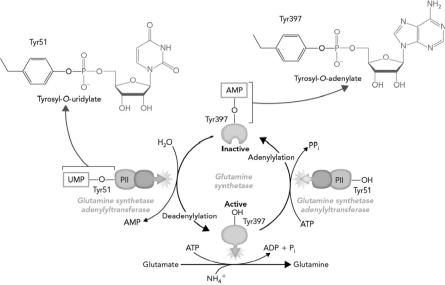
(80) For the figure below, summarize the interdependent regulation of glutamine synthetase and glutamine synthetase adenylyltransferase.
(Essay)
4.8/5 (81)
(81) 
Filters
- Essay(0)
- Multiple Choice(0)
- Short Answer(0)
- True False(0)
- Matching(0)