



 Chat with AI
Exam 24: Touring Our Solar System

Exam 1: An Introduction to Geology66 Questions
Exam 2: Plate Tectonics: a Scientific Revolution Unfolds77 Questions
Exam 3: Matter and Minerals74 Questions
Exam 4: Magma, Igneous Rocks, and Intrusive Activity76 Questions
Exam 5: Volcanoes and Volcanic Hazards81 Questions
Exam 6: Weathering and Soil67 Questions
Exam 7: Sedimentary Rocks72 Questions
Exam 8: Metamorphism and Metamorphic Rocks76 Questions
Exam 9: Geologic Time70 Questions
Exam 10: Crustal Deformation66 Questions
Exam 11: Earthquakes67 Questions
Exam 12: Earths Interior74 Questions
Exam 13: Divergent Boundaries83 Questions
Exam 14: Convergent Boundaries79 Questions
Exam 15: Mass Wasting83 Questions
Exam 16: Running Water75 Questions
Exam 17: Groundwater81 Questions
Exam 18: Glaciers and Glaciation84 Questions
Exam 19: Deserts and Winds72 Questions
Exam 20: Shorelines69 Questions
Exam 21: Global Climate Change82 Questions
Exam 22: Earths Evolution Through Geologic Time74 Questions
Exam 23: Energy and Mineral Resources80 Questions
Exam 24: Touring Our Solar System76 Questions
Select questions type


Planetary geology focuses only on those planets with a rocky surface such as Venus and Mars.
(True/False)
4.9/5  (85)
(85) The ________ explains the formation of the solar system by describing how the sun and planets formed from a rotating cloud of interstellar gases.
(Multiple Choice)
4.9/5 (78)
(78) 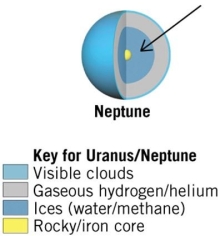 What substance makes up much of the interior layers of Neptune, marked with an arrow?
 (Multiple Choice)
4.9/5 (73)
(73) Today, erosion on the moon is dominated by ________, which helps to smooth the landscape.
(Multiple Choice)
4.9/5 (80)
(80) ________ is the study of the formation and evolution of the bodies in our solar system.
(Multiple Choice)
4.9/5 (78)
(78) ________ is the speed required for an object to escape a planet's gravitational force.
(Multiple Choice)
4.9/5 (78)
(78) Which of the following best describes the process that resulted in the Valles Marineris on Mars?
(Multiple Choice)
4.9/5 (85)
(85) Which of the following physical features has not yet been found on Mars?
(Multiple Choice)
4.9/5 (80)
(80) Because of Pluto's inclined orbital plane, it appears to cross paths with Neptune and will occasionally be closer to the sun than Neptune.
(True/False)
4.9/5 (76)
(76) ________ are small, solid, extraterrestrial particles that will burn and glow when passing through Earth's atmosphere.
(Multiple Choice)
4.9/5 (84)
(84) Compare and contrast the core of Mercury (40 percent of the planet's volume)to that of Earth (~10 percent of the planet's volume).If Mercury is smaller, why is its core bigger than Earth's?
(Essay)
4.9/5 (84)
(84) Mauna Loa, a shield volcano in Hawaii, is approximately 10 km in height.Olympus Mons is a shield volcano on Mars that is approximately 27 km in height.Compare the formation of both of these volcanoes.How is it that Olympus Mons could grow so much taller than Mauna Loa?
(Essay)
4.9/5 (76)
(76) In 2006, the International Astronomical Union developed a formal definition for what constitutes a planet.What is the definition of a planet?
(Essay)
4.9/5 (79)
(79) 
Filters
- Essay(0)
- Multiple Choice(0)
- Short Answer(0)
- True False(0)
- Matching(0)