



 Chat with AI
Exam 24: Touring Our Solar System

Exam 1: An Introduction to Geology66 Questions
Exam 2: Plate Tectonics: a Scientific Revolution Unfolds77 Questions
Exam 3: Matter and Minerals74 Questions
Exam 4: Magma, Igneous Rocks, and Intrusive Activity76 Questions
Exam 5: Volcanoes and Volcanic Hazards81 Questions
Exam 6: Weathering and Soil67 Questions
Exam 7: Sedimentary Rocks72 Questions
Exam 8: Metamorphism and Metamorphic Rocks76 Questions
Exam 9: Geologic Time70 Questions
Exam 10: Crustal Deformation66 Questions
Exam 11: Earthquakes67 Questions
Exam 12: Earths Interior74 Questions
Exam 13: Divergent Boundaries83 Questions
Exam 14: Convergent Boundaries79 Questions
Exam 15: Mass Wasting83 Questions
Exam 16: Running Water75 Questions
Exam 17: Groundwater81 Questions
Exam 18: Glaciers and Glaciation84 Questions
Exam 19: Deserts and Winds72 Questions
Exam 20: Shorelines69 Questions
Exam 21: Global Climate Change82 Questions
Exam 22: Earths Evolution Through Geologic Time74 Questions
Exam 23: Energy and Mineral Resources80 Questions
Exam 24: Touring Our Solar System76 Questions
Select questions type


Compare the surface of Earth to that of the moon.Why doesn't Earth's land retain the same scarring from meteorite impact as the moon? Why doesn't Earth's ocean retain the same scarring from meteorite impact?
(Essay)
4.7/5  (94)
(94) 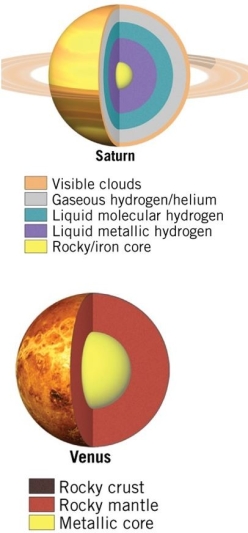 These images contain a cross section of Venus, a terrestrial planet, and Saturn, a Jovian planet.Notice how Venus, a terrestrial planet, has a rocky mantle.What is the equivalent layer in Saturn made from?
 (Multiple Choice)
4.8/5 (62)
(62) 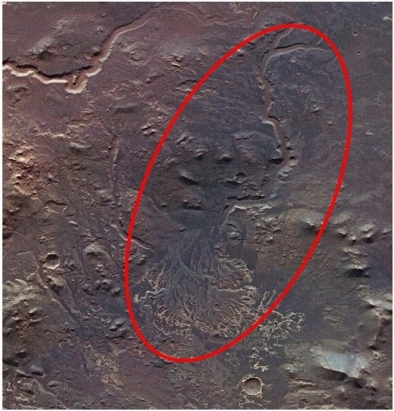 Which agent of erosion is responsible for the erosional pattern circled in this image?
 (Multiple Choice)
4.9/5 (83)
(83) 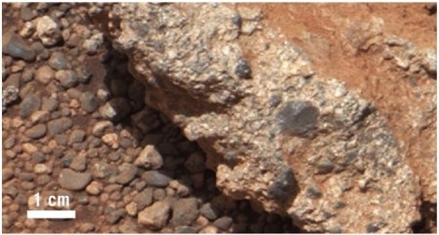 What kind of environment would have produced the Martian rock visible here?
 (Multiple Choice)
4.8/5 (87)
(87) During the formation of the solar system, which planet came the closest to starting the process of nuclear fusion, which would have resulted in a second sun?
(Multiple Choice)
4.8/5 (83)
(83) The maria are the light, highly cratered highlands visible on the moon.
(True/False)
4.8/5 (85)
(85) What is the term that describes the bright halo of a comet created when escaping gases carry dust away from the comet's surface?
(Multiple Choice)
4.8/5 (80)
(80) What is the most common igneous rock found on the lunar maria?
(Multiple Choice)
4.9/5 (80)
(80) What process produces the alternating dark-colored belts and light-colored zones visible on Jupiter?
(Multiple Choice)
4.9/5 (81)
(81) Saturn is the only planet in the solar system with rings composed of particles of water ice and rocky debris.
(True/False)
4.8/5 (80)
(80) Outside of Earth, which body in the solar system is likely to have liquid water beneath its icy surface?
(Multiple Choice)
4.8/5 (74)
(74) 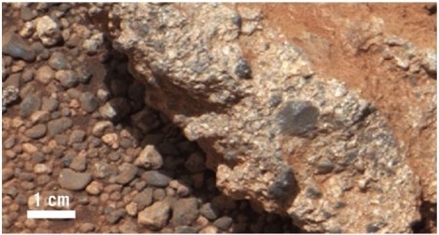 What kind of rock is visible in this image from Mars?
The reason Jupiter has so many moons around it is that ________.
(Multiple Choice)
4.9/5 (78)
(78) 
Filters
- Essay(0)
- Multiple Choice(0)
- Short Answer(0)
- True False(0)
- Matching(0)