



 Chat with AI
Exam 11: Earthquakes

Exam 1: An Introduction to Geology66 Questions
Exam 2: Plate Tectonics: a Scientific Revolution Unfolds77 Questions
Exam 3: Matter and Minerals74 Questions
Exam 4: Magma, Igneous Rocks, and Intrusive Activity76 Questions
Exam 5: Volcanoes and Volcanic Hazards81 Questions
Exam 6: Weathering and Soil67 Questions
Exam 7: Sedimentary Rocks72 Questions
Exam 8: Metamorphism and Metamorphic Rocks76 Questions
Exam 9: Geologic Time70 Questions
Exam 10: Crustal Deformation66 Questions
Exam 11: Earthquakes67 Questions
Exam 12: Earths Interior74 Questions
Exam 13: Divergent Boundaries83 Questions
Exam 14: Convergent Boundaries79 Questions
Exam 15: Mass Wasting83 Questions
Exam 16: Running Water75 Questions
Exam 17: Groundwater81 Questions
Exam 18: Glaciers and Glaciation84 Questions
Exam 19: Deserts and Winds72 Questions
Exam 20: Shorelines69 Questions
Exam 21: Global Climate Change82 Questions
Exam 22: Earths Evolution Through Geologic Time74 Questions
Exam 23: Energy and Mineral Resources80 Questions
Exam 24: Touring Our Solar System76 Questions
Select questions type


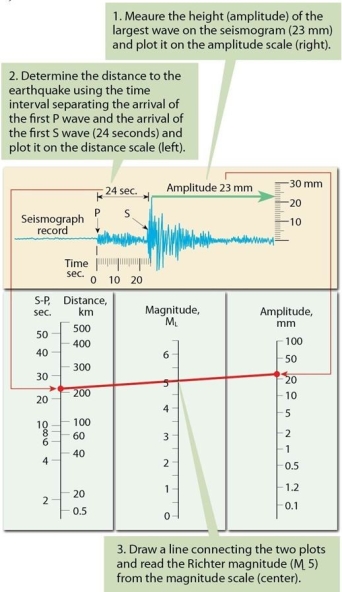 Assuming your S-P interval was 10 seconds and the maximum amplitude of the largest wave on the seismogram was 20 mm, what is the magnitude of this earthquake?
Free
(Multiple Choice)
4.8/5  (69)
(69) Correct Answer: Verified
B
Short-range earthquake predictions are reliable and widely used to get people to safety.
Free
(True/False)
4.8/5 (73)
(73) Correct Answer:Verified
VerifiedFalse
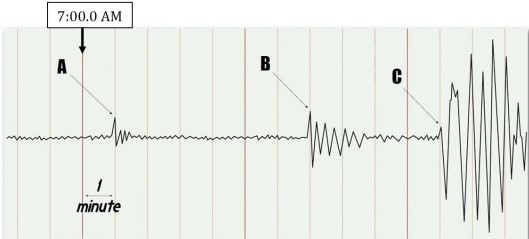 Using the arrival times in this image, determine the S-minus-P interval for this earthquake.
Free
(Multiple Choice)
4.9/5 (93)
(93) Correct Answer:Verified
VerifiedA
The ________ is a newer scale that measures the total energy released during an earthquake by determining the average amount of slip on the fault, the area of the fault surface that slipped, and the strength of the faulted rock.
(Multiple Choice)
4.9/5 (80)
(80) Seiches are dangerous to begin with, but which of the following situations is particularly dangerous during seiche formation?
(Multiple Choice)
4.8/5 (80)
(80) 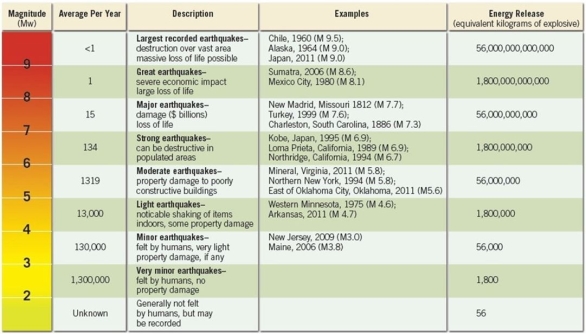 Which of the following events released more energy?
Chart of the Mercalli Intensity Scale, starting with an intensity of 1 and going up to an intensity of 13. 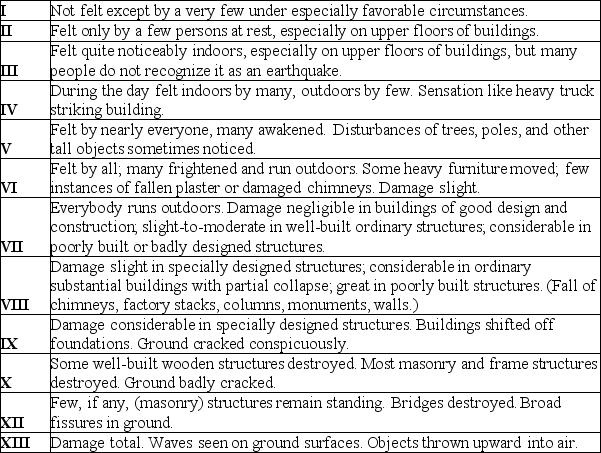 This table is an abridged copy of the Mercalli Intensity Scale.Use the following eyewitness account to determine the damage inflicted by this seismic event:
I was driving home when the earthquake hit.It's a good thing I wasn't far from home, because I had to pull over to the side of the road.The entrance to my neighborhood was blocked because of fallen trees and telephone polls.Thank goodness the school was built according to the earthquake codes! Although the school survived with a few cracks in the walls, most of the houses in the neighborhood had significant damage.The bricks from my chimney were all over the driveway.I had to crawl in through a window because I couldn't get the door open.Once I was in, I saw that it was blocked by one of my bookcases that had fallen over.
This table is an abridged copy of the Mercalli Intensity Scale.Use the following eyewitness account to determine the damage inflicted by this seismic event:
I was driving home when the earthquake hit.It's a good thing I wasn't far from home, because I had to pull over to the side of the road.The entrance to my neighborhood was blocked because of fallen trees and telephone polls.Thank goodness the school was built according to the earthquake codes! Although the school survived with a few cracks in the walls, most of the houses in the neighborhood had significant damage.The bricks from my chimney were all over the driveway.I had to crawl in through a window because I couldn't get the door open.Once I was in, I saw that it was blocked by one of my bookcases that had fallen over. (Multiple Choice)
4.7/5 (68)
(68) The New Madrid earthquakes of the early nineteenth century were some of the largest in American history.At their greatest, they caused buildings and bluffs to collapse, caused land subsidence, and displaced parts of the Mississippi River.Could another earthquake of this magnitude happen near New Madrid again? Explain how the earthquake devastation today would compare to that of the early nineteenth century.
(Essay)
4.9/5 (86)
(86) As of 2015, what was the strongest earthquake on record, and when did it occur?
(Multiple Choice)
4.8/5 (87)
(87) Earthquake A is classified as a 3 on the Richter Scale.Earthquake B is classified as a 6.How many times more energy has Earthquake B released than Earthquake A?
(Multiple Choice)
4.9/5 (80)
(80) The ground shaking produced by large earthquakes is not only ________, but takes a ________ time than shaking produced by slippage along small fault segments.
(Multiple Choice)
4.9/5 (74)
(74) Monitoring foreshocks has become a reliable indicator for predicting earthquakes.
(True/False)
4.7/5 (86)
(86) 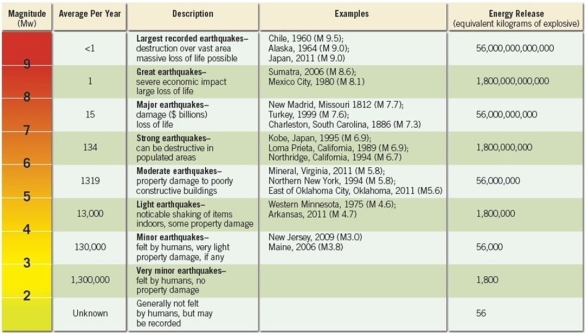 Approximately how much energy was released in the Mexico City earthquake in 1980?
 (Multiple Choice)
4.8/5 (81)
(81) When the entire length of a fault ruptures during a single seismic event, the slip will propagate at a speed of ________ kilometers per second.
(Multiple Choice)
4.9/5 (72)
(72) Earthquakes with a Richter magnitude less than 2.0 are generally not felt by humans.
(True/False)
5.0/5 (86)
(86) 
Filters
- Essay(0)
- Multiple Choice(0)
- Short Answer(0)
- True False(0)
- Matching(0)