



 Chat with AI
Exam 13: Divergent Boundaries

Exam 1: An Introduction to Geology66 Questions
Exam 2: Plate Tectonics: a Scientific Revolution Unfolds77 Questions
Exam 3: Matter and Minerals74 Questions
Exam 4: Magma, Igneous Rocks, and Intrusive Activity76 Questions
Exam 5: Volcanoes and Volcanic Hazards81 Questions
Exam 6: Weathering and Soil67 Questions
Exam 7: Sedimentary Rocks72 Questions
Exam 8: Metamorphism and Metamorphic Rocks76 Questions
Exam 9: Geologic Time70 Questions
Exam 10: Crustal Deformation66 Questions
Exam 11: Earthquakes67 Questions
Exam 12: Earths Interior74 Questions
Exam 13: Divergent Boundaries83 Questions
Exam 14: Convergent Boundaries79 Questions
Exam 15: Mass Wasting83 Questions
Exam 16: Running Water75 Questions
Exam 17: Groundwater81 Questions
Exam 18: Glaciers and Glaciation84 Questions
Exam 19: Deserts and Winds72 Questions
Exam 20: Shorelines69 Questions
Exam 21: Global Climate Change82 Questions
Exam 22: Earths Evolution Through Geologic Time74 Questions
Exam 23: Energy and Mineral Resources80 Questions
Exam 24: Touring Our Solar System76 Questions
Select questions type


The measurement of ocean depth and the topography of the ocean floor are known as ________.

Free
(Multiple Choice)
4.8/5  (86)
(86) Correct Answer: Verified
D
________ accounts for greater ocean depths moving away from the oceanic ridge toward the deep ocean basin.
Free
(Multiple Choice)
4.9/5 (93)
(93) Correct Answer:Verified
VerifiedC
Which of the following materials or features are not found at mid-ocean ridges?
Free
(Multiple Choice)
4.9/5 (71)
(71) Correct Answer:Verified
VerifiedC
The Challenger Deep of the Mariana Trench is named for the H.M.S Challenger, the ship that first measured it.
(True/False)
4.9/5 (74)
(74) 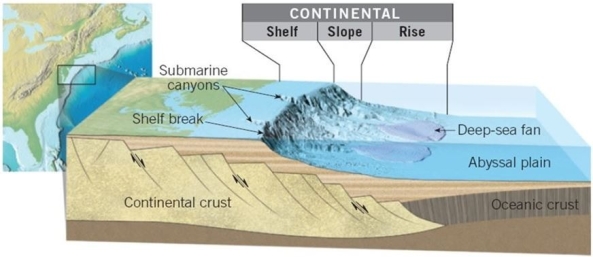 What kind of continental margin is visible in this image?
Which of the following is not a possible mechanism contributing to continental rifting?
(Multiple Choice)
4.9/5 (79)
(79) Which of the following will mark the furthest extent of a continent?
(Multiple Choice)
4.9/5 (78)
(78) What tool is often used to measure the topography of the seafloor today?
(Multiple Choice)
4.9/5 (100)
(100) Which of the following locations is an example of spontaneous subduction?
(Multiple Choice)
4.8/5 (79)
(79) Because massive submarine structures such as seamounts and ridges exert stronger than average gravitational attraction, they produce depressed areas on the ocean's surface.
(True/False)
4.9/5 (74)
(74) Oceanic Ridge A has slow spreading rates of 2-5 cm/yr.Oceanic Ridge B has intermediate spreading rates of 6-9 cm/yr.Oceanic Ridge C has fast spreading rates of 10-11 cm/yr.Compare and contrast the topography and structure that would be present at all three spreading centers.
(Essay)
4.9/5 (73)
(73) Describe the appearance of a rift valley that has started on land.How do these valleys form?
(Essay)
4.9/5 (82)
(82) 
Filters
- Essay(0)
- Multiple Choice(0)
- Short Answer(0)
- True False(0)
- Matching(0)