



 Chat with AI
Exam 7: Sedimentary Rocks

Exam 1: An Introduction to Geology66 Questions
Exam 2: Plate Tectonics: a Scientific Revolution Unfolds77 Questions
Exam 3: Matter and Minerals74 Questions
Exam 4: Magma, Igneous Rocks, and Intrusive Activity76 Questions
Exam 5: Volcanoes and Volcanic Hazards81 Questions
Exam 6: Weathering and Soil67 Questions
Exam 7: Sedimentary Rocks72 Questions
Exam 8: Metamorphism and Metamorphic Rocks76 Questions
Exam 9: Geologic Time70 Questions
Exam 10: Crustal Deformation66 Questions
Exam 11: Earthquakes67 Questions
Exam 12: Earths Interior74 Questions
Exam 13: Divergent Boundaries83 Questions
Exam 14: Convergent Boundaries79 Questions
Exam 15: Mass Wasting83 Questions
Exam 16: Running Water75 Questions
Exam 17: Groundwater81 Questions
Exam 18: Glaciers and Glaciation84 Questions
Exam 19: Deserts and Winds72 Questions
Exam 20: Shorelines69 Questions
Exam 21: Global Climate Change82 Questions
Exam 22: Earths Evolution Through Geologic Time74 Questions
Exam 23: Energy and Mineral Resources80 Questions
Exam 24: Touring Our Solar System76 Questions
Select questions type


Graded bedding will display particles that are fine near the bottom of the layer and get progressively coarser toward the top.
(True/False)
4.8/5  (82)
(82) Volcanic activity in the early history of the Earth is believed to be responsible for much of the CO2 found in the atmosphere.
(True/False)
4.8/5 (86)
(86) Which of the following makes up the sediment that forms an organic sedimentary rock?
(Multiple Choice)
4.9/5 (72)
(72) Chalk is a soft, porous rock composed of the hard parts of microscopic marine organisms.
(True/False)
4.8/5 (72)
(72) The Grinnell Formation in Glacier National Park contains mudcracks that date back nearly 1.5 billion years.How can delicate sedimentary structures such as these be preserved?
(Essay)
4.9/5 (64)
(64) Due to their size, stream gravels need a swift current to be transported, whereas sands need a current with less energy.
(True/False)
4.7/5 (72)
(72) Which of the following rocks composed of silt- and clay- sized particles displays fissility?
(Multiple Choice)
4.8/5 (73)
(73) A ________ marks the end of one episode of sedimentation and the beginning of another.
(Multiple Choice)
4.9/5 (83)
(83) Compare and contrast how the formation of biochemical sediments differs from the formation of inorganic sediments.(Note: The term inorganic sediments refers to those formed in chemical sedimentary rocks.)
(Essay)
4.9/5 (77)
(77) ________ are tiny "seed" particles created when small sediments or shell fragments are rolled by waves in water supersaturated with calcium carbonate.
(Multiple Choice)
5.0/5 (76)
(76) Explain how the size, shape, and sorting of sediments can provide information about the distance the sediment has traveled from its source.
(Essay)
4.9/5 (80)
(80) 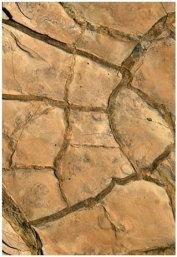 What sedimentary structure is visible in this image?
Approximately 75 percent of the planet's landmasses are covered by sedimentary and sedimentary rocks.
(True/False)
4.8/5 (79)
(79) Explain how the intrusive igneous rock granite can be broken down from a crystalline igneous rock to a sediment and then finally become a sedimentary rock.
(Essay)
4.9/5 (89)
(89) ________ is a variety of sandstone that is associated with submarine landslides called turbidity currents.
(Multiple Choice)
5.0/5 (75)
(75) The velocity of moving water controls the sediment it can carry.How will a decrease in water velocity control the size of the sediment particle that is deposited first?
(Essay)
4.8/5 (75)
(75) 
Filters
- Essay(0)
- Multiple Choice(0)
- Short Answer(0)
- True False(0)
- Matching(0)