



 Chat with AI
Exam 7: Climate and Biodiversity

Exam 1: Environmental Problems - Their Causes - and Sustainability95 Questions
Exam 2: Science - Matter - and Energy97 Questions
Exam 3: Ecosystems - What Are They and How Do They Work100 Questions
Exam 4: Biodiversity and Evolution100 Questions
Exam 5: Biodiversity - Species Interactions - and Population Control98 Questions
Exam 6: The Human Population and Urbanization102 Questions
Exam 7: Climate and Biodiversity101 Questions
Exam 8: Sustaining Biodiversity - the Species Approach99 Questions
Exam 9: Sustaining Biodiversity - the Ecosystem Approach100 Questions
Exam 10: Food - Soil - and Pest Management100 Questions
Exam 11: Water Resources and Water Pollution99 Questions
Exam 12: Geology and Nonrenewable Minerals100 Questions
Exam 13: Energy98 Questions
Exam 14: Environmental Hazards and Human Health100 Questions
Exam 15: Air Pollution Climate Change and Ozone Depletion96 Questions
Exam 16: Solid and Hazardous Waste100 Questions
Exam 17: Environmental Economics Politics and Worldviews99 Questions
Select questions type


Desert ecosystems are fragile because they have slow plant growth,low species diversity,slow nutrient cycling,and very little water.
(True/False)
4.9/5  (71)
(71) A forest that is known for its year-round uniformly warm temperature is the ____.
(Multiple Choice)
4.8/5 (83)
(83) Figure 7.11
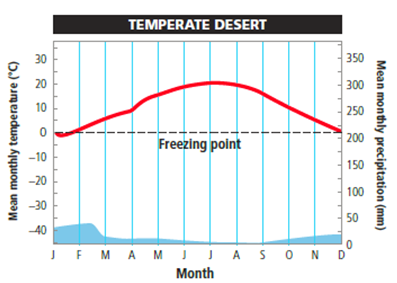
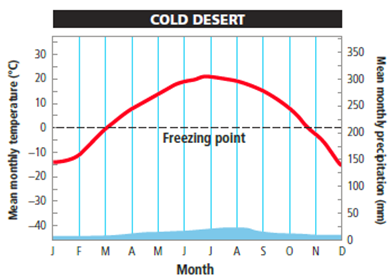 -Refer to the first graph above of a temperate desert and observe that the months of March and April are not the warmest,coldest or wettest months in this biome.However,the bloom of desert wildflowers will typically occur in these two months.Explain why this is the case.
 (Essay)
4.9/5 (88)
(88) The tendency for a transition zone between two different ecosystems to have greater species diversity and a higher density of organisms than are found in either of the individual ecosystems is called the ______________________________.
(Short Answer)
4.9/5 (53)
(53) Lakes that have a small supply of plant nutrients are called oligotrophic lakes.
(True/False)
4.8/5 (86)
(86) Deciduous forests are typically located at higher altitudes than coniferous forests.
(True/False)
4.9/5 (76)
(76) The Arctic,Atlantic,Pacific,Indian,and Southern Oceans are actually a single and continuous body of saltwater.
(True/False)
4.7/5 (71)
(71) Match the items listed below with the appropriate choice
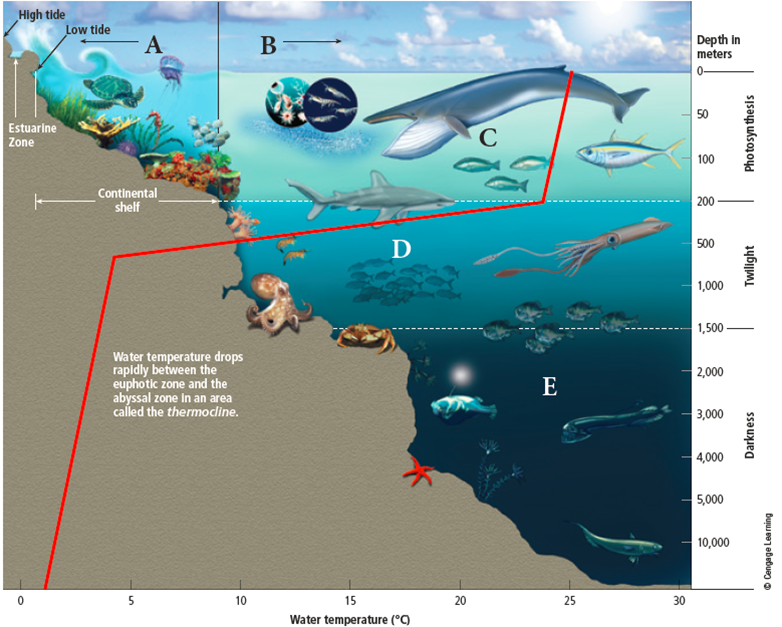 -On the ocean life zones figure,choose the zone that receives enough sunlight for photosynthesis.
 (Short Answer)
4.8/5 (75)
(75) A connected loop of deep and shallow ocean currents transports warm and cool water to various parts of the earth.
(True/False)
4.9/5 (78)
(78) ____________________ is underground soil in which captured water stays frozen for more than two consecutive years.
(Short Answer)
4.7/5 (88)
(88) Which one of the three major principles of sustainability is a driving force behind climate and biodiversity? Include in your answer an explanation of why this is true.
(Essay)
4.9/5 (88)
(88) Much of which biome has disappeared from the earth because it has been converted to farmland for growing crops and grazing cattle?
(Multiple Choice)
4.9/5 (77)
(77) The ____________________ zone is the brightly lit upper zone of the open sea,where drifting phytoplankton carry out about 40% of the world's photosynthetic activity.
(Short Answer)
4.9/5 (81)
(81) Net primary productivity (NPP)is quite low in the open sea,except in upwelling areas,where currents bring up nutrients from the ocean bottom.
(True/False)
4.7/5 (74)
(74) Aquatic life zones in higher-salinity waters are called ____________________ life zones.
(Short Answer)
4.8/5 (87)
(87) 
Filters
- Essay(0)
- Multiple Choice(0)
- Short Answer(0)
- True False(0)
- Matching(0)