



 Chat with AI
Exam 14: Environmental Hazards and Human Health


The process of using statistical methods to estimate potential harm from a particular hazard is called ____________________.

 (75)
 Verified
risk assessment
Malaria cannot be transmitted by blood transfusions or by sharing needles.
(95) VerifiedFalse
Discuss at least one of the factors that explains why most people do a poor job at evaluating risk.
(79) Verified Research shows that fear causes people to overestimate risks and to worry more about unusual risks than they do about common,everyday risks.Studies show that people tend to overestimate numbers of deaths caused by tornadoes,floods,fires,homicides,cancer,and terrorist attacks,and to underestimate death tolls from flu,diabetes,asthma,heart attack,stroke,and automobile accidents. The degree of control we have in a given situation.Most of us have a greater fear of things over which we do not have personal control.For example,some individuals feel safer driving their own car for long distances than traveling the same distance on a plane.But look at the numbers.The risk of dying in a car accident in the United States while using a seatbelt is 1 in 6,070,whereas the risk of dying in a U.S.commercial airliner crash is about 1 in 9 million. The third factor is whether a risk is catastrophic,not chronic.We usually are more frightened by news of catastrophic accidents such as a plane crash than we are of a cause of death such as smoking,which has a much higher death toll spread out over time. Fourth,some people suffer from optimism bias,the belief that risks that apply to other people do not apply to them.While people get upset when they see others driving erratically while talking on a cell phone or texting,they may believe that talking on the cell phone or texting does not impair their own driving ability. A fifth factor is that many of the risky things we do are highly pleasurable and give instant gratification,while the potential harm from such activities comes later.Examples are smoking cigarettes,eating lots of ice cream,and getting a tan.
We can prevent the spread of infectious diseases by reducing the use of ____.
(80) Some forms of ____ can grow from a population of 1 to well over 16 million in 24 hours.
(83) A basic principle of toxicology is that any synthetic or natural chemical can be harmful if ingested or inhaled in a large enough quantity.
(77) The immune system consists of specialized cells and tissues that protect the body against disease and harmful substances by forming ____.
(92) Laboratory-bred mice and rats are widely used for toxicity studies because their systems function generally similar to human systems.
(85) Figure 14.11
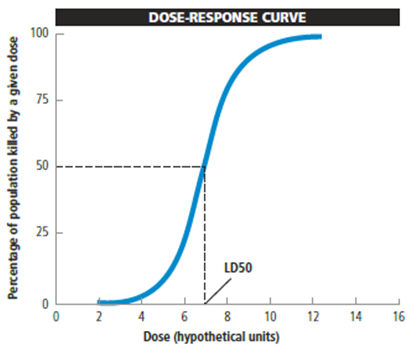 -On the accompanying graph,explain what the designation LD50 means.
 (74) Figure 14.5
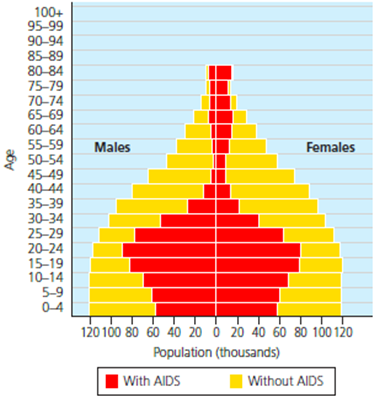 -In the accompanying figure,in what age range are females more likely to die from AIDS than males?
 (90) What is it about carcinogens that cause some people not to believe that their present day habits will lead to cancer?
(97) A person that develops asthma after living in a city with severe air pollution for decades is experiencing a(n)____.
(75) In the United States,the leading cause of preventable death is tobacco use.
(64) What has probably killed more people over the course of human history than all of the wars ever fought?
(74) What is expected to happen to populations of malaria-carrying mosquitoes in the coming century?
(76) The chemical pesticide DDT is persistent,or resistant to breakdown,and can be biologically magnified.
(76) Figure 14.5
-In the accompanying figure,how many more women between 20 and 24 years of age would survive if AIDS were eradicated?
-In the accompanying figure,how many more women between 20 and 24 years of age would survive if AIDS were eradicated? (81) Explain the following statement (quotation at the beginning of Chapter 15)made by the German scientist Paracelsus: "The dose makes the poison."
(75) If you typically consume large amounts of processed foods,and certain wines,which category of chemical hazard is introduced into your system?
(76) A deadly and apparently incurable form of ____ has been spreading,and killing about 150,000 people a year in India,China,and Russia.In order to control the spread of this disease,the victims must be permanently isolated from the rest of society.
(80) 
Filters
- Essay(0)
- Multiple Choice(0)
- Short Answer(0)
- True False(0)
- Matching(0)