



 Chat with AI
Exam 14: Environmental Hazards and Human Health

Exam 1: Environmental Problems - Their Causes - and Sustainability95 Questions
Exam 2: Science - Matter - and Energy97 Questions
Exam 3: Ecosystems - What Are They and How Do They Work100 Questions
Exam 4: Biodiversity and Evolution100 Questions
Exam 5: Biodiversity - Species Interactions - and Population Control98 Questions
Exam 6: The Human Population and Urbanization102 Questions
Exam 7: Climate and Biodiversity101 Questions
Exam 8: Sustaining Biodiversity - the Species Approach99 Questions
Exam 9: Sustaining Biodiversity - the Ecosystem Approach100 Questions
Exam 10: Food - Soil - and Pest Management100 Questions
Exam 11: Water Resources and Water Pollution99 Questions
Exam 12: Geology and Nonrenewable Minerals100 Questions
Exam 13: Energy98 Questions
Exam 14: Environmental Hazards and Human Health100 Questions
Exam 15: Air Pollution Climate Change and Ozone Depletion96 Questions
Exam 16: Solid and Hazardous Waste100 Questions
Exam 17: Environmental Economics Politics and Worldviews99 Questions
Select questions type


The ____________________ system is a complex network of glands that release tiny amounts of hormones into the bloodstreams of humans and other vertebrate animals.
(Short Answer)
5.0/5  (71)
(71) A(n)____________________ is the probability of suffering harm from a hazard that can cause injury,disease,death,economic loss,or damage.
(Short Answer)
4.8/5 (93)
(93) A ____ disease,like most cancers,is not caused by a living organism and does not spread from one person to another.
(Multiple Choice)
4.8/5 (84)
(84) After poverty and gender,the greatest risks people face are mainly from lifestyle choices.
(True/False)
4.9/5 (74)
(74) Some organisms live on or inside other organisms and feed on them,and can cause serious infectious diseases,including malaria.These are known as ____________________.
(Short Answer)
4.9/5 (76)
(76) What is the scientific process of using statistical methods to estimate how much harm a particular hazard can cause to human health or the environment?
(Multiple Choice)
4.9/5 (87)
(87) The blood of an average U.S.citizen contains traces of 212 different chemicals,including potentially harmful chemicals such as arsenic and bisphenol A.
(True/False)
4.9/5 (79)
(79) What do we call the probability of suffering harm from a hazard?
(Multiple Choice)
4.8/5 (82)
(82) Some research indicates that ____ causes people to overestimate risks and to worry more about unusual risks more so than common risks.
(Multiple Choice)
4.8/5 (75)
(75) Only water-soluble toxins can accumulate in body tissues and cells.
(True/False)
4.9/5 (72)
(72) The death toll from smoking in the United States is roughly equivalent to more than six fully loaded 200-passenger jet planes crashing every day with no survivors.
(True/False)
4.8/5 (78)
(78) Nitrous acid (HNO2),formed by the digestion of nitrite (NO2)preservatives in foods,can cause ____________________ that are linked to increases in stomach cancer in people who consume large amounts of processed foods and wine containing such preservatives.
(Short Answer)
4.9/5 (77)
(77) Several antimalarial drugs have become more effective against the Plasmodium parasites since about 1970.
(True/False)
4.9/5 (87)
(87) Water bottles can contain ____________________,which is an estrogen mimic that is used as a hardening agent in certain plastics.
(Short Answer)
4.8/5 (78)
(78) Describe at least one principle that can help us to evaluate and reduce risk.
(Essay)
4.8/5 (98)
(98) The system responsible for defense against disease and harmful substances is the ____.
(Multiple Choice)
4.9/5 (82)
(82) Figure 14.11
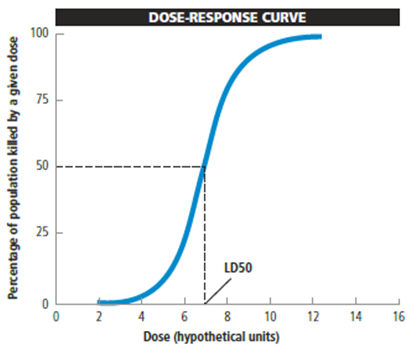 -What purpose does the accompanying graph serve in our challenge of evaluating hazardous chemicals?
 (Essay)
4.8/5 (73)
(73) 
Filters
- Essay(0)
- Multiple Choice(0)
- Short Answer(0)
- True False(0)
- Matching(0)