



 Chat with AI
Exam 1: Environmental Problems - Their Causes - and Sustainability

Exam 1: Environmental Problems - Their Causes - and Sustainability95 Questions
Exam 2: Science - Matter - and Energy97 Questions
Exam 3: Ecosystems - What Are They and How Do They Work100 Questions
Exam 4: Biodiversity and Evolution100 Questions
Exam 5: Biodiversity - Species Interactions - and Population Control98 Questions
Exam 6: The Human Population and Urbanization102 Questions
Exam 7: Climate and Biodiversity101 Questions
Exam 8: Sustaining Biodiversity - the Species Approach99 Questions
Exam 9: Sustaining Biodiversity - the Ecosystem Approach100 Questions
Exam 10: Food - Soil - and Pest Management100 Questions
Exam 11: Water Resources and Water Pollution99 Questions
Exam 12: Geology and Nonrenewable Minerals100 Questions
Exam 13: Energy98 Questions
Exam 14: Environmental Hazards and Human Health100 Questions
Exam 15: Air Pollution Climate Change and Ozone Depletion96 Questions
Exam 16: Solid and Hazardous Waste100 Questions
Exam 17: Environmental Economics Politics and Worldviews99 Questions
Select questions type


The tragedy of the commons refers to the ____.

Free
(Multiple Choice)
4.9/5  (86)
(86) Correct Answer: Verified
B
Use the accompanying figure to answer the following question
Table 1.1
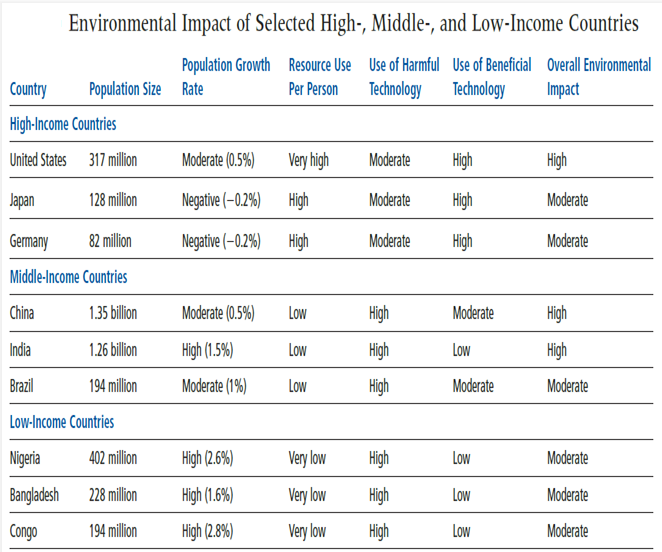 -How does the overall environmental impact of the United States compare to China?
Free
(Essay)
4.9/5 (80)
(80) Correct Answer:Verified
VerifiedThe overall environmental impact for both countries is similarly high.
What is the difference between a renewable resource and an inexhaustible resource?
Free
(Essay)
4.8/5 (82)
(82) Correct Answer:Verified
VerifiedA renewable resource can be replenished by natural processes within hours to centuries,as long as we do not use it up faster than natural processes can renew it.An inexhaustible resource,like solar energy,is in continuous supply.
What term refers to the average ecological footprint of an individual in a given country or area?
(Multiple Choice)
4.8/5 (86)
(86) The "tragedy of the commons" refers to a situation in which the cumulative effect of large numbers of people trying to exploit a widely available or shared resource can degrade it and eventually exhaust or ruin it.
(True/False)
4.9/5 (86)
(86) What is one of the three goals of environmental science,as proposed by your text?
(Multiple Choice)
4.7/5 (74)
(74) Use the accompanying figure to answer the following question
Table 1.1
-How does resource use per person in the United States compare to China?
-How does resource use per person in the United States compare to China? (Essay)
4.8/5 (73)
(73) Explain how the IPAT model and the ecological footprint model emphasize different aspects of how natural resources are affected by unsustainable use.
(Essay)
4.8/5 (103)
(103) Middle-income countries such as India and China may have low ____,but they have a high ____.
(Multiple Choice)
4.8/5 (93)
(93) What is a social movement that is dedicated to trying to sustain the earth's life-support system for all forms of life?
(Multiple Choice)
4.9/5 (71)
(71) Research by social scientists suggests that it takes only ____ of the population of a community,a country,or the world to bring about major social and environmental change.
(Multiple Choice)
4.8/5 (91)
(91) According to the human-centered environmental worldview,all species have value as participating members of the biosphere,regardless of their potential or actual use to humans.
(True/False)
4.8/5 (82)
(82) Indirect forms of solar energy,such as wind and flowing water,provide us with inexhaustible power that we can use to produce electricity.
(True/False)
5.0/5 (92)
(92) Which school of thought argued that public lands should be managed wisely and scientifically,primarily to provide resources for people?
(Multiple Choice)
4.9/5 (75)
(75) Clearly describe how affluence can have both harmful and beneficial environmental effects.
(Essay)
4.9/5 (77)
(77) A country's ecological footprint is larger than its biological capacity to replenish its renewable resources and absorb the resulting waste and pollution.What can be said about this country?
(Multiple Choice)
4.8/5 (78)
(78) 
Filters
- Essay(0)
- Multiple Choice(0)
- Short Answer(0)
- True False(0)
- Matching(0)