



 Chat with AI
Exam 7: Inflation

Exam 1: Economics: the Core Issues152 Questions
Exam 2: The Useconomy: a Global View146 Questions
Exam 3: Supply and Demand164 Questions
Exam 4: The Role of Government153 Questions
Exam 5: National Income Accounting152 Questions
Exam 6: Unemployment147 Questions
Exam 7: Inflation152 Questions
Exam 8: The Business Cycle153 Questions
Exam 9: Aggregate Demand149 Questions
Exam 10: Self-Adjustment or Instability140 Questions
Exam 11: Fiscal Policy151 Questions
Exam 12: Deficits and Debt151 Questions
Exam 13: Money and Banks146 Questions
Exam 14: The Federal Reserve System146 Questions
Exam 15: Monetary Policy149 Questions
Exam 16: Supply-Side Policy: Short-Run Options147 Questions
Exam 17: Growth and Productivity: Long-Run Possibilities143 Questions
Exam 18: Theory Versus Reality146 Questions
Exam 19: Consumer Choice136 Questions
Exam 20: Elasticity141 Questions
Exam 21: The Costs of Production151 Questions
Exam 22: The Competitive Firm148 Questions
Exam 23: Competitive Markets150 Questions
Exam 24: Monopoly147 Questions
Exam 25: Oligopoly145 Questions
Exam 26: Monopolistic Competition144 Questions
Exam 27: Natural Monopolies: Deregulation144 Questions
Exam 28: Environmental Protection144 Questions
Exam 29: The Farm Problem132 Questions
Exam 30: The Labor Market137 Questions
Exam 31: Labor Unions144 Questions
Exam 32: Financial Markets146 Questions
Exam 33: Taxes: Equity Versus Efficiency146 Questions
Exam 34: Transfer Payments: Welfare and Social Security146 Questions
Exam 35: International Trade149 Questions
Exam 36: International Finance142 Questions
Exam 37: Global Poverty141 Questions
Select questions type


The amount of money income received in a given time period,measured in current dollars,is
(Multiple Choice)
4.8/5  (84)
(84) To construct the Consumer Price Index,the Bureau of Labor Statistics must
(Multiple Choice)
4.9/5 (95)
(95) If consumers attempt to buy more goods than the economy can produce,the result is
(Multiple Choice)
4.8/5 (75)
(75) Table 7.2 GDP for Newland
Nominal GDP(in billions of dollars) GDP deflator \multicolumn 2 |c| CPI 2001 \ 5,900 120.1 128.3 2002 6,300 123.0 131.7 2003 6,800 126.3 136.5 Based on Table 7.2,the real GDP for 2002 was
(Multiple Choice)
4.8/5 (76)
(76) If you were interested in charting prices of resources used by producers of energy,which of the following would you use?
(Multiple Choice)
4.7/5 (69)
(69) Relative price changes are a desirable and essential ingredient of the market mechanism.
(True/False)
4.9/5 (79)
(79) An inflation goal set at a low rate but greater than zero allows all of the following except
(Multiple Choice)
4.8/5 (75)
(75) Demand-pull inflation is the result of excessive pressure on the demand side of the economy.
(True/False)
5.0/5 (76)
(76) During a period of inflation,are all prices rising? Explain your answer.
(Essay)
4.9/5 (71)
(71) When natural disasters,such as hurricanes on the U.S.Gulf Coast or an earthquake in Japan,disrupt supply chains and push up the costs of production,this may result in
(Multiple Choice)
4.9/5 (77)
(77) A friend tells you that his income has risen every year by 5 percent.At the same time,prices,on average,have risen by 5 percent.Your friend claims he is better off.Your friend
(Multiple Choice)
4.8/5 (69)
(69) 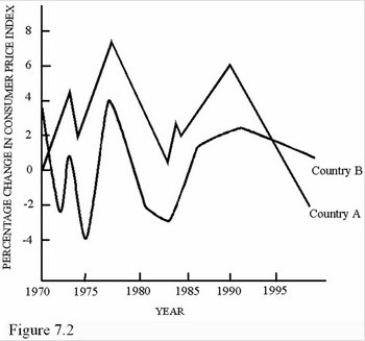 In the year 1995,which of the following statements is true about the two countries represented in Figure 7.2?
 (Multiple Choice)
5.0/5 (84)
(84) At the beginning of 2006 the CPI was 216.2.At the beginning of 2007,it was 225.1.What was the rate of inflation in 2006?
(Multiple Choice)
4.9/5 (86)
(86) 
Filters
- Essay(0)
- Multiple Choice(0)
- Short Answer(0)
- True False(0)
- Matching(0)