



 Chat with AI
Exam 7: Inflation

Exam 1: Economics: the Core Issues152 Questions
Exam 2: The Useconomy: a Global View146 Questions
Exam 3: Supply and Demand164 Questions
Exam 4: The Role of Government153 Questions
Exam 5: National Income Accounting152 Questions
Exam 6: Unemployment147 Questions
Exam 7: Inflation152 Questions
Exam 8: The Business Cycle153 Questions
Exam 9: Aggregate Demand149 Questions
Exam 10: Self-Adjustment or Instability140 Questions
Exam 11: Fiscal Policy151 Questions
Exam 12: Deficits and Debt151 Questions
Exam 13: Money and Banks146 Questions
Exam 14: The Federal Reserve System146 Questions
Exam 15: Monetary Policy149 Questions
Exam 16: Supply-Side Policy: Short-Run Options147 Questions
Exam 17: Growth and Productivity: Long-Run Possibilities143 Questions
Exam 18: Theory Versus Reality146 Questions
Exam 19: Consumer Choice136 Questions
Exam 20: Elasticity141 Questions
Exam 21: The Costs of Production151 Questions
Exam 22: The Competitive Firm148 Questions
Exam 23: Competitive Markets150 Questions
Exam 24: Monopoly147 Questions
Exam 25: Oligopoly145 Questions
Exam 26: Monopolistic Competition144 Questions
Exam 27: Natural Monopolies: Deregulation144 Questions
Exam 28: Environmental Protection144 Questions
Exam 29: The Farm Problem132 Questions
Exam 30: The Labor Market137 Questions
Exam 31: Labor Unions144 Questions
Exam 32: Financial Markets146 Questions
Exam 33: Taxes: Equity Versus Efficiency146 Questions
Exam 34: Transfer Payments: Welfare and Social Security146 Questions
Exam 35: International Trade149 Questions
Exam 36: International Finance142 Questions
Exam 37: Global Poverty141 Questions
Select questions type


Which of the following indexes tracks changes in the average prices paid by consumers?
(Multiple Choice)
4.8/5  (69)
(69) All of the following are detrimental macro consequences of inflation except
(Multiple Choice)
4.9/5 (70)
(70) The real interest rate is the rate of inflation minus the nominal interest rate.
(True/False)
4.8/5 (82)
(82) The price index that refers to all final goods and services produced in a country is the
(Multiple Choice)
4.8/5 (74)
(74) If the price of your cell phone service increases from $70 to $105 over a period of one year and your income rises from $1,500 to $1,525,your nominal income has
(Multiple Choice)
4.9/5 (81)
(81) Table 7.1 GDP
Nominal GDP(in billions of dollars) GDP deflator CPI 2002 \6 ,992.4 106.2 151.6 2003 7,431.6 109.1 153.8 2004 7,843.2 112.3 157.8 Based on Table 7.1,the rate of inflation between 2003 and 2004,using the GDP deflator,was
(Multiple Choice)
4.7/5 (84)
(84) 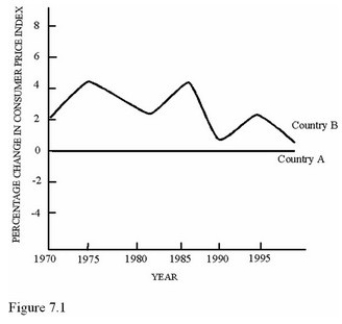 During the time period represented in Figure 7.1,Country A
To compute the real income of a household,the index that should be used is the
(Multiple Choice)
4.8/5 (83)
(83) If your real income rises but your nominal income falls,then you benefit from deflation.
(True/False)
4.9/5 (83)
(83) Table 7.1 GDP
Nominal GDP(in billions of dollars) GDP deflator CPI 2002 \6 ,992.4 106.2 151.6 2003 7,431.6 109.1 153.8 2004 7,843.2 112.3 157.8 Based on Table 7.1,the real GDP for 2004 was
(Multiple Choice)
4.9/5 (81)
(81) Which of the following is a macro consequence of a sudden increase in the average level of prices?
(Multiple Choice)
4.8/5 (68)
(68) Which of the following groups is protected from a sudden increase in inflation?
(Multiple Choice)
4.7/5 (69)
(69) Which of the following explains why redistribution occurs during inflation?
(Multiple Choice)
4.9/5 (96)
(96) Generally speaking,which of the following groups would tend to gain real income from the wealth effects of inflation?
(Multiple Choice)
4.9/5 (81)
(81) A decrease in the average level of prices of goods and services is
(Multiple Choice)
4.7/5 (84)
(84) 
Filters
- Essay(0)
- Multiple Choice(0)
- Short Answer(0)
- True False(0)
- Matching(0)