



 Chat with AI
Exam 8: The Business Cycle

Exam 1: Economics: the Core Issues152 Questions
Exam 2: The Useconomy: a Global View146 Questions
Exam 3: Supply and Demand164 Questions
Exam 4: The Role of Government153 Questions
Exam 5: National Income Accounting152 Questions
Exam 6: Unemployment147 Questions
Exam 7: Inflation152 Questions
Exam 8: The Business Cycle153 Questions
Exam 9: Aggregate Demand149 Questions
Exam 10: Self-Adjustment or Instability140 Questions
Exam 11: Fiscal Policy151 Questions
Exam 12: Deficits and Debt151 Questions
Exam 13: Money and Banks146 Questions
Exam 14: The Federal Reserve System146 Questions
Exam 15: Monetary Policy149 Questions
Exam 16: Supply-Side Policy: Short-Run Options147 Questions
Exam 17: Growth and Productivity: Long-Run Possibilities143 Questions
Exam 18: Theory Versus Reality146 Questions
Exam 19: Consumer Choice136 Questions
Exam 20: Elasticity141 Questions
Exam 21: The Costs of Production151 Questions
Exam 22: The Competitive Firm148 Questions
Exam 23: Competitive Markets150 Questions
Exam 24: Monopoly147 Questions
Exam 25: Oligopoly145 Questions
Exam 26: Monopolistic Competition144 Questions
Exam 27: Natural Monopolies: Deregulation144 Questions
Exam 28: Environmental Protection144 Questions
Exam 29: The Farm Problem132 Questions
Exam 30: The Labor Market137 Questions
Exam 31: Labor Unions144 Questions
Exam 32: Financial Markets146 Questions
Exam 33: Taxes: Equity Versus Efficiency146 Questions
Exam 34: Transfer Payments: Welfare and Social Security146 Questions
Exam 35: International Trade149 Questions
Exam 36: International Finance142 Questions
Exam 37: Global Poverty141 Questions
Select questions type


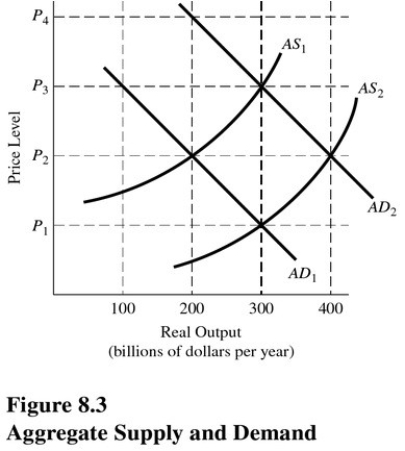 A supply-side policy approach in Figure 8.3,given AD1 and AS1,to achieve both lower prices and more output would be to
 (Multiple Choice)
4.9/5  (67)
(67) 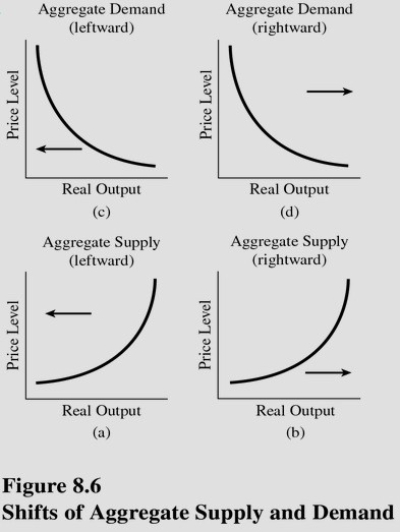 Choose the letter below that best represents the type of shift that would occur in the following situation in the United States: Between 1995 and 2000,the stock market's value increased significantly,adding billions of dollars to the wealth of U.S.households and businesses.(See Figure 8.6. )
 (Multiple Choice)
4.9/5 (86)
(86) Which of the following is a potential problem at macro equilibrium?
(Multiple Choice)
4.9/5 (73)
(73) 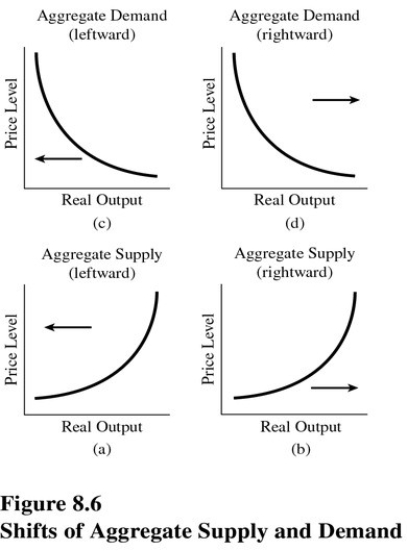 Choose the letter below that best represents the type of shift that would occur in the following situation in the United States: When the economy overheated,the U.S.government cooled it down with higher taxes,spending reductions,and less money.(See Figure 8.6. )
 (Multiple Choice)
4.8/5 (73)
(73) According to the classical view,if consumer demand slowed down,
(Multiple Choice)
4.9/5 (77)
(77) 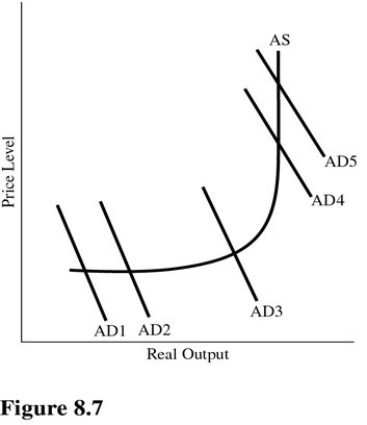 Assuming full employment is at the intersection of AD3 with the aggregate supply curve for the economy depicted in Figure 8.7,the worst unemployment problem would exist when AD is located at
 (Multiple Choice)
4.8/5 (82)
(82) Before the year 2000,the most prolonged departure from the long-term growth path for the United States occurred during
(Multiple Choice)
4.8/5 (70)
(70) The short-run aggregate supply curve is upward-sloping,while the long-run aggregate supply curve tends to be vertical.
(True/False)
4.8/5 (82)
(82) Which of the following would result if the price level were below the equilibrium level?
(Multiple Choice)
5.0/5 (69)
(69) Which combination of shifts of aggregate demand and supply would definitely cause an increase in real GDP?
(Multiple Choice)
4.8/5 (72)
(72) Who believed that small disturbances in output,prices,or unemployment were likely to be magnified by the invisible hand of the marketplace?
(Multiple Choice)
5.0/5 (75)
(75) Alternating periods of economic growth and contraction are
(Multiple Choice)
4.9/5 (73)
(73) 
Filters
- Essay(0)
- Multiple Choice(0)
- Short Answer(0)
- True False(0)
- Matching(0)