



 Chat with AI
Exam 8: The Business Cycle

Exam 1: Economics: the Core Issues152 Questions
Exam 2: The Useconomy: a Global View146 Questions
Exam 3: Supply and Demand164 Questions
Exam 4: The Role of Government153 Questions
Exam 5: National Income Accounting152 Questions
Exam 6: Unemployment147 Questions
Exam 7: Inflation152 Questions
Exam 8: The Business Cycle153 Questions
Exam 9: Aggregate Demand149 Questions
Exam 10: Self-Adjustment or Instability140 Questions
Exam 11: Fiscal Policy151 Questions
Exam 12: Deficits and Debt151 Questions
Exam 13: Money and Banks146 Questions
Exam 14: The Federal Reserve System146 Questions
Exam 15: Monetary Policy149 Questions
Exam 16: Supply-Side Policy: Short-Run Options147 Questions
Exam 17: Growth and Productivity: Long-Run Possibilities143 Questions
Exam 18: Theory Versus Reality146 Questions
Exam 19: Consumer Choice136 Questions
Exam 20: Elasticity141 Questions
Exam 21: The Costs of Production151 Questions
Exam 22: The Competitive Firm148 Questions
Exam 23: Competitive Markets150 Questions
Exam 24: Monopoly147 Questions
Exam 25: Oligopoly145 Questions
Exam 26: Monopolistic Competition144 Questions
Exam 27: Natural Monopolies: Deregulation144 Questions
Exam 28: Environmental Protection144 Questions
Exam 29: The Farm Problem132 Questions
Exam 30: The Labor Market137 Questions
Exam 31: Labor Unions144 Questions
Exam 32: Financial Markets146 Questions
Exam 33: Taxes: Equity Versus Efficiency146 Questions
Exam 34: Transfer Payments: Welfare and Social Security146 Questions
Exam 35: International Trade149 Questions
Exam 36: International Finance142 Questions
Exam 37: Global Poverty141 Questions
Select questions type


Equilibrium is unique;it is the only price-output combination that is mutually compatible with aggregate supply and demand.
(True/False)
4.8/5  (81)
(81) Assume you have $1,000 in a savings account at the beginning of the year and the price level is equal to 100.If the price level is equal to 115 at the end of the year,the real value of your savings is closest to
(Multiple Choice)
4.8/5 (67)
(67) Individual employment and training programs are levers most likely to be advocated by
(Multiple Choice)
4.9/5 (72)
(72) Both Keynesian and monetarist theories emphasize the potential of aggregate demand shifts to alter macro outcomes.
(True/False)
4.7/5 (78)
(78) Business cycles result from recurrent shifts of the aggregate supply and demand curves.
(True/False)
4.9/5 (86)
(86) Changes in the availability of money have little impact on the macro performance of the economy.
(True/False)
4.9/5 (81)
(81) An economic expansion refers to an increase in the volume of goods and services produced.
(True/False)
4.7/5 (67)
(67) 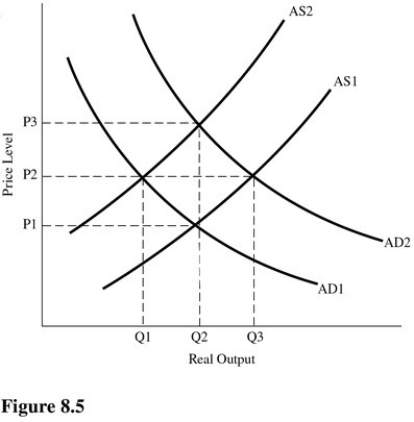 Using Figure 8.5,if the equilibrium price level is P1,then aggregate demand is
 (Multiple Choice)
4.8/5 (83)
(83) A decline in total real output for two or more consecutive quarters is referred to as
(Multiple Choice)
5.0/5 (83)
(83) Keynes argued that policy levers were both effective and necessary.
(True/False)
4.9/5 (66)
(66) Assume you have $2,000 in a savings account at the beginning of the year and the price level is equal to 100.If the price level is equal to 120 at the end of the year,the real value of your savings is closest to
(Multiple Choice)
4.9/5 (76)
(76) What is the real balances effect,and how does it explain the shape of the aggregate demand curve?
(Essay)
4.9/5 (88)
(88) In the absence of external shocks or government policy,an economy would
(Multiple Choice)
4.8/5 (84)
(84) According to Keynes,when the economy falters,the government should do any of the following except
(Multiple Choice)
4.9/5 (68)
(68) Determinants of macro performance work on macro outcomes through
(Multiple Choice)
4.7/5 (83)
(83) According to Keynesian theory,the correct fiscal policy to stimulate the economy would be to
(Multiple Choice)
4.7/5 (80)
(80) 
Filters
- Essay(0)
- Multiple Choice(0)
- Short Answer(0)
- True False(0)
- Matching(0)