



 Chat with AI
Exam 17: Growth and Productivity: Long-Run Possibilities

Exam 1: Economics: the Core Issues152 Questions
Exam 2: The Useconomy: a Global View146 Questions
Exam 3: Supply and Demand164 Questions
Exam 4: The Role of Government153 Questions
Exam 5: National Income Accounting152 Questions
Exam 6: Unemployment147 Questions
Exam 7: Inflation152 Questions
Exam 8: The Business Cycle153 Questions
Exam 9: Aggregate Demand149 Questions
Exam 10: Self-Adjustment or Instability140 Questions
Exam 11: Fiscal Policy151 Questions
Exam 12: Deficits and Debt151 Questions
Exam 13: Money and Banks146 Questions
Exam 14: The Federal Reserve System146 Questions
Exam 15: Monetary Policy149 Questions
Exam 16: Supply-Side Policy: Short-Run Options147 Questions
Exam 17: Growth and Productivity: Long-Run Possibilities143 Questions
Exam 18: Theory Versus Reality146 Questions
Exam 19: Consumer Choice136 Questions
Exam 20: Elasticity141 Questions
Exam 21: The Costs of Production151 Questions
Exam 22: The Competitive Firm148 Questions
Exam 23: Competitive Markets150 Questions
Exam 24: Monopoly147 Questions
Exam 25: Oligopoly145 Questions
Exam 26: Monopolistic Competition144 Questions
Exam 27: Natural Monopolies: Deregulation144 Questions
Exam 28: Environmental Protection144 Questions
Exam 29: The Farm Problem132 Questions
Exam 30: The Labor Market137 Questions
Exam 31: Labor Unions144 Questions
Exam 32: Financial Markets146 Questions
Exam 33: Taxes: Equity Versus Efficiency146 Questions
Exam 34: Transfer Payments: Welfare and Social Security146 Questions
Exam 35: International Trade149 Questions
Exam 36: International Finance142 Questions
Exam 37: Global Poverty141 Questions
Select questions type


Table 17.1 Year Real GDP Population 1 \ 575 billion 22 million 2 \ 580 billion 24 million 3 \ 605 billion 25 million 4 \ 606 billion 27 million
Refer to Table 17.1.The growth rate of the economy from year 2 to year 3 was
(Multiple Choice)
4.9/5  (77)
(77) Which of the following has made the greatest contribution to economic growth over time?
(Multiple Choice)
4.7/5 (88)
(88) One In the News article in the text is titled "The New Economy." Which of the following is a feature of the "new" economy?
(Multiple Choice)
4.7/5 (86)
(86) 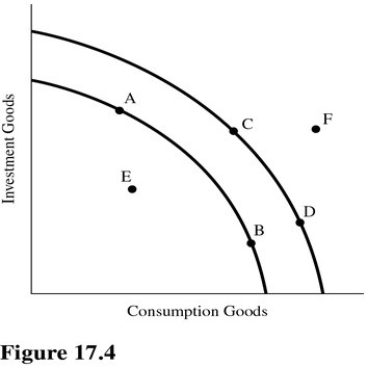 Refer to Figure 17.4.A long-run increase in productive capacity for the economy can be illustrated by a move from point
 (Multiple Choice)
4.8/5 (89)
(89) What is the most common measure of productivity? How is it calculated?
(Essay)
4.8/5 (62)
(62) Over time,foreign investment is credited with the greatest contribution to economic growth in the United States.
(True/False)
4.9/5 (75)
(75) Table 17.1 Year Real GDP Population 1 \ 575 billion 22 million 2 \ 580 billion 24 million 3 \ 605 billion 25 million 4 \ 606 billion 27 million
Refer to Table 17.1.This economy grew
(Multiple Choice)
4.8/5 (76)
(76) Output,including agricultural products,has increased at a geometric rate,not at the much slower arithmetic rate foreseen by Malthus.
(True/False)
4.9/5 (78)
(78) Economists often define economic growth in terms of changes in
(Multiple Choice)
4.7/5 (81)
(81) A decrease in the marginal propensity to save is likely to
(Multiple Choice)
4.7/5 (86)
(86) 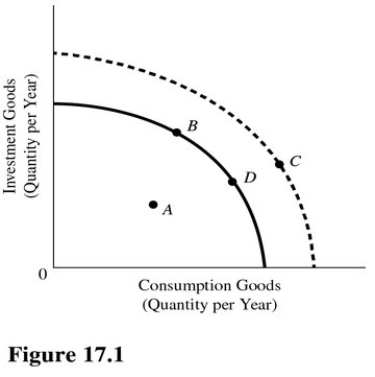 Negative economic growth in the long-run can be illustrated in Figure 17.1 by
 (Multiple Choice)
4.9/5 (85)
(85) 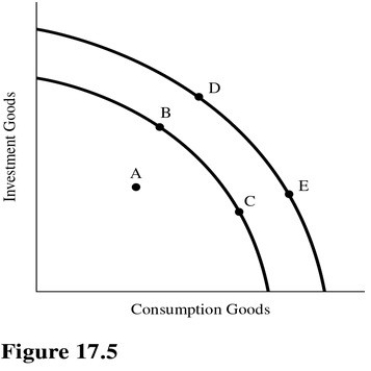 A movement from point C to point B in Figure 17.5 illustrates
 (Multiple Choice)
4.8/5 (74)
(74) Continued economic growth is desirable if it means that the standard of living continues to increase.
(True/False)
4.9/5 (79)
(79) If the number employed grows faster than the population,then the
(Multiple Choice)
4.9/5 (90)
(90) 
Filters
- Essay(0)
- Multiple Choice(0)
- Short Answer(0)
- True False(0)
- Matching(0)