



 Chat with AI
Exam 17: Growth and Productivity: Long-Run Possibilities

Exam 1: Economics: the Core Issues152 Questions
Exam 2: The Useconomy: a Global View146 Questions
Exam 3: Supply and Demand164 Questions
Exam 4: The Role of Government153 Questions
Exam 5: National Income Accounting152 Questions
Exam 6: Unemployment147 Questions
Exam 7: Inflation152 Questions
Exam 8: The Business Cycle153 Questions
Exam 9: Aggregate Demand149 Questions
Exam 10: Self-Adjustment or Instability140 Questions
Exam 11: Fiscal Policy151 Questions
Exam 12: Deficits and Debt151 Questions
Exam 13: Money and Banks146 Questions
Exam 14: The Federal Reserve System146 Questions
Exam 15: Monetary Policy149 Questions
Exam 16: Supply-Side Policy: Short-Run Options147 Questions
Exam 17: Growth and Productivity: Long-Run Possibilities143 Questions
Exam 18: Theory Versus Reality146 Questions
Exam 19: Consumer Choice136 Questions
Exam 20: Elasticity141 Questions
Exam 21: The Costs of Production151 Questions
Exam 22: The Competitive Firm148 Questions
Exam 23: Competitive Markets150 Questions
Exam 24: Monopoly147 Questions
Exam 25: Oligopoly145 Questions
Exam 26: Monopolistic Competition144 Questions
Exam 27: Natural Monopolies: Deregulation144 Questions
Exam 28: Environmental Protection144 Questions
Exam 29: The Farm Problem132 Questions
Exam 30: The Labor Market137 Questions
Exam 31: Labor Unions144 Questions
Exam 32: Financial Markets146 Questions
Exam 33: Taxes: Equity Versus Efficiency146 Questions
Exam 34: Transfer Payments: Welfare and Social Security146 Questions
Exam 35: International Trade149 Questions
Exam 36: International Finance142 Questions
Exam 37: Global Poverty141 Questions
Select questions type


If nominal GDP rises from $550 billion to $600 billion,then
(Multiple Choice)
4.8/5  (88)
(88) Table 17.1 Year Real GDP Population 1 \ 575 billion 22 million 2 \ 580 billion 24 million 3 \ 605 billion 25 million 4 \ 606 billion 27 million
Refer to Table 17.1.GDP per capita was the
(Multiple Choice)
4.9/5 (88)
(88) Tax preferences for Individual Retirement Accounts will,ceteris paribus,
(Multiple Choice)
5.0/5 (77)
(77) The emphasis on the importance of advances and dissemination of knowledge is a cornerstone of the
(Multiple Choice)
4.9/5 (88)
(88) If the real GDP in Afghanistan grew at an annual rate of 1.5 percent and the country's population grew at an annual rate of 2.5 percent,how long would it take for GDP per capita to double?
(Multiple Choice)
4.9/5 (87)
(87) 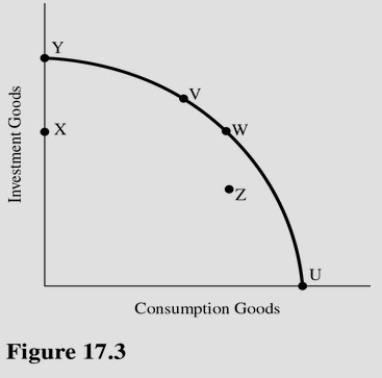 Refer to Figure 17.3.Assume X units of plants and equipment wear out each year.What will happen to the PPC in the future if the economy currently produces at point U?
 (Multiple Choice)
4.9/5 (77)
(77) 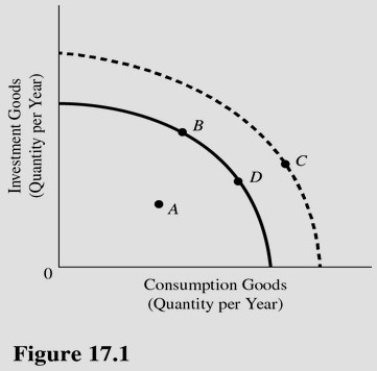 Monetary and fiscal policies that encourage the long-run growth of net investment and increase labor productivity are designed to move the economy in Figure 17.1 from point
 (Multiple Choice)
4.8/5 (76)
(76) A sustained increase in total output is possible only if the aggregate
(Multiple Choice)
4.9/5 (86)
(86) Which of the following also occurs as the production possibilities curve shifts outward?
(Multiple Choice)
4.9/5 (81)
(81) There is an inverse relationship between the share of output allocated to investment and the growth rate of an economy.
(True/False)
4.8/5 (69)
(69) Assume the real U.S.GDP in 1998 was $7,552 billion and the U.S.population was 270 million,and the real U.S.GDP in 2000 was $10 trillion and the U.S.population was 280 million.From 1998 to 2000,the per capita real GDP
(Multiple Choice)
4.9/5 (72)
(72) From 1975 to 2000,the employment rate in the United States had been
(Multiple Choice)
4.8/5 (83)
(83) The "new growth theory" of economic growth emphasizes the importance of
(Multiple Choice)
4.9/5 (64)
(64) If the growth rate of the labor force is 2 percent and the growth rate of productivity is 1.5 percent,the growth rate of total output is
(Multiple Choice)
5.0/5 (91)
(91) 
Filters
- Essay(0)
- Multiple Choice(0)
- Short Answer(0)
- True False(0)
- Matching(0)