



 Chat with AI
Exam 21: The Costs of Production

Exam 1: Economics: the Core Issues152 Questions
Exam 2: The Useconomy: a Global View146 Questions
Exam 3: Supply and Demand164 Questions
Exam 4: The Role of Government153 Questions
Exam 5: National Income Accounting152 Questions
Exam 6: Unemployment147 Questions
Exam 7: Inflation152 Questions
Exam 8: The Business Cycle153 Questions
Exam 9: Aggregate Demand149 Questions
Exam 10: Self-Adjustment or Instability140 Questions
Exam 11: Fiscal Policy151 Questions
Exam 12: Deficits and Debt151 Questions
Exam 13: Money and Banks146 Questions
Exam 14: The Federal Reserve System146 Questions
Exam 15: Monetary Policy149 Questions
Exam 16: Supply-Side Policy: Short-Run Options147 Questions
Exam 17: Growth and Productivity: Long-Run Possibilities143 Questions
Exam 18: Theory Versus Reality146 Questions
Exam 19: Consumer Choice136 Questions
Exam 20: Elasticity141 Questions
Exam 21: The Costs of Production151 Questions
Exam 22: The Competitive Firm148 Questions
Exam 23: Competitive Markets150 Questions
Exam 24: Monopoly147 Questions
Exam 25: Oligopoly145 Questions
Exam 26: Monopolistic Competition144 Questions
Exam 27: Natural Monopolies: Deregulation144 Questions
Exam 28: Environmental Protection144 Questions
Exam 29: The Farm Problem132 Questions
Exam 30: The Labor Market137 Questions
Exam 31: Labor Unions144 Questions
Exam 32: Financial Markets146 Questions
Exam 33: Taxes: Equity Versus Efficiency146 Questions
Exam 34: Transfer Payments: Welfare and Social Security146 Questions
Exam 35: International Trade149 Questions
Exam 36: International Finance142 Questions
Exam 37: Global Poverty141 Questions
Select questions type


Refer to Table 21.5: Table 21.5
AVC MC 0 15 - - 1 23 2 4 3 15 The marginal cost of the third unit of output in Table 21.5 is
(Multiple Choice)
4.9/5  (84)
(84) The law of diminishing returns indicates that the marginal physical product of a variable input declines as more of it is employed,ceteris paribus.
(True/False)
4.8/5 (76)
(76) If the marginal cost curve is rising,which of the following must be true?
(Multiple Choice)
4.9/5 (83)
(83) Which of the following is least likely to increase labor productivity?
(Multiple Choice)
4.8/5 (77)
(77) The change in total output associated with one additional unit of input is the
(Multiple Choice)
4.8/5 (81)
(81) Megan used to work at the local pizzeria for $15,000 per year but quit in order to start her own deli.To buy the necessary equipment,she withdrew $20,000 from her inheritance (which paid 8 percent interest).Last year she paid $25,000 for ingredients and $500 per month rent but had revenue of $50,000.She asked her dad the accountant and her mom the economist to calculate her costs for her.
(Multiple Choice)
4.9/5 (79)
(79) When the wage rate is $10 per hour and the MPP of a worker is 15 units per hour,the unit labor cost is
(Multiple Choice)
4.9/5 (77)
(77) The marginal physical product of the third unit of labor in Figure 21.1 is 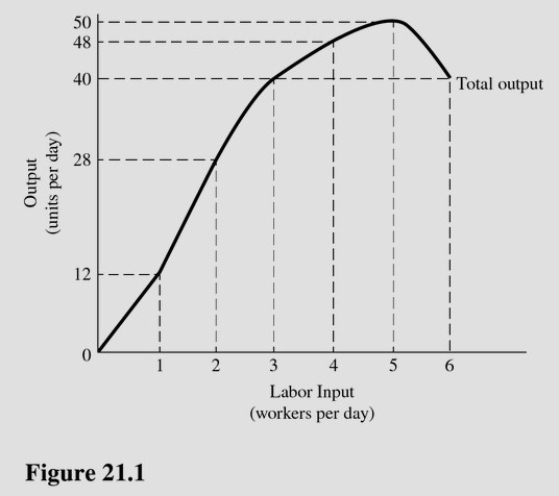
(Multiple Choice)
4.9/5 (77)
(77) Marginal physical product is the change in total output associated with one additional unit of input.
(True/False)
5.0/5 (76)
(76) Explain how firms' production functions and cost curves will change as science and technology advance and as the knowledge of how to organize and manage resources improves.
(Essay)
4.8/5 (72)
(72) One In the News article titled "Funeral Giant Moves In on Small Rivals" reports that profit for a Houston-based funeral giant is 31 cents on every dollar versus a profit of 12 cents for the funeral industry in general.Such profits are most likely the result of
(Multiple Choice)
4.9/5 (80)
(80) Refer to Figure 21.3.The best estimate of where diminishing marginal returns begin is at an output level of 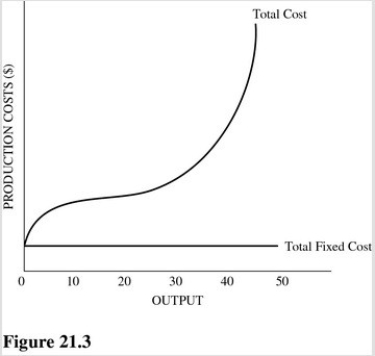
(Multiple Choice)
4.9/5 (77)
(77) In Figure 21.1,diminishing marginal returns first occur with the 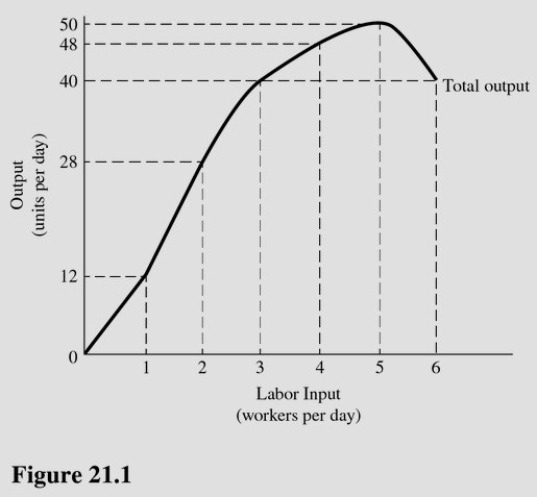
(Multiple Choice)
4.8/5 (69)
(69) Table 21.2 Output (units per day) 0 10 20 30 Total cost (dollars per day) \ 40 \ 54 \ 62 \ 80
At 20 units of output in Table 21.2,the average variable cost is
(Multiple Choice)
4.8/5 (79)
(79) 
Filters
- Essay(0)
- Multiple Choice(0)
- Short Answer(0)
- True False(0)
- Matching(0)