



 Chat with AI
Exam 21: The Costs of Production

Exam 1: Economics: the Core Issues152 Questions
Exam 2: The Useconomy: a Global View146 Questions
Exam 3: Supply and Demand164 Questions
Exam 4: The Role of Government153 Questions
Exam 5: National Income Accounting152 Questions
Exam 6: Unemployment147 Questions
Exam 7: Inflation152 Questions
Exam 8: The Business Cycle153 Questions
Exam 9: Aggregate Demand149 Questions
Exam 10: Self-Adjustment or Instability140 Questions
Exam 11: Fiscal Policy151 Questions
Exam 12: Deficits and Debt151 Questions
Exam 13: Money and Banks146 Questions
Exam 14: The Federal Reserve System146 Questions
Exam 15: Monetary Policy149 Questions
Exam 16: Supply-Side Policy: Short-Run Options147 Questions
Exam 17: Growth and Productivity: Long-Run Possibilities143 Questions
Exam 18: Theory Versus Reality146 Questions
Exam 19: Consumer Choice136 Questions
Exam 20: Elasticity141 Questions
Exam 21: The Costs of Production151 Questions
Exam 22: The Competitive Firm148 Questions
Exam 23: Competitive Markets150 Questions
Exam 24: Monopoly147 Questions
Exam 25: Oligopoly145 Questions
Exam 26: Monopolistic Competition144 Questions
Exam 27: Natural Monopolies: Deregulation144 Questions
Exam 28: Environmental Protection144 Questions
Exam 29: The Farm Problem132 Questions
Exam 30: The Labor Market137 Questions
Exam 31: Labor Unions144 Questions
Exam 32: Financial Markets146 Questions
Exam 33: Taxes: Equity Versus Efficiency146 Questions
Exam 34: Transfer Payments: Welfare and Social Security146 Questions
Exam 35: International Trade149 Questions
Exam 36: International Finance142 Questions
Exam 37: Global Poverty141 Questions
Select questions type


If the MPP of a worker is 12 units per hour and the wage rate is $10 per hour,the unit labor cost is equal to $1.20 per unit of output.
(True/False)
4.8/5  (81)
(81) The period in which at least one input is fixed in quantity is the
(Multiple Choice)
4.8/5 (76)
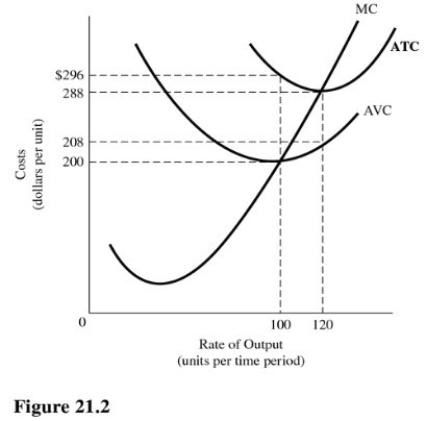
(76) 
Diseconomies of scale imply that the average total cost curve is downward-sloping in the long run.
(True/False)
4.7/5 (63)
(63) The vertical distance between a firm's ATC and AVC curves grows smaller as output increases.
(True/False)
4.7/5 (88)
(88) Which of the following would cause a firm's production function to shift upward?
(Multiple Choice)
4.9/5 (86)
(86) Total cost refers to the market value of all resources used in producing a good or service.
(True/False)
4.9/5 (85)
(85) When a firm is able to achieve the output indicated by a production function,it is producing with technical efficiency.
(True/False)
4.8/5 (74)
(74) Refer to Table 21.5: Table 21.5
AVC MC 0 15 - - 1 23 2 4 3 15 The total variable cost of the first unit of output in Table 21.5 is
(Multiple Choice)
4.8/5 (85)
(85) Total output may continue to rise even though marginal physical product is declining.
(True/False)
4.9/5 (85)
(85) Refer to Table 21.3 below: Table 21.3
Units of Lubor Units of Output MPP 0 0 1 30 2 66 3 30 4 116
How many units of output can be produced when three units of labor are employed in Table 21.3?
(Multiple Choice)
4.8/5 (83)
(83) Which of the following statements is not true regarding the production function and the production possibilities curve?
(Multiple Choice)
4.7/5 (76)
(76) The In The News article "Tesla Banks on Gigafactory" says that
(Multiple Choice)
5.0/5 (84)
(84) Which of the following costs do not change when output changes in the short run?
(Multiple Choice)
4.8/5 (74)
(74) Refer to Table 21.5: Table 21.5
AVC MC 0 15 - - 1 23 2 4 3 15 The total variable cost of 2 units of output in Table 21.5 is
(Multiple Choice)
4.9/5 (73)
(73) 
Filters
- Essay(0)
- Multiple Choice(0)
- Short Answer(0)
- True False(0)
- Matching(0)